
Enjoy your courtside pass to Australian tennis history with rare archival footage, surprising stories and legendary moments from the icons who shaped the game. It's all here: upcoming legends, reunited rivals, empty courts and historic finals.
Enjoy your courtside pass to Australian tennis history with rare archival footage, surprising stories and legendary moments from the icons who shaped the game. It's all here: upcoming legends, reunited rivals, empty courts and historic finals.
From Barellan to the world stage
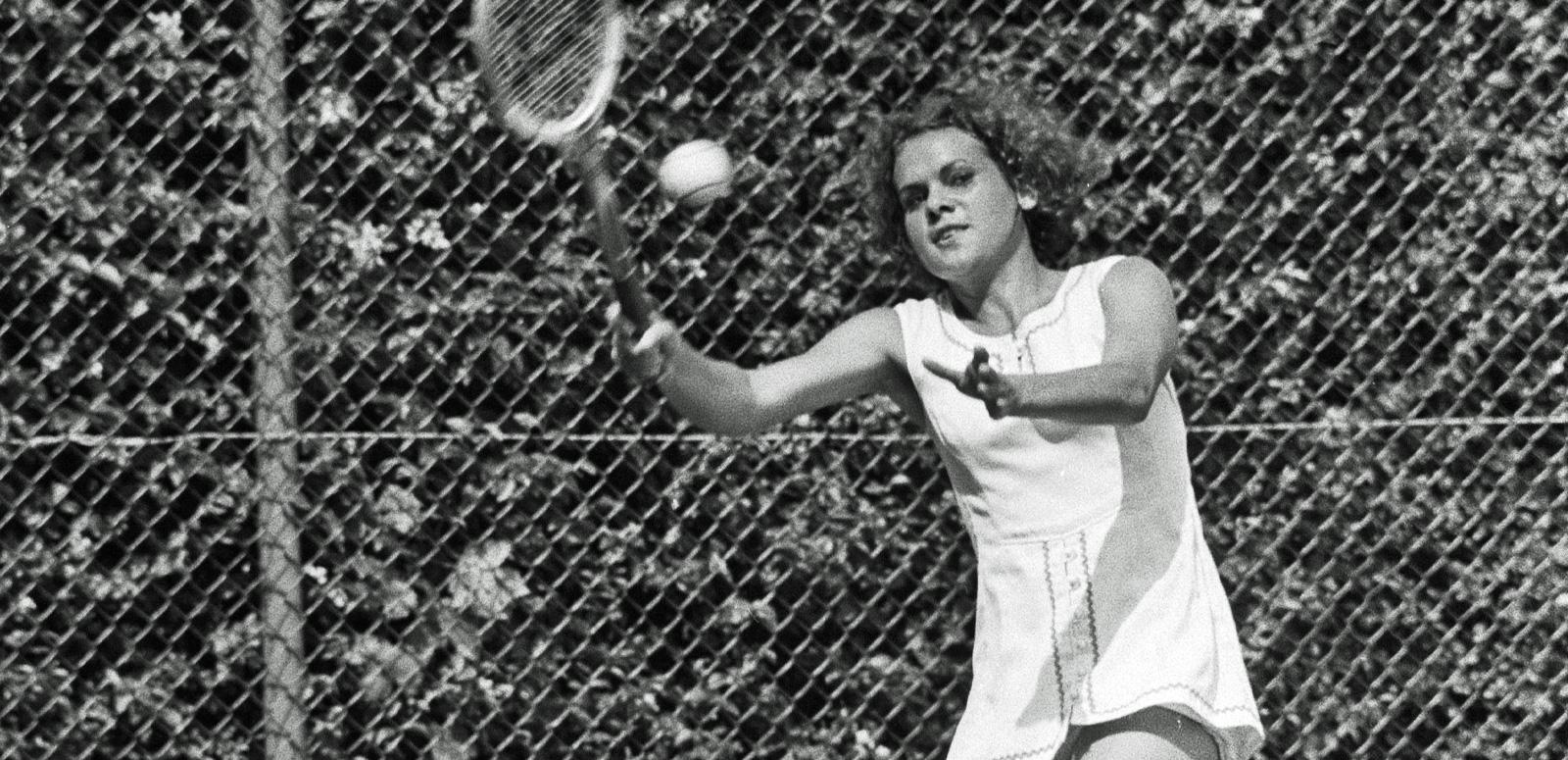
Evonne Goolagong Cawley’s journey is one of the most powerful chapters in Australian sporting history. This NFSA-preserved footage offers a rare look at her early life, her emergence as a rising star and the media attention that followed her every step.
As a young Wiradjuri girl growing up in Barellan, Evonne honed her skills with a homemade paddle and a water tank for a wall. Within a few years, she was competing on the world stage, emerging as the first Indigenous Australian to win a Grand Slam singles title and later becoming a two-time Wimbledon champion.
In this clip from a 1972 Commonwealth Film Unit production, Evonne speaks openly about how the media treated her as a showpiece – repeatedly referencing her Aboriginality. Yet she also reflects on the immense pride she felt in being the only Indigenous Australian tennis player on the international tour, even as she navigated the scrutiny and expectations placed upon her.
The film also captures her in action, showing off her athletic, all-court game. Seen here is rare footage of the 20-year-old player up against fellow future Australian Tennis Hall of Fame inductee Jan O’Neill, in the women’s singles final of the 1972 New South Wales Hardcourt Championships held at Grenfell. Goolagong Cawley would win comfortably – 6-1, 6-2 – capping a hugely successful state championships, also winning the women’s doubles and mixed doubles events.
Eight years later, Evonne Goolagong Cawley would win her second Wimbledon Women’s Singles Championship in 1980, the first mother to win the English title in 66 years.
Her success as a champion and sporting role model paved the way for future generations of Australian women’s players, including Ash Barty. Goolagong Cawley’s enduring advocacy for Indigenous health, education and opportunities through sport continues to influence Australia today.
Excerpt from The Goolagong Story, 1971. Courtesy: Cinesound Movietone Productions
Want to read more like this?
Sign up now for the stories you missed about the culture you love.
Dominance on Centre Court
Lleyton Hewitt’s 2002 Wimbledon victory was the first time an Australian man had lifted the trophy in 15 years.
This segment from Sky News Australia takes you back to the heart of that final, focusing closely on the match itself so you can experience Hewitt’s precision, athleticism and absolute dominance over Argentina’s David Nalbandian as it unfolded.
It also includes the outrageous mid-match moment that a streaker bolts across Centre Court, and we see the reactions of the Royal Family watching from the stands.
The interview at the end of the clip shows Hewitt reflecting on what the win means not just for him, but for the young Australian players coming up behind him.
A straight sets championship victory – winning 6-1, 6-3, 6-2 – capped a remarkable tournament for the 21-year-old South Australian, losing only two sets across seven matches. The world No. 1 and top seed would break English hearts, similarly dispatching local favourite ‘Tiger’ Tim Henman in their semifinal in straight sets.
Nearly a quarter of a century on, no Australian player has since managed to win the Men’s Singles Championship at Wimbledon. Gallant losing finalists Pat Rafter (2000, 2001), Mark Philippoussis (2003) and Nick Kyrgios (2022) have come the closest.
News coverage of Lleyton Hewitt's victory in the Men's Singles tournament at Wimbledon, 2002. Broadcaster: Sky News Australia. NFSA title: 554933
A look back at 1968
In 1968, Australian Diary turned its lens to a sport in transition and asked: Was Australia losing interest in tennis?
At a time when crowds at major matches were thinning, tennis courts were being abandoned, and public enthusiasm looked uncertain, this short film explored whether the era of tennis as a dominant summer sport was coming to an end.
The seven-minute colour newsreel captures a specific moment in the sport’s history. At one point, the film’s narration posed the question, 'Will Open Tennis change the scene?' This referenced the seismic shift introduced in the year the film was produced.
Known as ‘the Open Era’, from 1968, professional tennis players were eligible to enter the major tennis tournaments, including the four Grand Slam events. Previously, entry was available only to amateur players competing at the Wimbledon, Australian, French and US Opens, shutting out many of the sport’s finest players.
This newsreel also posed the question of whether tennis’ popularity as a social pastime would remain as high when competing with newer interests pursued by young people in ‘today’s fast-moving scene’.
Highlighting the growing lure of other, higher-energy activities, sequences of young girls marching and training in perfectly regimented lines are juxtaposed with shots of boys trail-biking and playing rugby union. Produced by the Australian Commonwealth Film Unit and preserved by the NFSA, this piece is a rare look at the cultural crossroads facing the sport in the late 1960s.
'Who's For Tennis?', Australian Colour Diary No. 33, 1968. Produced by the Australian Commonwealth Film Unit.
This is Your Life
This rare television moment, preserved by the NFSA from the two-inch broadcast videotape master, brings together three giants of 1970s tennis.
Hosted by Roger Climpson, this 1977 episode of the long-running series This Is Your Life pays tribute to John Newcombe, one of Australia’s most successful and versatile champions, with surprise appearances from Ken Rosewall and Jimmy Connors.
Rosewall, whose remarkable career featured 35 major finals and 8 Grand Slam singles titles, reflects on Newcombe’s determination and the era they helped define. Connors adds his own perspective as a fierce rival, noting that despite their long careers, they met in only one Grand Slam final: the 1975 Australian Open.
With his trademark handlebar moustache, broad grin and natural charisma, ‘Newk’ became one of Australian sport’s most high-profile personalities. This excerpt also features several examples of his iconic post-game net jumps. The winner of 26 Grand Slam titles across singles, doubles and mixed doubles, his record places him among the game’s greatest players.
Newcombe retired from professional tennis in 1981 but remained heavily involved in the sport, captaining the Australian Davis Cup team to victory (1999) and working in commentary for many years. He was inducted into the International Tennis Hall of Fame in 1986.
Produced by Lifetime Associates Pty Ltd, this piece offers us a glimpse into the mutual respect shared among champions who pushed each other to be better.
Excerpt from This Is Your Life: John Newcombe, 1977. Courtesy: Lifetime Associates Pty Ltd
The legend in action
This 1961 Movietone newsreel highlights the style and technique of one our most decorated tennis players.
The NFSA holds only the 35mm film picture negative for this revealing footage of champion Australian left-hander Rod Laver, captured before the Queenslander turned professional in 1962.
As the NFSA does not yet hold a print with picture and sound intact, the voice-over narration that would have accompanied these images for cinema screenings at the time is absent here.
Without sound, Laver’s timing, power and movement come into clear view. His serve-and-volley game, aggressive ground strokes and precise technique unfold shot by shot, with the aid of slow-motion filming. Close-ups of his grip and strokes reveal why commentators have described him as ‘technically faultless’.
The footage includes Laver playing Italy’s Nicola Pietrangeli in the 1961 Davis Cup Challenge Round at Kooyong Stadium, Melbourne, as well as a doubles match alongside Neale Fraser against Pietrangeli and Orlando Sirola. Australia went on to win the tie five rubbers to nil, and the team is shown with the trophy.
Laver’s legendary tennis status was sealed in 1969 after completing the ‘Big Four’ for the second time, winning the four Grand Slam tournaments (Australian Open, French Open, Wimbledon, US Open) all in the same year, after first achieving this in 1962.
Considered by many experts the greatest men’s player of all time, Laver retired from professional tennis in 1979. The Australian Open’s largest indoor arena was renamed in his honour in 2000.
How It's Played: Tennis Secrets by Rod Laver, 1961. Courtesy: Cinesound Movietone Productions. NFSA: 130935
Triumph at Wimbledon
This Nine News Adelaide report returns us to the moment Ash Barty became the first Australian woman in more than 40 years to win Wimbledon. Opening with the final point, the clip captures the emotion of her victory and the celebrations that followed, echoing Pat Cash’s unforgettable climb into the stands in 1987.
You’ll see the key moments that defined the match, including Barty’s early dominance over former world No. 1 Karolína Plíšková and the composure she carried through decisive points. In the tight three-set battle, the Australian top seed and world No. 1 would prevail over her Czech opponent 6-3, 6-7, 6-3 in one hour and fifty-five minutes.
The Queenslander’s post‑match reflections and on‑court speech highlight the years of work behind the win and her deep connection to mentor Evonne Goolagong Cawley, whose own Wimbledon triumphs frame the significance of this achievement.
With Goolagong Cawley appearing later in the report to celebrate Barty’s performance, the clip brings together past and present – a reminder of how meaningful this moment is in First Nations sporting history.
News coverage of Ash Barty winning the Women's Singles tournament at Wimbledon, 11 July 2021. Broadcaster: Nine Network. NFSA title: 1651924
World No. 1 in 1933
This 1933 Movietone newsreel film takes you back to the year Jack Crawford stood at the top of world tennis.
After winning the Australian Open, the French Open and Wimbledon, Crawford came within one match of becoming the first player in history to claim all four Grand Slam tournaments in a single year – narrowly missing out in a five‑set final against Fred Perry at the US Championships.
Brief match footage seen in this clip includes action from his victory over American Ellsworth Vines in the 1933 Wimbledon Championships Men’s Final; both players wearing flannel trousers. Crawford can be seen playing with his trademark Cressy Wizard, a uniquely designed flat-top racquet produced by Tasmanian company Alexanders.
In an epic two-hour struggle, Crawford would hold off his opponent in five sets, winning 4-6, 11-9, 6-2, 2-6, 6-4, Australia’s first Wimbledon champion since 1922. Such was the excitement surrounding the game, Australian newspapers reported Crawford’s mother fainting upon news of his victory while listening to the relayed broadcast via Sydney radio station 2FC.
Captured nearly a century ago, the film offers a glimpse of Crawford’s much-copied fluent style: a game built less on power and more on accuracy, anticipation and smooth court movement.
In likely the earliest surviving footage to feature his voice, ‘Gentleman Jack’ – a moniker attributed to his exemplary sportsmanship – then uncomfortably addresses the camera, appearing to read from a script positioned close to the camera as he recalls his Wimbledon victory.
Crawford would continue to wear his trademark long trousers on court well into his retirement. Retaining much popularity with the public, the Albury-born champion would be inducted into the International Tennis Hall of Fame in 1979.
Jack Crawford in A Year to Remember: 1933, newsreel compilation, 1966. Courtesy: Cinesound Movietone Productions.
Main image: Evonne Goolagong Cawley

The oldest tennis tournament in the world is no stranger to Australian winners – lift the cup with Lleyton, celebrate with Ash, and travel back in time with these moments from Wimbledon history.

Enjoy a selection of clips featuring some of Australia's greatest tennis champions.
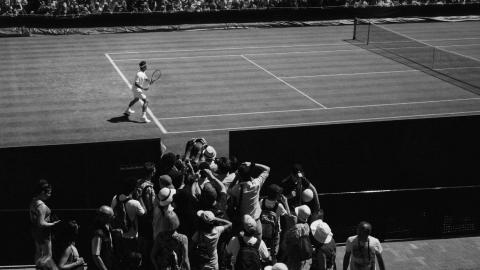
Johnny Milner explores why Australian tennis stars have excelled on the traditional grass court at Wimbledon.
The National Film and Sound Archive of Australia acknowledges Australia’s Aboriginal and Torres Strait Islander peoples as the Traditional Custodians of the land on which we work and live and gives respect to their Elders both past and present.