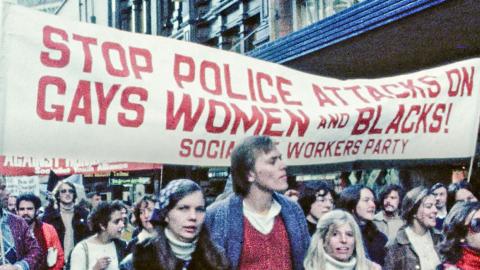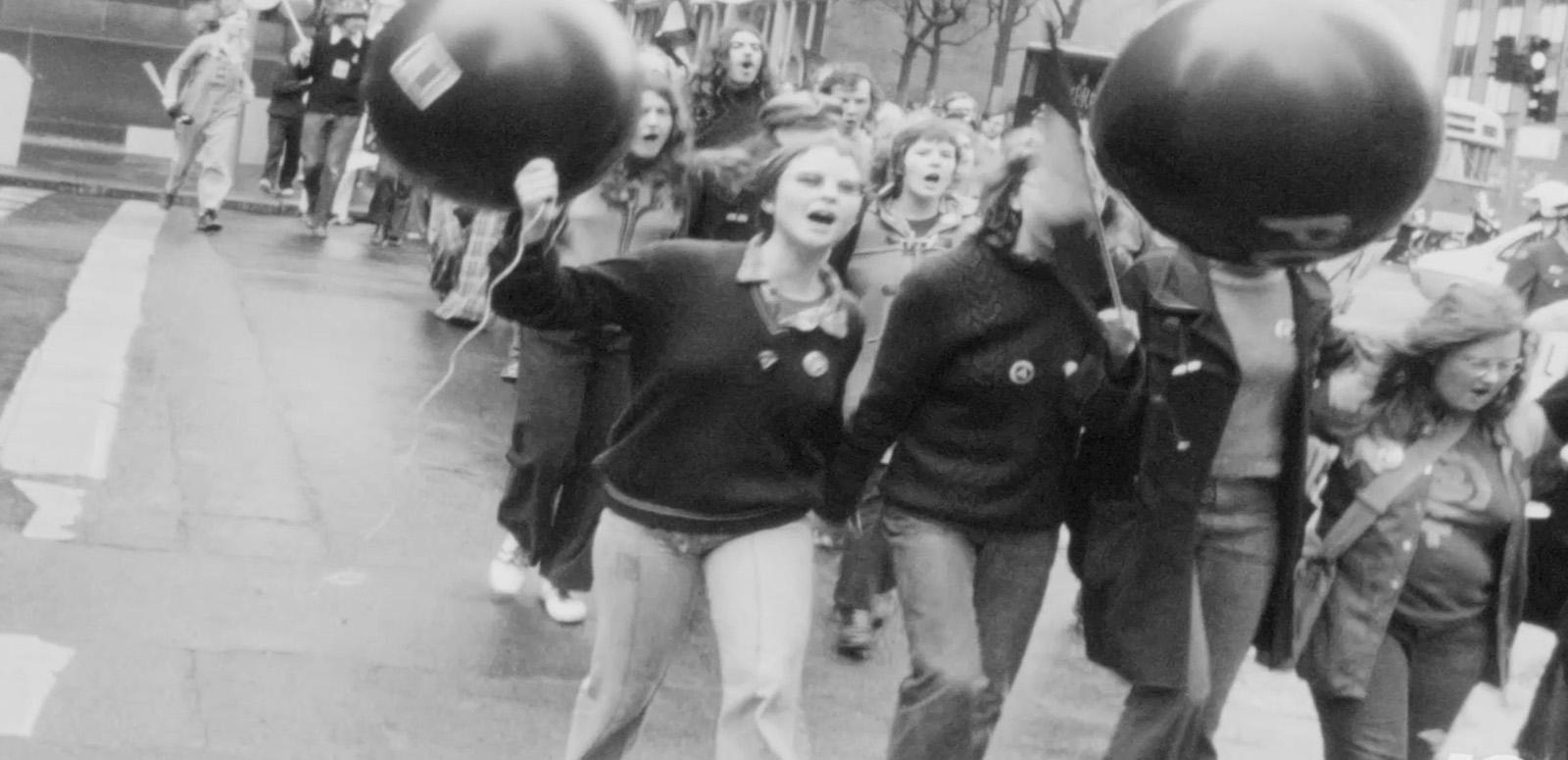
protest march, black and white image, 1973
https://www.nfsa.gov.au/sites/default/files/2026-02/Gay%20Pride%20week%201973_banner_opt3.jpg

Gay Pride Week 1973

BY
 Nick Henderson

The first Sydney Mardi Gras in 1978 was a defining moment in Australia’s history, galvanising gay and lesbian communities and bringing national attention to the push for legal and social change. But it wasn’t the first LGBTQIA+ demonstration of its kind.

In July 1973, Sydney's Gay Liberation group proposed the first national Gay Pride festival for September, a callout that was taken up by groups in Adelaide, Brisbane and Melbourne. What resulted was a slew of festivities and arrests, which created momentum for subsequent landmark movements.  
 

Gay Pride Week across the nation 

The aims of the Gay Pride festivals were outlined in the August 1973 issue of the Sydney Gay Liberation newsletter: 

‘Gay Pride Week will hit all the institutions of our oppression: the police courts, job discrimination, the bigoted churchmen and politicians, the media, the psychiatrists, the aversion therapists, the military, the schools, the universities, the workplaces … It will also seek to change the mind of the prejudiced, the fearful, the conditioned, the sexually repressed, all those who in oppressing us, oppress themselves.’ 

A diverse schedule of activities, blending community bonding with political action, unfolded across the country. Adelaide’s Gay Activists’ Alliance organised a press conference, a dance, church leafletting, speak-outs and a Remembrance Day, along with a Pride-themed meeting, march and fair. Brisbane’s Campus Camp organised letters to the editors of the local press and radio interviews. They held a series of demonstrations, where they handed out leaflets and boiled lollies and sold badges and fairy floss. Melbourne’s Gay Liberation group also organised demonstrations called ‘zaps’ alongside social events: poetry readings, film screenings, graffiti paint-ups, a talk to high school students, an evening for parents of gays and lesbians, a dance, and a picnic in the Botanical Gardens. 


Want to read more like this? 

Sign up now for the stories you missed about the culture you love.

Sign up for In Focus


These Adelaide, Brisbane and Melbourne Gay Pride festivals largely concluded without a hitch, aside from the Melbourne picnic drawing the ire of at least one police officer, who announced that games of ‘Drop-the-hanky' and ‘Spin-the-bottle' were not permitted. However, the Sydney festival took a more confrontational turn.  

Following a week of activities that included a speak-out, a festival in The Domain and a public meeting, the final event was to be a demonstration. 

The Sydney Gay Pride Week demonstration attracted around 200 lesbians and gay men, who set out from Sydney Town Hall to lay a wreath at the Cenotaph. This discovered clip from Ten Network’s Eyewitness News shows protestors marching through the Sydney CBD alongside a significant police presence. The footage offers a window into a formative period in Australia’s LGBTQIA+ history and the community organising that shaped it:

Footage of a Gay Pride Week demonstration in Sydney, Eyewitness News, September 1973. Courtesy: Ten Network


Police sought to block and corral the demonstrators, who were armed with black and pink balloons, banners and streamers, chanting, ‘Ho, Ho, homosexual, the ruling class is ineffectual!’ Another popular chant was: ‘Out of the beats and onto the streets.’ Even as the march is dispersed, participants respond with cheers and raised fists. 

Though protestors continually evaded police by darting through traffic, the camera records several arrests during the demonstration. As they moved towards Philip St Police Station, there were further arrests; in all, 18 people were charged.  


Melding pride with politics  

The violence of these clashes can be gleaned from the demonstrators’ first-hand accounts. Two activists, Lance Gowland (1925-2008) and Mim Loftus, spoke to a journalist after the arrests.   

Gowland was an Australian peace and LGBTQIA+ rights activist, unionist and member of the Campaign Against Moral Persecution (CAMP) and Communist Party. He is perhaps best known for helping organise the first Mardi Gras in 1978, in which he drove the lead truck. Loftus, meanwhile, was an active member of Sydney Gay Liberation, writing about sexism in the movement and working to improve lesbian visibility. In this clip from Eyewitness News, Gowland and Loftus describe activists – including Gowland himself – being pushed, shoved and provoked by police: 

Activists Lance Gowland and Mim Loftus interviewed after a Gay Pride Week demonstration in Sydney, Eyewitness News, September 1973. Courtesy: Ten Network

Diane Minnis, Co-Chair of First Mardi Gras Inc, further illustrates the tensions of 1973: ‘I was arrested, the only one of my friends to be nicked. I eventually got off the charges because I had a newspaper photo of me being grabbed by uniformed cops as I was standing on the edge of the demo outside Phillip St Police Station, when detectives got up in court and swore that they arrested me for "unseemly words, resisting arrest and assaulting police"'.  

The activism of Australia’s first Gay Pride Week, including many of the first ‘pride marches’, may not have stuck in the national consciousness like the ongoing parade now known as the Sydney Gay and Lesbian Mardi Gras. But a closer look reveals that the events of 1973, with its melding of pride and politics, formed the model on which Mardi Gras and similar pride festivals around Australia are based. 


Looking for more? 


Main image: Screenshot from Eyewitness News footage of Gay Pride Week demonstration in Sydney, September 1973. Courtesy: Ten Network. NFSA title: 614293