We acknowledge Australia’s Aboriginal and Torres Strait Islander peoples as the Traditional Custodians of the land on which we work and live and give respect to their Elders, past and present.

Read our Statement of Reflection

Your Cart

Your cart is empty right now...

Discover what's on
Your Stuff
Lists
No lists found
Create list
List name
0 Saved items
Updated: a few seconds ago
Getting Started
Get started with Your Stuff

A free Your Stuff account allows you to save, list and share your favourite collection items and articles. This account will give you access to Your Stuff, NFSA Player and Pro. You will need to create an additional account for Canberra event tickets.

Confirm
Skip to main content
National Film and Sound Archive of AustraliaNational Film and Sound Archive
National Film and Sound Archive of Australia
National Film and Sound Archive
National Film and Sound Archive of Australia
National Film and Sound Archive

Women in radio: Queenie Ashton

Radio pioneer Queenie Ashton

Women played an important role during Australia’s early years of radio broadcasting. We look at the contributions of several pioneering women, starting with Queenie Ashton.

Written by Carla Teixeira
12 February, 2013
3 minute read

Women played an important role during Australia’s early years of radio broadcasting. We look at the contributions of several pioneering women, starting with Queenie Ashton.

From London to Blue Hills

Queenie Ashton was born in England in 1903. Ashton studied dancing from the age of four. From the age of 16 she studied voice production, drama and sight reading. Her first professional appearance was at the Prince of Wales Theatre in London, where she sang a duet with Noël Coward in a production of Happy Family.

Ashton began her radio career in 1924 at Radio 2LO in London singing brackets of classical songs. Her ability to both act and sing led her into musical comedy. She performed in several London productions which earned her recognition abroad and in 1927 she was offered work in the musical Sunny at the new Empire Theatre in Sydney (which later became Her Majesty’s Theatre).

She returned to England but soon came back to Australia to perform again in a number of musical comedies. In 1931 Ashton married Lionel Lawson, leader of the Sydney Symphony Orchestra. They had two children, though they later divorced.

During the 1930s Queenie Ashton worked on a number of ABC radio musical comedies. She appeared regularly with Dick Bentley on 2GB’s program Oh, Quaite! In 1939, Ashton was cast in her first role as an actress in a radio drama, when she was cast as the lead in the serial Marie Antoinette:

Invalid url

Queenie Ashton (as the titular queen) and Harvey Adams (as Louis XVI) in the 1939 radio serial Marie Antoinette. 

National Film and Sound ArchiveK2CRM12Q

In the same year she also played the female lead in the serial East Lynne, and after these roles her destiny as one of Australia’s most loved radio performers was sealed and Ashton was in constant demand for roles in radio productions.

Invalid url

Excerpt from East Lynne radio serial featuring Queenie Ashton (as Lady Isabel) and Ronald Morse (as Francis Levison), 1939. Courtesy: Grace Gibson Productions.

National Film and Sound ArchiveH7YWE9PS

As well as performing in radio drama, Ashton continued her singing career through the 1940s and performed in ABC musicals with singers Gladys Moncrieff and Strella Wilson.

It was for her roles in the long-running Australian Broadcasting Corporation (ABC) serial The Lawsons, and later Blue Hills, that Ashton became most famous. The series ran for 28 years. Ashton was cast as Mrs Gordon, the country doctor’s wife in the first episode and later, towards the end of the series, she was cast as Grannie Bishop, a character 40 years Ashton’s senior, who became a much-loved national figure.

Queenie Ashton

ABC 'Blue Hills' publicity photograph from 1949 featuring Queenie Ashton (seated) with Nellie Lamport, Max Osbiston and Gordon Grimsdale.
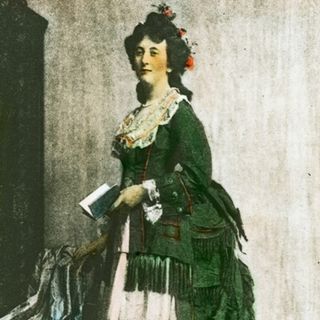
Advertisement for Marie Antoinette, produced by Grace Gibson’s BAP and broadcast on radio 2UE. From Radio Pictorial Australia, February 1939, Vol. 4, No. 8.
Advertisement for East Lynne, produced by Grace Gibson’s BAP and broadcast on 2CH and 2HD. From Radio Pictorial Australia, May 1939.

References

Lane, Richard and National Film and Sound Archive of Australia, 1994, The Golden Age of Australian Radio Drama 1923-1960: A History Through Biography, Melbourne University Press, Carlton South, Vic

This article was first published in 2013. The text was updated in 2023.

Collections to explore

  • Australian women

  • 1930s

  • Radio serial

  • Start your own collection

    A free Your Stuff account allows you to save, organise and share your favourite videos, audio and stories.

More in Stories+

Personalized your experience

Save, create and share

With NFSA Your Stuff