The Colony: Life on the Hawkesbury River (2005)
2005
The Colony: Life on the Hawkesbury River (2005)
2005
- NFSA IDM47PV3DM
- TypeTelevision
- MediumMoving Image
- FormDocumentary
- Duration5 hrs, 20 mins
- GenresDocudrama, Reality
- Year2005
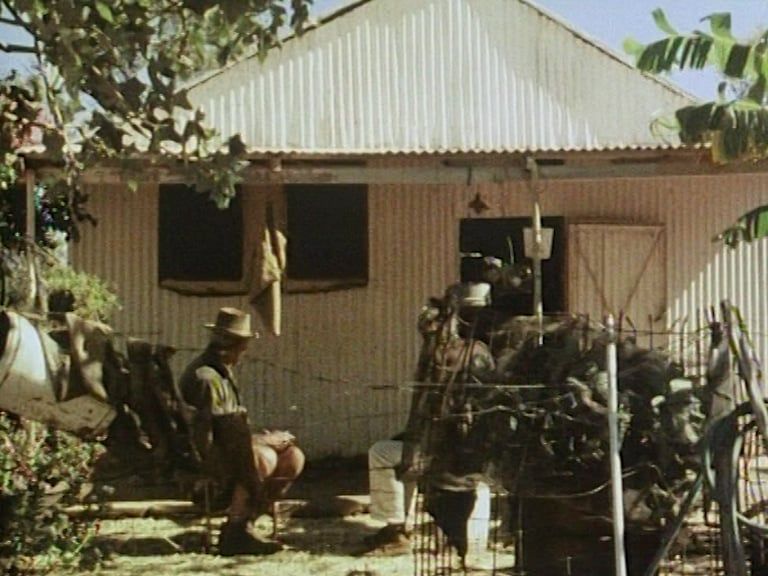
The Aboriginal participants introduce the Europeans to some of the bush tucker of the region. Only John and his wife are prepared to try the worm-like carbora, although they know they’ll be a rich source of protein. Luckily a river trader arrives with the basic food ration that was the right of every free settler family for a year after they arrived in the new colony. The trader is also keen to barter with the local Aborigines for their artefacts, in high demand back in the old world. They’re traded for rum and tobacco.
The Aboriginal participants introduce the Europeans to some of the bush tucker of the region. Only John and his wife are prepared to try the worm-like carbora, although they know they’ll be a rich source of protein. Luckily a river trader arrives with the basic food ration that was the right of every free settler family for a year after they arrived in the new colony. The trader is also keen to barter with the local Aborigines for their artefacts, in high demand back in the old world. They’re traded for rum and tobacco.
- NFSA IDM47PV3DM
- TypeTelevision
- MediumMoving Image
- FormDocumentary
- Duration5 hrs, 20 mins
- GenresDocudrama, Reality
- Year2005
- Production companyHilton CordellCo-ProducerDeborah SzapiroSeries ProducerChris HiltonDirectorMalcolm McDonaldComposerScott Saunders
This clip shows some of the participants in a ‘living history’ project gathering at the Hawkesbury River, New South Wales and waiting for government supplies to arrive in a small riverboat that is also carrying historian Michael McKernan. Indigenous people have caught fresh carbora, but only a few Europeans try this bush tucker. McKernan explains conditions in the colony of NSW and barters food for Indigenous artefacts, including a woomera and a boomerang.
Educational value points
- Historian Michael McKernan plays a major part in this clip and his inclusion in modern-day dress is intended to highlight that this reality program is a contrived representation of the past. His role in these scenes is to give participants and viewers a history lesson on the amount of rations provided by the colonial administration, the importance of trade along the River and the extent of bartering between Indigenous people and British traders and colonists.
- As McKernan explains, British colonists in this area in about 1800 were usually given 40 hectares of land, agricultural tools and two convict servants per family to establish themselves. They were supplied with food for a year, during which time they had to set up a farm that might both support them and produce additional food for the market.
- The clip shows some of the non-Indigenous participants tasting the carbora, or shipworm, an Indigenous delicacy and protein source. At the time of colonisation Indigenous people managed the land in sustainable ways, gathering and eating only what they needed immediately, as well as storing small amounts of food. In contrast, the white settlers built fences, cultivated crops, introduced domestic animals and traded goods.
- The clip shows some of the participants tasting the carbora, or shipworm. The shipworms shown are examples of the teredo (Teredo navalis), a bivalve mollusc that eats cellulose, which it obtains by boring into wood immersed in water. It uses fine ridges on its tiny shell to rasp away the wood, creating tunnels up to 1 m long in the wood. Teredos are found on the more southerly coasts of Australia and Indigenous Australians are known to have used them as food.
- As re-created in this clip, colonial traders bartered items such as food for Indigenous artefacts, which were later sold at a profit in London. Non-monetary exchange involving natural and crafted goods was a part of Indigenous life. Indigenous peoples had established use rights, sometimes shared, to gather and hunt for food in distinct areas. They gathered for ceremonies, which involved eating food, but did not rely on trade to live, as many settlers did.
- There was an active market in England for Indigenous artefacts such as those being traded in this clip. The 18th and 19th centuries saw the great age of collections, in which gentlemen collected ‘curiosities’ and artefacts from other cultures for the purposes of display and scientific study and because of a romantic interest in the ‘noble savage’. The collections of flora that the botanist Joseph Banks (1743–1820) brought back from Cook’s first voyage (1768–71) had created a sensation.
- This clip is from producer Chris Hilton’s series The Colony, which he conceived as an educational living history project that sought to create ‘a microcosm of our history in present time’ (www.australiantelevision.net). Three years’ pre-production research on conditions in NSW between 1795 and 1815 informed the project, which involved several families and singles from the UK and Australia, including Aboriginal families, living in the bush for 4 months.
- The scenes from this clip come from Day 10 of the living history project and raise issues associated with the production of historical reality programs. While the producers of such programs want them to be entertaining as well as informative, the outcomes are determined to some extent by what participants are prepared to do and say, the economic and social limits of the experiment, and the crew’s cinematic and creative skills.
- Immersion programs such as this living history project are likely to be limited in terms of an authentic re-creation of history for many reasons, including the skills and preconceptions of the participants, advisers and organisers, the temporary nature of the experience, the necessary avoidance of physical and psychological risks, and the demands of being filmed for television. In this heavily narrated clip there are only glimpses of participants’ daily activities.
- The acclaimed Australian actor Jack Thompson (1940–) narrated The Colony. Thompson is well known for his roles in many Australian feature films and television series. For his role in Breaker Morant he won the Australian Film Institute Award for Best Actor in a Lead Role in 1980, as well as a Cannes Film Festival Best Supporting Actor Award. In 1995 Thompson received the Raymond Longford Award.
by Janet Bell
Each family group looks dirty and unkempt. They’ve lived out in the bush for 10 days and are exhausted with the work of building reliable shelter while trying to find enough food to keep starvation at bay. Historian Michael McKernan doubles as a river trader who is able to explain to the families just what colonists could expect in the way of assistance during the first years of the colony.
The clip relies heavily on Jack Thompson’s narration to provide educational information. While necessary in some parts, it is also often intrusive as the footage itself isn’t permitted to tell the story. Too many times it feels like the footage takes a backseat to the voice-over. Nonetheless, for anyone interested in history it is compelling viewing.
Need to license this item? A/V professionals and researchers can shortlist licensing enquiries via our NFSA Pro catalogue search and membership.
Collections to explore
.jpg?w=320&h=240&auto=format)
Documentary
SBS Television

2000s
Start your own collection
A free Your Stuff account allows you to save, organise and share your favourite videos, audio and stories.
.jpg?w=640&h=480&auto=format)


.jpg?fp-x=0.6552734375&fp-y=0.20791304347826087&w=1024&h=776&fit=crop&crop=focalpoint&auto=format)
.jpg?fp-x=0.45556640625&fp-y=0.2252173913043478&w=1024&h=776&fit=crop&crop=focalpoint&auto=format)
.jpg?fp-x=0.23567708333333334&fp-y=0.8780381944444444&w=640&h=485&fit=crop&crop=focalpoint&auto=format)
.jpg?rect=4,0,760,576&w=640&h=485&fit=min&auto=format)