Painting Country: Maps of the country
2000
Painting Country: Maps of the country
2000
- NFSA IDP0532RQG
- TypeTelevision
- MediumMoving Image
- FormDocumentary
- Duration52 mins, 14 secs
- GenresIndigenous themes or stories, Indigenous as subject
- Year2000
- WARNING: Aboriginal and Torres Strait Islander viewers are advised that the following program may contain images and/or audio of deceased persons
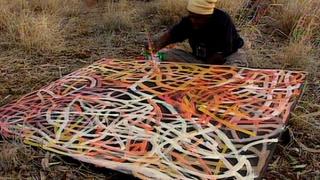
Aboriginal paintings feature maps of a specific area, mythology, personal history and storytelling. Summary by Damien Parer.
- WARNING: Aboriginal and Torres Strait Islander viewers are advised that the following program may contain images and/or audio of deceased persons
Aboriginal paintings feature maps of a specific area, mythology, personal history and storytelling. Summary by Damien Parer.
- NFSA IDP0532RQG
- TypeTelevision
- MediumMoving Image
- FormDocumentary
- Duration52 mins, 14 secs
- GenresIndigenous themes or stories, Indigenous as subject
- Year2000
- Production companyElectric Pictures, Robin Eastwood ProductionsProducerAndrew Ogilvie, Robin EastwoodExecutive ProducerAndrew Ogilvie (Electric Pictures)Executive ProducerEtsuzo Yamazaki (NHK)Executive ProducerRobin Eastwood (Robin Eastwood Productions)DirectorSally IngletonWriterSally IngletonComposerChris NormanCommissioning editorJohn Hughes (SBSi)AcknowledgementsProduced in association with SBS Independent and NHK. Produced with the assistance of Screenwest and the Film Financing Corporation Australia
Dot paintings depict traditional Indigenous country which is then shown in footage.
Narrator The paintings act as maps of the artist’s country, but these are not just topographical. They contain layers of mythology as well as personal history and storytelling. The interconnecting paths and circles depict ancestral travel along the ancient Dreaming tracks. Out here these Dreaming tracks go in all directions and only those who own the story or belong to that country can paint them.A small group of Indigenous artists, accompanied by non-Indigenous arts workers, are visiting their country.
Woman 1 (subtitled) This is Kukatja country now. Ngardi country is finished. That’s the land of my family.
Woman 2 (subtitled) This is Kukatja land, not Wangkajungka.
Tjumpo Tjapanangka (subtitled) This road is mine all the way to Piparr.
Arts worker We can see that one – Piparr.
Tjumpo Yeah.
Arts worker Tjumpo is a major lawman, one of the last ones left for this area and has got very large ceremonial responsibilities from right down into Central Australia and all the way up to the north, so in great demand around the country for his knowledge and wisdom.
Tjumpo digs for water.
Tjumpo There’s water there.
Onlookers clap as water is revealed under the soil.
Man 1 Living water. It never finishes, water all the time. Summer and winter.Narrator When people like Tjumpo look out over the land, they’re recalling where they used to walk to find water. In the desert, this knowledge of waterholes means survival and all the artists are preoccupied with it. The rockhole, soak and perpetual or living water are dominant icons in their work.
Painting Country is an engaging work, offering accessible explanations of Aboriginal art. The painters are among the most respected artists in Australia and their gentle wisdom and dignity makes the viewing experience so much richer.
Painting Country Synopsis
Balgo is a centre for Aboriginal painters in the remote north of Western Australia. The artists originally come from hundreds of kilometres around the area. They decide to go on a painting trip to their home lands after many years away. Painting Country follows the off-road vehicles on their journey as the artists recall their country and meet relations.
Notes by Damien Parer
Additional curator's notes
The strength of this documentary is that it allows the audience to access the ancient philosophy framing these Indigenous artists’ works. It allows us to see that the Indigenous artists involved in this documentary are reliving and recording lived experience, knowledge and wisdom accumulated through their lifetime, and the lives of those who came before. It does this through showing us the connection with land, the responsibility of custodianship over territory and the clear understanding of boundaries in relation to land as understood and agreed upon by each artist.
The artists are able to recall landmarks with incredible accuracy and clarity, and for the audience there is a momentary glimpse into an Indigenous perspective of the land. Suddenly, land that may be seen by an outsider as rather obsolete and without familiar symbols, comes alive, and the way the artists inhabit the land as a Westerner would a house, becomes the primary focus of the film. The joy of the elders being returned to country, or the recounting of past food gathering expeditions is the essence of the art itself, and we begin to see that it is the artist’s life and cultural inheritance of wisdom and knowledge that is the basis of such beautiful works. Though the works of art may appear simple in design and composition, they are in fact gateways into another philosophical tradition and world view.
This film provides a good example of the non-linear notion of time as understood by Indigenous peoples. For example, the personal life stories of the individual artists overlap with the Dreaming stories of the Ancestors and these are re-created within the art. The idea of past and future are imbued within the present, and all narratives – past and future – are woven together through the relationship to land as represented in the artwork.
Additional notes by Romaine Moreton
Education notes
This clip shows full-screen shots of Indigenous Australian paintings that are maps of the artists’ country or homeland. These paintings trace the land’s topography, but also contain personal history, mythology and the Dreaming tracks that crisscross this country. Aboriginal lawman Tjumpo Tjapanangka is shown talking about his land and demonstrating how he is able to find a living or perpetual waterhole. The clip shows that perpetual waterholes, which are essential to survival in remote regions, are recurring motifs in the paintings. It includes examples of paintings produced by Indigenous Australian artists from the Warlayirti Artists Co-operative at Balgo in Western Australia, and shows the Balgo artists journeying back to their country.
Educational value points
- Indigenous Australians belong to different tribal groups, each of which has its own country or land – Painting Country follows ten artists, including Tjumpo Tjapanangka, Lucy Yukenbarri and Sam Tjampitjin, as they journey back to their country; the Warlayirti Artists Co-operative organised this journey as many of these artists had been moved into government settlements, such as Balgo, and no longer live in the country represented in their paintings; the Balgo artists draw inspiration from a deep spiritual connection they have with their land and this is embodied in their art; for many this was the first time in decades that they had returned to this country.
- The Warlayirti artists affirm and maintain a continuing link to their country through a complex depiction of this land in their paintings – the paintings can represent the topographical or physical relationship between different features of the landscape, however they are primarily maps of the conceptual relationship of the people to the land, both in the past and present; topographical features are usually shown in a mythical rather than a physical relationship to one another; art is the way some Indigenous Australian people record and reclaim their history and, in so doing, define their own identity.
- The paintings shown depict Dreaming tracks that trace the journey of ancestral beings who travelled across the unshaped world during the Dreaming or creation time – on these journeys they made the landscape and laid down the laws of social and spiritual behaviour; an intricate web of ancestral tracks covers Australia; much Indigenous Australian art concerns stories about the ancestral beings who are present in the features of the landscape, in natural species and within individuals, and who continue to sustain their human descendants; Dreaming refers to a creation time and also to an ongoing belief system.
- Indigenous Australians traditionally have a deep affinity with and connection to the land and this connection is central to identity – the land is regarded as a whole environment that sustains and is sustained by the people, and is also the basis of spirituality; country is defined by geographical boundaries such as rivers, lakes and mountains; these landmarks also represent an ongoing connection with Dreaming; elders pass down knowledge about country through song, dance, stories and art.
- Indigenous Australian artists explain that their knowledge of country is passed on through paintings – the dispersal of many Indigenous communities since European settlement has meant that stories of country and Dreaming are being lost; for the artists from Balgo, many of whom live hundreds of kilometres from their country, painting is a way of maintaining a link with this country and their ancestral beings; through art, they can also pass on stories about the history and spiritual significance of each feature of their country to younger Indigenous Australians.
- The clip provides examples of, and an insight into, the work of Indigenous Australian artists – Indigenous Australian art is the oldest continuous living art tradition in the world; earlier art was created on rock, bark, wood and in the ephemeral sand paintings; in the 1970s many Indigenous Australian artists, particularly those separated from their land, began using Western materials such as acrylic paint on canvas; the Balgo artists are from an isolated desert settlement on the edge of the Tanami and Great Sandy deserts; Tjumpo Tjapanangka, who is shown in this clip, is a senior artist in the community.
- The paintings provide examples of the symbols used in Indigenous Australian art – there are several traditions of Indigenous Australian art and each has its own distinct visual language, icons and symbols that Indigenous people believe were passed down from the ancestral beings; for example, a circle or concentric circles may represent a waterhole, while spiral lines show running water; symbols are used in combination to tell complex stories; today, Indigenous Australian paintings often include an 'outside’ story for the public to see, and an 'inside’ story that is understood by those with the right knowledge and dreaming tracks.
- The waterhole is a recurring symbol in the work of the Balgo artists – in remote and arid regions such as the Great Sandy Desert, knowledge of waterholes or where to find water is essential to survival; as one of the artists indicates, water can be found all year around (and not just in the wet season) if you know where to look for it; the paintings provide a map of water sources; as an elder, Tjumpo Tjapanangka has extensive knowledge of the water sources in his country.
Education notes provided by The Learning Federation and Education Services Australia
Need to license this item? A/V professionals and researchers can shortlist licensing enquiries via our NFSA Pro catalogue search and membership.
Collections to explore
Painting
SBS Television

Art deco
Start your own collection
A free Your Stuff account allows you to save, organise and share your favourite videos, audio and stories.


