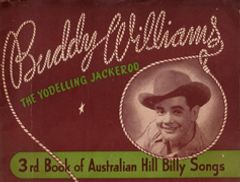
Lonesome For Your Mother Dear by Buddy Williams
1939
Lonesome For Your Mother Dear by Buddy Williams
1939
- NFSA ID68MM64TQ
- TypeMusic and Sound Recordings
- MediumAudio
- FormMusic
- GenresCountry music, Popular music
- Year1939
Buddy Williams sings Lonesome For Your Mother Dear, a sad song about a man missing his dead mother. This clip is from the start of the song.
Summary by Paul Byrnes
Buddy Williams sings Lonesome For Your Mother Dear, a sad song about a man missing his dead mother. This clip is from the start of the song.
Summary by Paul Byrnes
- NFSA ID68MM64TQ
- TypeMusic and Sound Recordings
- MediumAudio
- FormMusic
- GenresCountry music, Popular music
- Year1939
- PerformerBuddy Williams
It is surely no accident that Buddy Williams, raised in an orphanage and a foster home, should choose to sing three songs about parents in his first recording session. Lonesome For Your Mother Dear was recorded on 7 September 1939, four days after war was declared in Europe. Williams recorded only six tracks, three of which were about separation from parents. ‘Mother dear’ has the mournful tone of a country blues song – a simple melodic line in which the voice carries enormous emotion and pain. Williams’s vocal technique here is interesting – he elongates his words to accentuate the song’s strong rhythm on the guitar. It’s a very haunting recording, especially as it was probably listened to in the next few years by many men going off to war, thinking of their own mothers. Buddy Williams enlisted soon after these songs were recorded and was wounded at Balikpapan in Borneo.
Lonesome For Your Mother Dear synopsis
Buddy Williams recorded six songs in his first recording session, on 7 September 1939 – the start of a career that would last 40 years and make him one of the foundation artists of Australian country music. Three of those songs – including the two presented here – were about parents, a subject that was intensely personal, as he had grown up in an orphanage in Sydney.
Curator’s notes
Australian country music was in its infancy in 1939, with few local recording artists and even fewer who sounded Australian. Tex Morton had made his first Australian recordings in Sydney in 1936, for EMI’s Regal Zonophone label, but he modelled himself initially on American singers and sang American songs (hence the name ‘Tex’). Morton was already a big success by 1939, and his songs had become much more Australian in subject by the time that Buddy Williams walked into the same studios at EMI at Homebush, Sydney. Williams was also heavily influenced by American country and ‘hillbilly’ idioms, but these first recordings show a distinct Australian flavour. They are also intensely personal, possibly because of Williams’s own difficult childhood.
The man who became known as the ‘Yodelling Jackaroo’ was actually born in Newtown, an inner-city working-class suburb of Sydney on 5 September 1918, two months before the end of the First World War. Some sources give his birth name as Harold Taylor. He spent seven years at the Glebe Point Orphanage, and then several years on a farm near Dorrigo, New South Wales, with foster parents. The experience doesn’t seem to have made him happy, because he ran away at 15, around 1933. He began to busk at public gatherings around Coffs Harbour and found he could make good money passing around the hat. Six years later, he persuaded Arch Kerr, of EMI, to record him singing his own songs. Kerr had recorded Tex Morton three years earlier, and EMI’s Regal Zonophone was the premium label in Australian country music. Getting to record six songs on such a label shows that Williams had both talent and a drive to succeed. That three of the songs he recorded were about parents might tell us that his orphanage background had had a profound effect on his personality.
Williams continued to write songs and record during the war years. He enlisted and was wounded at Balikpapan in Borneo. He became a member of the 2/31st Battalion Concert Party, an entertainment outfit. His greatest recordings, according to country music historian Eric Watson, were those he made between 1942 and 1946. They include the songs ‘Music in My Pony’s Feet’, ‘Where the White-faced Cattle Roam’ and ‘The Overlander Trail’. He ran a travelling rodeo tent show for nine years after the war, then a country and western variety show for the next 25 years. Like many other country artists, he toured constantly, taking his growing family on the road for up to 20,000 miles a year.
In 1976, Tex Morton became the first name inscribed in the Country Music Roll of Renown. Buddy Williams was the second, in 1977. He died in 1986, from lung cancer.
Notes by Paul Byrnes
Need to license this item? A/V professionals and researchers can shortlist licensing enquiries via our NFSA Pro catalogue search and membership.
Collections to explore

Country music

Sounds of Australia

1930s
Start your own collection
A free Your Stuff account allows you to save, organise and share your favourite videos, audio and stories.