The Great Air Race: England to Australia
1934
The Great Air Race: England to Australia
1934
It was billed as the Greatest Air Race ever, requiring participants to fly from London to Melbourne within 16 days stopping at Baghdad, Allahabad, Singapore, Darwin and Charleville along the way. The 1934 MacRobertson Centenary Air Race celebrated Melbourne’s centenary and came with £15,000 worth of prize money.
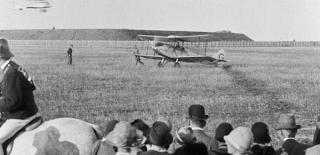
Here we see the winners – Britain’s CWA Scott and T Campbell Black – in a red DeHavilland 88 Comet named Grosvenor House, landing at Laverton Aerodrome om Melbourne before being ferried to Flemington racecourse in two De Havilland DH.60 Moths for the official ceremony.
They completed the 11,300 mile race in 71 hours. Their aeroplane was one of three De Havilland 88s competing which had been specially built for the air race. Following rapid development the aircraft had its maiden flight only six weeks before the race started.
The race was named after Melbourne’s confectionary 'king' Sir Macpherson Robertson (creator of Freddo Frog and Cherry Ripe chocolates) who supplied the prize money. A number of well-known international aviators participated in the air race including Amy Johnson, Jim Mollison and American Roscoe Turner (renowned for flying with a pet lion named Gilmore). Of the 20 planes which started the race on 20 October 1934, only 11 finished.
While the winning aircraft was a specially designed aircraft it was an indicator of just how far aviation had come that the second and third placed aircraft (a Douglas DC-2 and a Boeing 247). which finished 20 hours after Scott and Campbell Black, were both civilian airliners.
The Grosvenor House DeHavilland 88 Comet G-ACSS was restored to flying condition in 1987 by the Shuttleworth Flying Collection at Old Warden, UK.
It was billed as the Greatest Air Race ever, requiring participants to fly from London to Melbourne within 16 days stopping at Baghdad, Allahabad, Singapore, Darwin and Charleville along the way. The 1934 MacRobertson Centenary Air Race celebrated Melbourne’s centenary and came with £15,000 worth of prize money.
Here we see the winners – Britain’s CWA Scott and T Campbell Black – in a red DeHavilland 88 Comet named Grosvenor House, landing at Laverton Aerodrome om Melbourne before being ferried to Flemington racecourse in two De Havilland DH.60 Moths for the official ceremony.
They completed the 11,300 mile race in 71 hours. Their aeroplane was one of three De Havilland 88s competing which had been specially built for the air race. Following rapid development the aircraft had its maiden flight only six weeks before the race started.
The race was named after Melbourne’s confectionary 'king' Sir Macpherson Robertson (creator of Freddo Frog and Cherry Ripe chocolates) who supplied the prize money. A number of well-known international aviators participated in the air race including Amy Johnson, Jim Mollison and American Roscoe Turner (renowned for flying with a pet lion named Gilmore). Of the 20 planes which started the race on 20 October 1934, only 11 finished.
While the winning aircraft was a specially designed aircraft it was an indicator of just how far aviation had come that the second and third placed aircraft (a Douglas DC-2 and a Boeing 247). which finished 20 hours after Scott and Campbell Black, were both civilian airliners.
The Grosvenor House DeHavilland 88 Comet G-ACSS was restored to flying condition in 1987 by the Shuttleworth Flying Collection at Old Warden, UK.
- Production companyHerschells Films Pty Ltd.
Need to license this item? A/V professionals and researchers can shortlist licensing enquiries via our NFSA Pro catalogue search and membership.
Collections to explore
1930s

Roads, rails and runways

Planes
Start your own collection
A free Your Stuff account allows you to save, organise and share your favourite videos, audio and stories.


