First Contact: Gramophone
1983
First Contact: Gramophone
1983
- NFSA IDCVD4YK2P
- TypeFilm
- MediumMoving Image
- FormDocumentary
- Duration54 mins
- Year1983
Michael Leahy’s photographs and footage show the highlanders surrounding and looking at a gramophone (with a 1930s recording of ‘Looking on the Bright Side of Life’ playing on the soundtrack). In an interview, later on in the film, one of the highlanders recounts the experience and tells how they thought the gramophone was a box full of ghosts. Summary by Pat Fiske.
First Contact was nominated for Best Documentary Feature at the 1983 Academy Awards.
Michael Leahy’s photographs and footage show the highlanders surrounding and looking at a gramophone (with a 1930s recording of ‘Looking on the Bright Side of Life’ playing on the soundtrack). In an interview, later on in the film, one of the highlanders recounts the experience and tells how they thought the gramophone was a box full of ghosts. Summary by Pat Fiske.
First Contact was nominated for Best Documentary Feature at the 1983 Academy Awards.
- NFSA IDCVD4YK2P
- TypeFilm
- MediumMoving Image
- FormDocumentary
- Duration54 mins
- Year1983
- Production companyArundel ProductionsProducersBob Connolly, Robin AndersonAssociate ProducerDick SmithDirectorsBob Connolly, Robin AndersonMusicRon CarpenterCastRichard OxenburghAcknowledgementsMade in association with The Institute of Papua New Guinea Studies and with the assistance of Dick Smith
This is extraordinary footage. The highlanders thought that the Leahys were their ancestors who had been bleached by the sun and had returned from the dead. In this clip, this thinking goes further. They thought their dead ancestors were actually inside the gramophone. The Leahys told them to dance and they did, thinking they were dancing with their ancestors.
Via airplanes, the Leahy brothers flew ‘treasure’ into the highlands such as dolls, mirrors, cameras and the wind-up gramophone. Things, of course, that the highlanders would never have seen before.
First Contact synopsis
First Contact is an astonishing documentary about the three Australian Leahy brothers (Michael, Dan and James) who went gold prospecting in what they thought was a completely uninhabited part of the remote Western Highlands of New Guinea. They encountered thousands of highlanders who were seeing ‘white’ men for the very first time. The documentary uses both the footage shot by Michael Leahy in the early 1930s and interviews shot 50 years later with the two surviving Leahy brothers and some of the highlanders who witnessed their coming.
First Contact curator's notes
Although Robin Anderson and Bob Connolly had made several films together, First Contact was their first major independent documentary. The idea of the film was sparked by a conversation they had with ABC Radio’s Tim Bowden who was working on an oral history project about Australia’s involvement in Papua New Guinea. The filmmakers were intrigued by the Leahy brothers‘ expeditions into uncharted areas in the highlands of New Guinea searching for gold. Robin Anderson set about researching and struck ‘gold’ herself when Michael Leahy’s son, Richard, gave her seven rusty cans of old 16mm film – two hours of footage that documented the ‘first contact’. This material became the basis of First Contact.
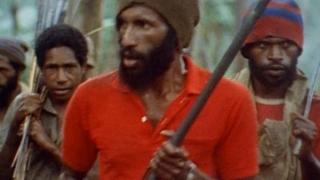
Much to the Leahy brothers’ surprise, a million New Guinea tribespeople lived in the remote and mountainous highland area that they had ventured into. The highlanders had no knowledge of the outside world. The Leahys wore clothes, came in airplanes and brought with them shells, steel axes, tools of trade, tin cans, rifles, a 16mm camera and a gramophone. The film explores the memories of the Leahys and the highlanders, and their behaviour and reactions to each other.
First Contact is a complex documentary about cultural contact and confrontation. The documentary at times is surprising, shocking and humorous but overall it is compelling. It is full of paradoxes and contradictions and leaves the viewer to ponder issues of exploitation, greed, desire, racial superiority, colonialism, cultural differences and similarities.
Creating First Contact set the filmmakers on a 10-year journey making a trilogy of films ‘investigating the historical, social and economic factors facing the first peoples of Papua New Guinea and the conflicting values of tribalism and capitalism’. The other two films in the trilogy are Joe Leahy’s Neighbours (1989) and Black Harvest (1992).
First Contact won 10 international awards, including the Australian Film Institute Award for Best Documentary in 1983, the Grand Prix at the prestigious Festival Cinéma du Réel in Paris in 1983 and was nominated for an Academy Award in 1984.
Anderson and Connolly co-wrote a book about their experiences, also called First Contact (1987, Viking Penguin).
First Contact screened in many film festivals around the world before it was broadcast in Australia on Channel 7 in 1983 and then in the US, Canada and countries across Europe.
Notes by Pat Fiske
Education Notes
This clip shows the responses of Papua New Guinea Highlanders in the 1930s to a gramophone played to them by two Australian brothers, the Leahys. Michael Leahy’s black-and-white photographs and film footage from the time show the Highlanders surrounding and looking at a gramophone. The 1983 filmmakers have edited a 1930s recording of the song ‘Looking on the bright side of life’ into their film. In 1983 one of the Highlanders describes the 1930s experience and says they thought the gramophone was ‘a box full of ghosts’. Subtitles are used.
Educational value points
- This clip illustrates the complexity of the first meeting of Western and Papua New Guinea (PNG) Highlander cultures by presenting the contrasting meanings given to the gramophone by the Highlanders and the Leahy brothers. The Highlanders linked the box and its sounds to their belief system and the spirits of their ancestors, and the footage indicates their caution. Leahy presents it as entertainment, leading a young Highlander woman as if to dance.
- The serious and apparently fearful response of some of the Highlanders to the playing of the gramophone in the 1930s footage is explained in the 1980s interview as being a result of their belief that their dead ancestors were in the box. Men are shown sitting transfixed around the gramophone, but they are reluctant to respond to the Leahy’s instructions to dance and they move away quickly when he moves the gramophone towards them. A child runs to a man for protection.
- The 1983 filmmakers, Bob Connolly and Robin Anderson, have combined the 1930s song ‘Looking on the bright side of life’ with Michael Leahy’s 1930s footage to emphasise the clash of cultures in the 1930s. The simple optimistic words and the lightness of the tune are juxtaposed with the serious responses from the Highlanders, evident in their facial expressions and movements.
- This clip provides firsthand accounts of the interaction between the Leahys and Highlanders in the 1930s from both points of view. The more recent Highlander account explaining their understanding at the time complements the 1930s images. The combination of Michael Leahy’s photographs and film from the 1930s with the 1980s interview asserts the two-sidedness of the contact and the need to provide the Highlanders’ point of view, missing from the 1930s footage.
- The archival footage mainly depicts male Highlanders interacting with the Leahys in the 1930s, but the sequence showing Leahy leading a young woman as if in a Western dance suggests the intrusion of Western gender roles. In traditional PNG Highland society separate gender roles were clearly defined. The women had the major role in producing food from their gardens while the men were involved in business such as negotiations with newcomers.
- The gramophone depicted in this clip is one of the consumer goods introduced into the PNG Highlands in the 1930s in order to impress the Highlanders with the skills and materials of the West and to create the desire for new goods. Traditional society was based on an economy in which villagers were largely self-sufficient, able to grow enough food and to use local materials for building houses and providing for their own needs.
Education notes provided by The Learning Federation and Education Services Australia
Need to license this item? A/V professionals and researchers can shortlist licensing enquiries via our NFSA Pro catalogue search and membership.
Collections to explore

Academy Awards

1930s

Papua New Guinea
Start your own collection
A free Your Stuff account allows you to save, organise and share your favourite videos, audio and stories.


