5 Seasons: Everything has a cycle
2004
5 Seasons: Everything has a cycle
2004
- NFSA IDRV6KG7C7
- TypeTelevision
- MediumMoving Image
- FormDocumentary
- Duration50 mins, 48 secs
- GenresIndigenous themes or stories, Indigenous as subject
- Year2004
- WARNING: Aboriginal and Torres Strait Islander viewers are advised that the following program may contain images and/or audio of deceased persons
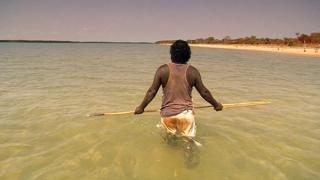
Tom E Lewis introduces the concept of five seasons over footage of an overflowing Rose River – the land inundated with water, followed by a montage of a dry riverbed. Lewis describes the wet season over images of Indigenous men hunting birds, fish and a turtle. Lewis tells us that the people sing songs to the land, rivers and sea. They sing to the spirits of the animals that are hunted. ‘Everything has a cycle, and we are guided by this cycle’, says Lewis. Summary by Romaine Moreton.
- WARNING: Aboriginal and Torres Strait Islander viewers are advised that the following program may contain images and/or audio of deceased persons
Tom E Lewis introduces the concept of five seasons over footage of an overflowing Rose River – the land inundated with water, followed by a montage of a dry riverbed. Lewis describes the wet season over images of Indigenous men hunting birds, fish and a turtle. Lewis tells us that the people sing songs to the land, rivers and sea. They sing to the spirits of the animals that are hunted. ‘Everything has a cycle, and we are guided by this cycle’, says Lewis. Summary by Romaine Moreton.
- NFSA IDRV6KG7C7
- TypeTelevision
- MediumMoving Image
- FormDocumentary
- Duration50 mins, 48 secs
- GenresIndigenous themes or stories, Indigenous as subject
- Year2004
- Production companyCAAMA ProductionsProducersPriscilla Collins (AKA Cilla Collins), Citt WilliamsExecutive ProducerPriscilla Collins (AKA Cilla Collins)DirectorSteve McGregorNarratorTommy Lewis (AKA Tom E Lewis, Tommy E Lewis)WritersDanielle Maclean, Steve McGregorAcknowledgementsProduced with the assistance of the Film Finance Corporation Australia and in association with SBS Television
A boat travels Rose River at sunset.
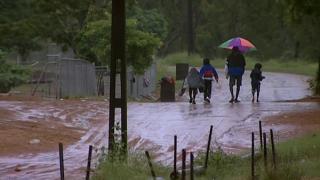
Tom E Lewis (voice-over) Rose River, Numbulwar. This is (inaudible) country. Nunggubuyu people. And that river, him run from way up middle of Arnhem Land, and him flow out to the Gulf of Carpentaria.Shots of dramatic lightning, a tropical rainstorm and overflowing river.
Lewis (voice-over) In wet season time, the skies filled up with lightning. That rain him come and him fill up the billabong and the rivers. Fish everywhere. Following the rain, that country him dry up.Shots of landscape during dry season.
Lewis (voice-over) Dry season. White people, they know only two seasons, the wet and the dry seasons. My people, Nunggubuyu people, we have five seasons.Men in a boat at sunset hunt and capture a turtle.
Lewis (voice-over) Every season has a song, and we sing to the country which feeds us. We have to sing to the spirits of the animals who we are hunting. We sing to the spirit of the land, the rivers and the sea. And everything has a cycle. We are guided by the cycle. This is what we like to share.We are introduced to the ancient Indigenous philosophy of land management, whereby the people are responsible to and for the land with human social structure determined by the land and its cycles. Indigenous philosophy and its relationship with land are very different to western ideology for Indigenous people acknowledge that the land is alive, an entity and a being that requires respect.
5 Seasons synopsis
A documentary narrated by Tom E Lewis about a region that western society says has two seasons, the wet and the dry. The Numurindi people of south-east Arnhemland in the Northern Territory’s Gulf of Carpentaria recognise their country has five seasons;
Migirarrga – May to July. Cold weather time.
Durrmala – August to October. Turtle egg time, hot dry winds.
Barra – October to December. Rains coming.
Barra Amilmilariri – January to February. Flood plains underwater, heavy rains.
Mariga – March to April. Flood plains drying up. Cool weather coming.These five seasons within the calendar year direct the lives of the Numurindi people. The land is alive, and Junggayi Moses Numamurdirdi, or Mawulu, introduces us to the concept of the land being an entity and responsive to all human actions. ‘This country is fragile. It is important that we know the songs of the country’, says Lewis in voice-over narration, ‘The songs and dances are important as it tells … us who we are, where we belong, the creation of our country, and the stories of our old people’. The responsibility of song and singing to the land is about respecting its cycles and rhythms.
5 Seasons describes how the region regenerates itself within five cycles, guiding all aspects of the lives of the Numurindi peoples, instructing them on what food is available and what is not, whether they will sit waiting for the rains to subside during the Barra season, which is also the season when the seas offer the greatest source of bush food, or whether it is time to collect turtle eggs during the Durrmala season.
5 Seasons curator's notes
The juxtaposition of archival footage with contemporary or present-day footage is evocative. Director Steve McGregor in a few simple frames represents the unchanging traditions of the Indigenous people of the area and a shift occurring in the use of western technology to incorporate ancient hunting and gathering methods. Stunning cinematography by Allan Collins and Warwick Thornton reveal this land as a montage of incredible colours and movement. To look upon this country through the eyes of Collins and Thornton, who as cinematographers support the perspective of Junggayi Moses Numamurdirdi, reveals a country that is achingly beautiful and fragile. A country that is a being requiring the most sensitive of responsibility and interaction, fulfilled here by the moieties of water and fire, or shark and crocodile. There is an exhilarating sequence towards the end of the film in Barra Amilmilariri season in which, during a thunderstorm, a crocodile moves towards the beach shore to feed from a carcass.
This film illustrates, with a gentle authority, the stark contrast between western cultural land management and the ancient Indigenous philosophies and cosmologies that treat the land as a living entity and worthy of respect.
Notes by Romaine Moreton
Education notes
This clip shows dramatic footage illustrating aspects of the annual five-season cycle identified by the Nunggubuyu people who live on the south-west coast of the Gulf of Carpentaria in the Northern Territory. Footage includes the Rose River in spate, a tropical storm, a dry riverbed, firestick farming, circling magpie geese above the rich growth after rain and a turtle being caught. The clip is narrated by Tom E Lewis.
Educational value points
- The five seasons of the Nunggubuyu people are illustrated in this clip. Migirarrga (May-July) is cold weather time; Durrmala (August-October) is turtle egg time, with hot dry winds; Barra (October-December) anticipates the coming rains; Barra Amilmilariri (January-February) involves very heavy rain with flooding in low-lying areas; and in Mariga (March-April), the flood plains dry up and comparatively cool weather can be anticipated.
- In this clip the narrator Tom E Lewis identifies his people as Nunggubuyu. 'Nunggubuyu’ is the main language spoken at Numbulwar, the area depicted in the clip, as well as the name used to identify traditional ownership of the country on which Numbulwar is situated.
- The clip describes Indigenous Australians’ deep affinity with 'country’ – the land they call home – as a defining part of their identity. For people living in traditional ways, this has produced a keenly observed understanding of their natural environment, its climatic conditions, the behaviour of its wildlife and vegetation, and the best places to hunt and gather food. Humans are just one aspect of the world, which is viewed as a living organic whole.
- The clip reveals how for the Nunggubuyu people 'every season has a song’. Participation in the land’s behaviour is detailed in song cycles and ceremonies that have ancient provenance and that are specific to location and events.
- The Nunggubuyu people believe that their creation ancestors sang the world into existence. Singing the correct song at the correct place and time is a custodial responsibility reinforcing the connection with the environment and all beings that inhabit it, both spiritual and physical. Singing also ensures the continued cycling of the seasons and the balance of birth and death that this cycle represents.
- The clip includes images of firestick farming, in which a small fire is started and burns slowly through the dry grass. This drives out animals and birds so that they can be caught but, as the narrator explains, 'we have to sing to the spirits of the animals that we are hunting’. The practice of firestick farming is still widely carried out today in the tropical and subtropical parts of the Northern Territory in the relevant seasons.
- The footage in this clip indicates that the 'land’, meaning the country of the Nunggubuyu people, also has a maritime aspect in that the sea and the rivers of the region are important sources of food. Turtle meat – caught in this instance with the contemporary aid of a motor boat – is considered a great delicacy.
- Narrator Tom E Lewis, born at Ngukurr in south-east Arnhem Land, has a wide range of artistic achievements to his credit. He is a gifted musician, has worked extensively in the theatre, and his film credits include the lead role in Fred Schepisi’s The Chant of Jimmie Blacksmith (1978). In 2005 Lewis was awarded the Bob Maza Fellowship by the Australian Film Commission for his co-authored short documentary film Yellow Fella.
- Indigenous Australian writer and director Steven McGregor graduated from the Australian Film, Television and Radio School in 2001. His documentary My Brother Vinnie (2006) won the Best Documentary Short Film at the 2006 Melbourne International Film Festival.
- The clip is from a documentary produced by the Central Australian Aboriginal Media Association (CAAMA), which is owned by the Aboriginal people of central Australia. CAAMA was established in 1980 for the social, cultural and economic advancement of Aboriginal peoples.
Education notes provided by The Learning Federation and Education Services Australia
Need to license this item? A/V professionals and researchers can shortlist licensing enquiries via our NFSA Pro catalogue search and membership.
Collections to explore
Cars

AFL and AFLW
Supernatural
Start your own collection
A free Your Stuff account allows you to save, organise and share your favourite videos, audio and stories.


