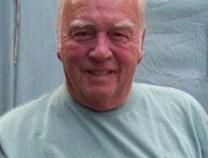
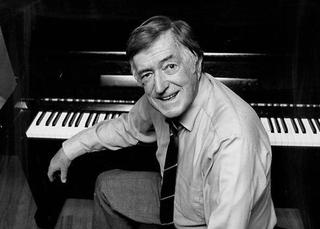
The NFSA marks the death of Graeme Bell, who passed away in Sydney on 13 June 2012 at the age of 97.
Graeme Bell
1914 - 2012
The NFSA pays tribute to Australian jazz legend Graeme Bell.
Written by Tamara Osicka
14 June, 2012
3 minute readLatest
 ArticlesMade of memories
 ArticlesGame On: '80s Australia in 8-bit



Decades
People
Themes

Graeme Bell in front of a sign advertising The Graeme Bell All Stars tour in Czechoslovakia, 1947
Pianist, composer, band leader and a passionate promoter of jazz in Australia, Bell had a musical career which spanned 70 years. He is regarded by many as the most influential jazz musician that Australia has ever produced.
Graeme first trained as a classical pianist but was converted to jazz by his brother Roger Bell, playing their first gig together in 1935 in a Scout Hall as the ‘Hot Air Men’.
As well as being a superb musician, he was an active member of the Australian jazz community who worked to raise the profile of Australian jazz. He created opportunities for jazz musicians to play, set up the Uptown Jazz Club and formed groups such as the Victorian Jazz Lovers Society.
This is an excerpt from 'Two Day Jag’, one of the first jazz recordings of Graeme Bell’s Dixieland Band, from a session in January 1944:
Bell is also remembered for playing a part in the Australian Jazz Convention, a movement during the Second World War which was a magnet for radical arts and political groups including the Eureka Youth League. During his long career, he toured extensively both nationally and internationally, perhaps most significantly to the World Youth Festival in Czechoslovakia in 1947. Graeme was made a Member of the British Empire (MBE) in 1978, an Officer of the Order of Australia in 1990 and was inducted into the ARIA Hall of Fame in 1997.
Country Jazz

Graeme Bell being presented to HRH Princess Elizabeth by Lord Donegall who is standing next to Princess Elizabeth. Left to Right is: Deryck Guyler (compere), Humphrey Lyttelton, Joe Daniels, Mick Mulligan, Graeme Bell and Alan Radcliffe.
Bell is also featured in the NFSA’s Film Australia Collection. Australian Colour Diary 37: Country Jazz captures the New South Wales township of Dubbo in the throes of a jazz festival – the 25th Annual Australian Jazz Convention 1970 – and New Year’s Eve celebrations.
Musicians featured include the original Graeme Bell Australian Jazz Band (playing 'At a Geogia Camp Meeting’); Lachie Thompson’s New Whispering Gold Orchestra ('Old Time Religion’, featuring vocals by Margaret Roadknight); Nick Polities and His New Year’s Revelers; and the Dubbo Corps Salvation Army Band.
It was directed by Bob Kingsbury and produced by The Commonwealth Film Unit 1971:
More by Tamara
- The Official Film of the Busy Bee, 191414 May, 2021
- Alternative Canberra designs by Walter Scott Griffiths16 September, 2019
- The Johnny O'Keefe scrapbooks27 January, 2016
Collections to explore

In memoriam
1940s
Obituaries
Start your own collection
A free Your Stuff account allows you to save, organise and share your favourite videos, audio and stories.