We acknowledge Australia’s Aboriginal and Torres Strait Islander peoples as the Traditional Custodians of the land on which we work and live and give respect to their Elders, past and present.

Read our Statement of Reflection

Your Cart

Your cart is empty right now...

Discover what's on
Your Stuff
Lists
No lists found
Create list
List name
0 Saved items
Updated: a few seconds ago
Getting Started
Get started with Your Stuff

A free Your Stuff account allows you to save, list and share your favourite collection items and articles. This account will give you access to Your Stuff, NFSA Player and Pro. You will need to create an additional account for Canberra event tickets.

Confirm
Skip to main content
National Film and Sound Archive of AustraliaNational Film and Sound Archive
National Film and Sound Archive of Australia
National Film and Sound Archive
National Film and Sound Archive of Australia
National Film and Sound Archive

Great AFL Moments

We bring you a highlights package of Australian Rules brilliance – rare historical footage, legendary players, magic moments and the ultimate footy anthem. Football is the winner!

Written by Rose Mulready
04 July, 2025
5 minute read

Did football exist before colonisation? What did a grand final look like in 1909? We bring you a highlights package of Australian Rules brilliance – rare historical footage, legendary players, magic moments and the ultimate footy anthem. Football is the winner!

1

The Marn Grook game

Was Aussie Rules a First Nations invention? 

Aboriginal and Torres Strait Islander viewers are advised that the following program contains images and/or audio of deceased persons

Marn Grook is a First Nations game very similar to Australian Rules football, and it has been proposed that the AFL’s game is derived from it.

In their official history, the Australian Football League (AFL) details how Thomas Wills and his cousin, HCA Harrison, combined elements of soccer, Gaelic football and rugby union to come up with a concoction that incorporated all the codes, and founded Australian Rules in the 1860s.

In the 1996 documentary Marn Grook: An Aboriginal Perspective on Australian Rules, we learn that only 20 years earlier, in the 1840s, an Assistant Protector of Aboriginals called William Thomas documented young First Nations men playing a game strikingly like Aussie Rules. He noted that the ball, made of possum skin, was dropped onto the foot to be kicked, and that some men leapt as high as five feet to catch it. The player who caught it was the one to kick it.

The documentary uses evocative footage of silhouettes to imagine an 1840s Marn Grook game.

Excerpt from Marn Grook: An Aboriginal Perspective of Australian Rules Football, 1996.

National Film and Sound ArchiveHVPY80JR
2

Earliest Known Footage of Australian Rules

The granddaddy of all telecasts

This silent footage from the 1909 Victorian Football League (VFL) Grand Final is the earliest surviving footage of an Australian Rules game. It didn’t take long for adopters of cinematic technology to realise the crowd-pleasing potential of a footy match – and we’re still tuning in.

The game – a tough, low-scoring contest between Carlton and South Melbourne (the Blues and the Bloods) – was played on Saturday 2 October at the Melbourne Cricket Ground in front of more than 37,000 fans. South Melbourne, chasing their first VFL premiership, held off a desperate Carlton, who had dreamed of winning their fourth consecutive flag. Despite being held goalless in the last quarter, the Bloods triumphed by two points.

The footage runs to a little over 10 minutes and offers a remarkable insight into long-forgotten aspects of the game: place kicks, 'slap' passes, numberless guernseys, players chaired from the field post-match by excited spectators – relics of the past, fortuitously captured by film exhibitor Charles Cozens Spencer's production.

1909 VFL Grand Final, South Melbourne vs Carlton. Please note: this clip is silent.

National Film and Sound ArchiveCG5750DM
3

VFL Personalities of Yesteryear

Up the mighty Same Olds

This silent promo film for the Victorian Football League (VFL) was made for cinemas in the late 1920s or early 1930s. Things may look a little different – the hand-stitched emblems on the guernseys, the baggy shorts, the complete absence of mullets – but the intensity on the spectators’ faces and the cheeky camaraderie among the players feel as fresh as today.

The full film features several of the teams from what was then the VFL (now the AFL), but this excerpt focuses on the players from Essendon, a club formed in the late 19th century and at first colloquially known as the Sash Wearers or the Same Olds. The Dons, the nickname current at the time of this film, is still in use today; the Bombers was a 1940s innovation.

Excerpt from Australian Rules Football: Personalities of the 1920s and 1930s, 1928. Please note: this clip is silent.

National Film and Sound ArchiveT8EKBTH2
4

‘Up There Cazaly’

The crowd’s on your side 

Portrait of Mike Brady.

Mike Brady

For anyone who was around in the 1980s, when ‘Up There Cazaly’ was used to promote Channel Seven’s VFL broadcasts, the Two-Man Band’s song is forever associated with that era. But Roy Cazaly actually played in the 1920s, and the term had been part of the Australian vernacular for decades before the song stormed up the charts.

Cazaly, who played with St Kilda and South Melbourne, was a ruckman with a preternatural leap: his team-mates would take up the cry when he was going for a mark, and the fans soon followed suit. It became a general term of encouragement and was even used by Australian soldiers on the battlefields of the Second World War.

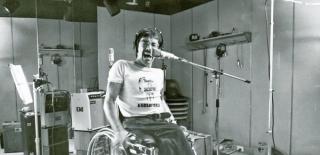
The 1979 song, written by Mike Brady and performed by him with Peter Sullivan, is an ode to the highs of football fandom whose chorus kicks in with a tidal wave of echoing vocals and thumping kick drum.

Invalid url

'Up There Cazaly' by The Two-Man Band, 1979.

National Film and Sound ArchiveDVM4XS4C
5

Montage from the 1970 Grand Final

'Jesaulenko, you beauty!'

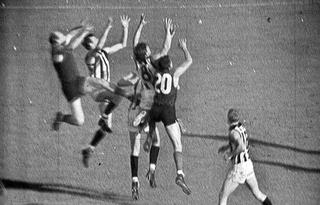
Superbly captured in one uninterrupted shot under the direction of HSV7’s football broadcasting pioneer Alf Potter, 25-year-old Carlton full forward Alex Jesaulenko made a perfectly timed run and leap onto Collingwood ruckman Graeme 'Jerker' Jenkin on the MCG members’ wing.

Want to read more like this? Subscribe to rewind and rediscover.

Sign up for In Focus - our email newsletter curating Australia’s sound and screen history. Delivered straight to your inbox every month.

It remains the most famous grab in VFL history, and has been endlessly rescreened ever since. Channel Seven’s commentator Mike Williamson’s accompanying catchcry – 'Jesaulenko, you beauty!' – entered the national lexicon, transcending the moment of play and enshrining both the player and event in Australian sporting folklore.

We’ve put together an edited montage of surviving TV, film and radio coverage from the NFSA collection of 'Jezza’s' most famous moment, including the remarkable sequence in colour.

VFL Grand Final excerpts, Melbourne Cricket Ground, 26 September 1970. Courtesy: Seven Network, Nine Network, Vera Kinnear, 3AW.

Looking for more?

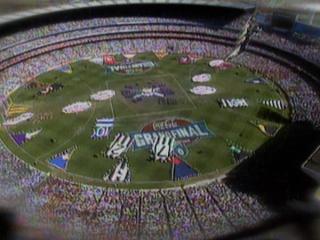
Main image: The Melbourne Cricket Ground during the 2022 AFL Grand Final. Credit: Storm Machine, licensed under CC BY-SA 4.0.

Collections to explore

  • Melbourne

  • 1970s

  • AFL and AFLW

  • Start your own collection

    A free Your Stuff account allows you to save, organise and share your favourite videos, audio and stories.

More in Stories+

Personalized your experience

Save, create and share

With NFSA Your Stuff