We acknowledge Australia’s Aboriginal and Torres Strait Islander peoples as the Traditional Custodians of the land on which we work and live and give respect to their Elders, past and present.

Read our Statement of Reflection

Your Cart

Your cart is empty right now...

Discover what's on
Your Stuff
Lists
No lists found
Create list
List name
0 Saved items
Updated: a few seconds ago
Getting Started
Get started with Your Stuff

A free Your Stuff account allows you to save, list and share your favourite collection items and articles. This account will give you access to Your Stuff, NFSA Player and Pro. You will need to create an additional account for Canberra event tickets.

Confirm
Skip to main content
National Film and Sound Archive of AustraliaNational Film and Sound Archive
National Film and Sound Archive of Australia
National Film and Sound Archive
National Film and Sound Archive of Australia
National Film and Sound Archive

The Women Who Made Australian Television 1 – The Beginnings of Television

The Women Who Made Australian TV Part 1

In the first of a five-part series, Dr Jeannine Baker looks at the vital – and often unrecognised – role that women played in bringing the first Australian TV programs to air.

Written by Jeannine Baker
11 October, 2021
7 minute read

This is the first article in a 🚨 Invalid link 🚨 5-part serieson women’s contribution to early Australian television production. For creating the series, Jeannine Baker received the 2022 Oral History Australia Media Award.

Australia’s earliest television broadcasts are usually depicted as all-male affairs, and the ‘first face’ of Australian television is generally understood to be TCN9 Sydney’s Bruce Gyngell, who said 'Welcome to television' on 16 September 1956. But the story is more complicated. Although women are largely invisible in the public record, they were vital to the efficient running of stations, and for getting the first programs to air.

Albert Moran argues that there was no ‘neat, clean beginning’ for Australian television, but a ‘series of beginnings’ as television progressed from experimental transmissions for a select audience in Sydney and Melbourne, to widespread availability in all capital cities and regional areas. An alternative contender for the ‘first face’ of television is Blue Ribbon Westinghouse Chef Zina Chaplin, who conducted a televised cooking demonstration in David Jones’s Sydney store in July 1956.

Molly Brownless

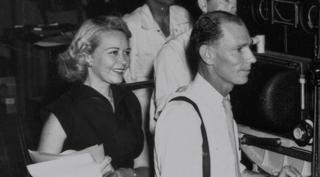
Left to right: Molly Brownless, producer Mike Ramsden and master controller Max Maxwell in the TCN9 control room on 16 September 1956. Supplied by Molly Brownless.

A running sheet marked-up with handwritten notes.

TCN9 opening night running sheet used by Molly Brownless in central control. Supplied by Molly Brownless.

On the night of 16 September 1956, Molly Brownless was working in TCN9’s central control room and was responsible for ensuring the ‘first’ broadcast was transmitted without a hitch.

Highly qualified in technical aspects of television, Molly had previously worked in BBC Engineering, initially at radio transmitter stations during the Second World War, and from 1946 as a camera operator and vision switcher in the post-war television service at Alexandra Palace in London.

After migrating to Australia, Molly began working at TCN9 while the station was still in the testing phase and was one of the only staff members with practical experience in television engineering. In this excerpt from her oral history interview, Molly explains her role in central control:

Audio: Molly Brownless interviewed by Jeannine Baker, 2019.
Image: Molly Brownless, 2019. Photographer: Jeannine Baker.

National Film and Sound ArchiveKN2PBSDW

Other women working at TCN9 in the early days were grams operator Helen Chandler, film technicians Joan Filmer and Betty Doughty, and Jean Jenkinson, personal assistant to chief engineer John Briton. Jean’s handwritten transmission log is one of the only pieces of evidence of the opening night broadcast:

Daily programme master log, opening night of TCN9, 16 September 1956. Courtesy Nine Network.

National Film and Sound ArchiveT1D4F67N

Kay Roberts

Also at TCN9’s Willoughby studio that night was Kay Roberts, director of one of the first television commercials to be broadcast. Roberts began working at Artransa Park Studios in Frenchs Forest when the studio facilities were still being built, and 'gumboots and things were the thing to have because it was knee deep in mud and buildings going up'. From Artransa’s earliest days, staff were engaged in producing commercials in preparation for the launch of television.

Kay Roberts (middle) with cast and crew shooting a Seppelts television commercial at Artransa Park Studios.

National Film and Sound ArchiveN7WB8SK1

In this excerpt from her oral history interview, Kay talks about performing multiple roles, including continuity, 'script girl' and casting, and her excitement at seeing her commercial go to air:

Audio: Kay Roberts interviewed by Stuart Glover, 1998.Image: Kay Roberts. Supplied by Di Morrissey

National Film and Sound ArchiveW4C163G8

ABC Sydney

The ABC in Sydney (ABN2) had been preparing for its opening in November 1956 by providing in-house training in television production. Beverley (Bev) Gledhill, then just 16 and working in the education department in radio, jumped at the chance to attend the first training school in November 1955.

The training course was held at St Peter’s Church hall in Forbes Street, Darlinghurst. In this excerpt from her oral history interview, Bev captures the widespread excitement about the new technology, as well as the 'all in' approach to early production:

Bev Gledhill interviewed by Brendan Horgan, 2000.

National Film and Sound ArchiveGWPB280S

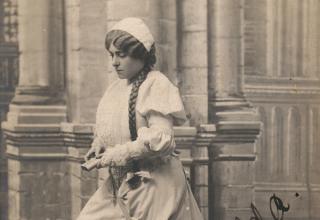
As Bev recalls, ABN2’s opening broadcast included the first live drama produced for Australian television – The Twelve Pound Look (not The Million Pound Note), based on JM Barrie’s stage play and directed by Paul O’Loughlin at the Arcon, Gore Hill. The costumes were designed by Thelma Afford, an experienced designer for theatre, film, and large public celebrations:

Images: Joan Lord as Lady Sims wearing Thelma Afford’s costume design for The Twelve Pound Look.

Margo Lee as Kate wearing Thelma Afford’s costume design for The Twelve Pound Look.

National Film and Sound ArchiveBWAN8J30

Afford’s designs for the ABC were made by theatrical dressmaker Peggy Henderson, and wardrobe mistresses the Weatherly sisters prepared the costumes for the performance:

The Weatherly sisters, wardrobe mistresses, preparing Thelma Afford’s costumes on the opening night of national television, 5 November 1956. Courtesy Australian Broadcasting Corporation Library Sales.

Floor manager Helen Lockhart and script assistants Ruth Page (pictured below) and Prue Bavin also worked on the ABC launch.

ABC producer Alan Burke and script assistant Ruth Page. Courtesy Australian Broadcasting Corporation Library Sales.

National Film and Sound ArchiveNK2D97QA

Prue later recalled the anticipation in the air:

Mungo [MacCallum] was the producer and I was there as his script assistant. The OB Van was parked in Kellett Street. We used a large radio/orchestral training studio above Woolworths as the opening night studio. That’s where the official party was located. Michael Charlton did all the presentation from the same studio. The production team there included Ray Menmuir as the producer and Ruth Page as the script assistant. We were all chewing our fingernails, but the whole thing went off very well.
Prue Bavin (later Wyndham)

Val Byth

Val Byth began working at GTV9 Melbourne as secretary to Managing Director Colin Bednall, while the station was still in its testing phase. It was a multifaceted job that included selecting the first booth announcers, assisting with test pattern transmissions, and fielding enquiries from the public about how to operate television sets. As Val explains here, she was even tasked with recording the results for the 1956 Melbourne Olympic Games, which GTV9 filmed as part of its test transmission:

Val Byth interviewed by Brendan Horgan, 2000.

National Film and Sound ArchiveE42TPXVE

TVW7 Perth

In 1959 Bev Gledhill, then working at ATN7 Sydney as a producer and director, was head-hunted to join Western Australia’s first television station TVW7. There she joined 2 other significant women in the development of the station: Penny Hoes, an experienced script assistant from London, and Coralie Condon, a theatre producer, actor, composer and television scriptwriter. The 3 women were responsible for selecting TVW7’s on-air talent for the start of broadcasting on 16 October 1959. As one of the few people with television production experience, Gledhill taught 'cameramen, studio hands, everyone, how to do things', and even helped to paint sets.

This film about the launch of TVW7 shows women working in the film department preparing films for the opening night, and the auditioning of performers by producer Coralie Condon, director Bev Gledhill, assistant Penny Hoes and program manager Lloyd Lawson. The team reviewed over 300 acts, including singers, instrumentalists, comedians, actors and a performing dog:

Excerpt from Project Teleview, 1959. Courtesy Seven Network. All rights reserved. ©

National Film and Sound Archive1KZF6T19

Bev Gledhill was also the director of the opening night’s program. This sequence from Project Teleview shows Gledhill and director’s assistant Penny Hoes in the Studio 2 control room on opening night, giving instructions to the studio crew:

Excerpt from Project Teleview, 1959. Courtesy Seven Network. All rights reserved. ©

National Film and Sound Archive1KZF6T19

In her interview with Brendan Horgan in 2002, Coralie Condon recalls producing TVW7’s first variety show, Spotlight, on a shoestring budget:

Coralie Condon interviewed by Brendan Horgan, 2002.

National Film and Sound ArchiveEJZY4BP0

Women continued to be instrumental in production at TVW7 for many years. Coralie went on to produce children’s, women’s and variety programs, including TVW7’s first daytime women’s program Televisit, which she also presented from 1962. She also wrote and produced televised musical comedy The Good Oil in 1962.

Penny Hoes became a producer and director. Other notable women at TVW7 included studio director Jean Hunsley, presenters Carolyn Noble (later Tannock) and Audrey Barnaby (later Long), and Marion Greiling (later Leyer), who began as a production assistant in 1960 and rose to become a producer, director and production manager.

Credits

This is the first part of a 5-part series, The Women Who Made Australian Television, written and curated by Dr Jeannine Baker, media historian and Honorary Fellow in the Faculty of Arts, Social Sciences and Humanities, University of Wollongong.

This series was made possible with the generous support of the Media Studies Commission of FIAT/IFTA, the National Film and Sound Archive of Australia, Seven Network, Nine Network, Network 10, and the Australian Broadcasting Corporation – Library Sales.

Read The Women Who Made Australian Television Part 2 – Behind the Scenes: Women Technicians, Part 3 - Calling the Shots, Part 4 – Women's and Children's Programs and Part 5 – Rosemary Eather.

Main image: Crowd watching test TV transmission in Townsville, 1962. NFSA title: 809738.
Image with quote: Script assistant Prue Bavin with (L-R) Gordon Waterhouse, Lloyd Berndt, Ken Middleton and Mungo MacCallum inside an OB van during a training exercise, 1956. Courtesy Australian Broadcasting Corporation Library Sales.

References

Hogan, Christine. Look at Me! Behind the Scenes of Australian TV with the Women Who Made It. ABC Books, 2006.

Moran, Albert. ‘Some beginnings for Australian television: the first Governor-General’, Continuum: The Australian Journal of Media & Culture volume 4, no 2, 1991.

Ashton, Richard. ‘TVW Opening’, watvhistory.com

Collections to explore

  • 1950s

  • Australian women

  • 1940s

  • Start your own collection

    A free Your Stuff account allows you to save, organise and share your favourite videos, audio and stories.

More in Stories+

Personalized your experience

Save, create and share

With NFSA Your Stuff