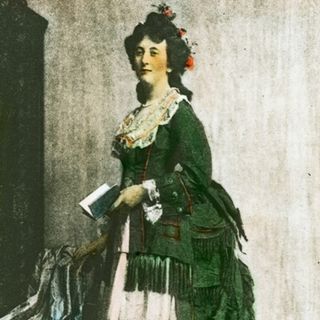
A glass slide in the NFSA’s Soldiers of the Cross set; a photographic copy on glass of a black and white reproduction of Jean Léon Gérome’s original 1872 painting Thumbs Down. This copy was then coloured by hand.
One of the highlights of my SAR Fellowship on The significance of the NFSA’s glass lantern-slide collection a couple of years ago was the chance to see the 200 or so glass magic lantern slides from Soldiers of the Cross on the light-table out at the NFSA’s facility in Mitchell, ACT.
I’m very interested in magic lantern slides and the history of the magic lantern in Australia. I suspected that these slides hadn’t yet received the attention they deserved, because Soldiers of the Cross – an evangelical lecture produced by the Salvation Army in Melbourne in 1900 – had been thought about by historians primarily interested in finding the origins of Australia’s cinema industry and, of course, the Australian cinematic part of the original presentation (13 or so kinematographic films) is now lost.
The slides, however, far from being just the remnants of a primarily movie-related event, are fascinating in their own right.
There is a lot of visual information recorded on the 9×9 cm glass slides, not to mention their extravagant hand-colouring, and their careful and inventive narrative sequencing. One of the people responsible for their production was also the youngest son of the founder of the Salvation Army, Herbert Booth. He left the Army in 1902 and took the slides with him overseas as an independent evangelist. He died in 1926, and the slides he had used for all those years didn’t return to Australia until the 1950s.
I gained access to some of the high resolution digital copies produced by the NFSA in order to show them as part of Arc Cinema’s Cinema’s Golden Summer program. It was wonderful to be able to dive into the detail in the slides, particularly the faces of the members of the Salvation Army who had dressed up as Romans or Christian martyrs to re-enact the stories of the persecution of the early Christians. By showing the slides in sequence I established that there were several distinct modes of temporality in the production, including what I dubbed the ‘iterative’, ‘expository’ and ‘action’ modes.
We had always known that some of the slides in the set that came back to Australia had been made a long time after the original production — the tableaus were more complex and the costumes and sets more elaborate. So I became intrigued to know where exactly the later slides had come from. At the Salvation Army Heritage Centre in Melbourne I had been shown a page from the Illustrated London News of 1907 where Booth was featured with his ‘evangelisation by tableaux vivants’ and ‘bioscope lecture’, so Booth was ‘on the road’ with slides and film for quite a long time. He was still touring when his first wife died in 1920.
I showed some of the later slides to colleagues in the lantern-slide researcher community, as well as the cinema historian community, and dropped them into Google Image Search. I found that some were actually production stills from the 1913 Italian blockbuster Quo Vadis. NFSA Chief Cinema Programmer Quentin Turnour had also cunningly programmed Quo Vadis into the NFSA’s season of Cinema’s Golden Summer, and when I saw the film at Arc cinema I identified 12 slides from the NFSA’s Soldiers of the Cross set as having their origin in Quo Vadis. They were most probably a set made by a commercial slide manufacturer in association with the exhibition of the blockbuster, purchased by Booth, and then interleaved amongst the existing Soldiers of the Cross set.