We acknowledge Australia’s Aboriginal and Torres Strait Islander peoples as the Traditional Custodians of the land on which we work and live and give respect to their Elders, past and present.

Read our Statement of Reflection

Your Cart

Your cart is empty right now...

Discover what's on
Your Stuff
Lists
No lists found
Create list
List name
0 Saved items
Updated: a few seconds ago
Getting Started
Get started with Your Stuff

A free Your Stuff account allows you to save, list and share your favourite collection items and articles. This account will give you access to Your Stuff, NFSA Player and Pro. You will need to create an additional account for Canberra event tickets.

Confirm
Skip to main content
National Film and Sound Archive of AustraliaNational Film and Sound Archive
National Film and Sound Archive of Australia
National Film and Sound Archive
National Film and Sound Archive of Australia
National Film and Sound Archive

Film repair and splicing

George Eastman House exchange

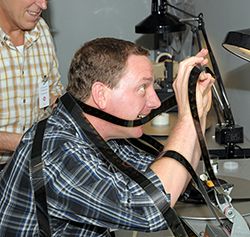
Juan Vrijs from Haghefilm gives a lesson in film repair and splicing.

Written by Darren Weinert
17 May, 2010
2 minute read

Darren Weinert.

Friday 14 May saw me start the day with Juan Vrijs from Haghefilm for a lesson in film repair and splicing. I was joined by two L. Jeffrey Selznick School students, Josh Haidet from Alliance, Ohio and HyunJu Jang from South Korea. Juan took us through film preparation and a variety of repair techniques including ultrasonic film splicing and film sprocket repair. Careful examination of film to be duplicated is essential. This ensures any damage to the sprocket holes or film surface is repaired prior to the film being duplicated, thus reducing the chance of further damage occurring to the film during the duplication process.

Following Juan’s instructions proved to me why I chose a path into the digital realm.

After a quick lunch at the LDR Charpit I visited Todd Gustavson, Curator of Technology and toured the GEH Photographic Equipment Vault.

The vault is an environmentally controlled collection of photographic history. It contains cameras from the era of the Lumiere Brothers as used by Marius Sestier in Australia in the late 1890s, through to digital technology. One of my personal favourite items is the Cinematographe by Lumiere. Todd is the author of Camera, A History of Photography from Daguerrotype to Digital and is currently working on the second volume.

Lumiere, Cinematographie, 1890s.

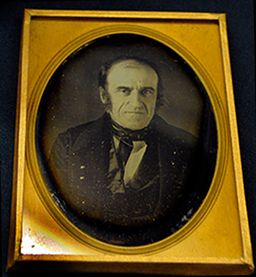
Daguerreotype from the GEH Collection.

After the Photographic Equipment Vault tour I met with Joe Struble of the Photography Department for a tour of the Photography vault. Joe is passionate about the photography collection and has been at GEH for over 20 years. Walking through the vault I noticed names on the archive storage boxes like a who’s who of photography … Henri Cartier-Bresson, Eadweard Muybridge, Ansel Adams, Julia Margaret Cameron … the list just didn’t stop.

The collection also contains early photographic examples such as daguerreotypes of which Joe showed me one of his favourites. A gold encased daguerreotype of a gentleman that looked like it could have been taken yesterday, although it is over 100 years old, a stunning example and an amazingly captivating image.

On Sunday I head off on my USA road trip to Culpeper, Virginia to spend the week at the Library of Congress facility. There I will be taking part in classes including, optical printing, film quality control, film processing and data security.

Collections to explore

More in Stories+

Personalized your experience

Save, create and share

With NFSA Your Stuff