
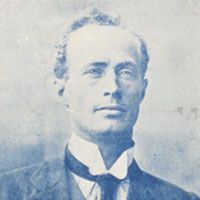
Douglas Mawson (detail), from a poster promoting the AAE film, 1913
In Part Two of his essay, the NFSA’s Chief Cinema Programmer Quentin Turnour investigates Frank Hurley’s association with the promotion of Douglas Mawson’s Australasian Antarctic Expedition (AAE) film. And the facts about the ownership and titling of the 1911–1916 film that came to be known as Home of the Blizzard are revealed.
This essay is in two sections. Go to Part One.
Did Frank Hurley lecture with the AAE film?
Not being about to cut the 1913 film release also means that Hurley was almost certainly in Java when the AAE film premiered in Melbourne at West’s Picture Palace on Saturday 19 July 1913 (not in Sydney, as is always stated). No review or advertisement for the 1913 season mentions his live presence, nor anyone else’s for that matter
So was Frank Hurley being misleading when he told of lecturing with the AAE film? The fault might rest with his hagiographers rather than Hurley himself.
Most Hurley biographers have written in detail of his successful Australian tour lecturing in 1919 with In the Grip of the Polar Ice, his own cut of Shackleton’s Imperial Trans-Antarctic Expedition footage. Philip Ayres’s 1999 biography of Mawson also describes Hurley and Mawson’s correspondence on the 1931 sound re-release of the British Australian, New Zealand, Antarctic Research Expedition (BANZARE) film Siege of the South. The commercial failure of the film was another source of irritation between Mawson and Hurley for the remainder of both men’s lives.
It is not as widely known that the first commercial version of Siege of the South, released in 1930 as Southward Ho with Mawson, was silent. The Sydney Morning Herald on 11 August 1930 described how ‘Captain Hurley has synchronised appropriate noises with the visual image. The sea-lions … utter curious shrill roars. The hull of the ship sends out a sustained hiss as it cleaves the ice. The sailors sing [s]hanties while they work. All this increases the realism of the story while, at the same time, it has not been made obtrusive enough to drown Captain Hurley’s voice as he speaks through a microphone and gives a stream of comment on the various incidents’.(37)
Apart from the new technologies of the microphone and gramophone, it sounds familiar as an anecdotal account of Hurley’s supposed 1913 gig – except that the performance was in 1930. One can’t help but wonder whether his biographers might have crossed Hurley’s recollections of his lecturing with the Imperial Trans-Antarctic Expedition and BANZARE material with the AAE film.


%20Saved%20by%20a%20Well.jpg?w=640&h=512&auto=format)


