The Tracker: 'Born for that noose'
2002
The Tracker: 'Born for that noose'
2002
- NFSA IDXWMPNH2T
- TypeFilm
- MediumMoving Image
- FormFeature Film
- Duration1 hr, 38 mins
- GenresIndigenous themes or stories, Indigenous as subject, Drama
- Year2002
- WARNING: Aboriginal and Torres Strait Islander viewers are advised that the following program may contain images and/or audio of deceased persons
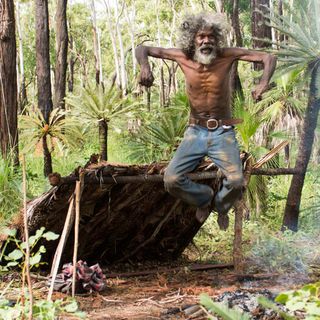
The veteran (Grant Page) has been wounded by a spear. The fanatic (Gary Sweet) wants to leave him, but the tracker (David Gulpilil) refuses – even when horse-whipped. The tracker knows he is indispensable. Summary by Paul Byrnes.
- WARNING: Aboriginal and Torres Strait Islander viewers are advised that the following program may contain images and/or audio of deceased persons
The veteran (Grant Page) has been wounded by a spear. The fanatic (Gary Sweet) wants to leave him, but the tracker (David Gulpilil) refuses – even when horse-whipped. The tracker knows he is indispensable. Summary by Paul Byrnes.
- NFSA IDXWMPNH2T
- TypeFilm
- MediumMoving Image
- FormFeature Film
- Duration1 hr, 38 mins
- GenresIndigenous themes or stories, Indigenous as subject, Drama
- Year2002
- Production companyVertigo ProductionsProducerJulie Ryan, Rolf de HeerExecutive ProducersDomenico Procacci, Bryce Menzies, Bridget IkinDirectorRolf de HeerWriterRolf de HeerSongs and Music composed byGraham TardifAcknowledgementsProduced with the assistance of the film Finance Corporation Australia and SBS Independent in association with the South Australian Film Corporation. Produced in association with the Adelaide Festival of the Arts
A difficult and confronting scene, for its obvious cruelty, but also mysterious, in the way the two men laugh at the end, over the prospect of the tracker being hanged when they get back. This may be the point at which the tracker decides he’s not going back – or he may have decided this earlier, which might explain his laughter. It’s certainly the point when the fanatic realises the limits of his physical power over the tracker. He may kill him, but he can’t force him to go forward. The fanatic’s response is to rid himself of the problem. In camp that night, as everyone is sleeping, he kills the veteran in his bed-roll.
The Tracker synopsis
In rough bush country in 1922, an Aboriginal tracker (David Gulpilil) leads three white men in the hunt for a black fugitive. The senior policeman in charge (Gary Sweet) murders 'bush blacks’ on sight; a young constable (Damon Gameau) joins in, but then takes a stand; a third man, probably a farmer (Grant Page) does nothing to stop the killing, even though he disapproves. The tracker watches and waits for his chance to turn the tables, as the party rides further into the bush.
The Tracker curator's notes
The Tracker is partly about the violent stain in Australian race relations, but it’s also about depictions of violence on the screen. The movie is incredibly direct and confronting in showing cruelty and humiliation, but it substitutes a series of paintings, created for the film by South Australian artist Peter Coad, for most of the explicit depictions of ultimate violence. These paintings disrupt the place that violent scenes usually occupy in violent cinema – there is no payoff for the viewer who wants the thrill of gore. Instead, each killing becomes a kind of instant history. The paintings could be from any time, representing a collective memory. Director Rolf de Heer is turning these despicable, unspeakable acts into a kind of cinematic cave painting.
The story is fictional but we know that these things happened, and de Heer’s strategy is to make us feel them in a different way. The film isn’t just about white violence or white justice, though. When Gulpilil’s character does eventually exact revenge, he gives the policeman a mock-trial in British court-style, and a British form of execution – hanging. White law is then superseded, as the local tribesmen take the tracker and the young policeman prisoner. They already have the black fugitive in custody, for the rape of a woman of their clan. The tracker has to spear him in the leg, a punishment that again is replaced with a painting.
The film was shot with a small crew, in sequence, on location in the northern Flinders Ranges of South Australia, and the paintings were done on location. De Heer and Gulpilil continued their collaboration four years later with another provocative and visually stunning film about Aboriginal life, Ten Canoes (2006).
World premiere: March 2 2002, Her Majesty’s Adelaide
National release: 8 August 2002Notes by Paul Byrnes
Additional curator's notes
The Tracker, a film directed by Rolf de Heer about an Aboriginal tracker employed by colonists to pursue an Aboriginal fugitive, touches on historic events that may or may not have happened.
The Tracker (David Gulpilil) at the beginning of the flim is fully clad in European clothes, distinguishing him from the ‘bush blacks’. Symbols such as these that were used to convey the distinction or the different classifications of Aboriginal peoples in use during this period (the film is set in 1922). We see Tracker gradually discard his European garb as he begins to see little distinction between himself and the Aborigines he is pursuing.
The tension between white law and Indigenous law is central to this narrative, and Tracker (David Gulpilil) is himself hostage to the chains of white civility as much as the Aboriginal man he is tracking, who has been found guilty of murdering a white woman. The decision by de Heer to use paintings to depict onscreen violence is both a creative and political decision. The choice not to depict the violence of the massacres of Aboriginal peoples can be interpreted in a number of ways. Firstly, the visual strength of seeing white men commit atrocities against Indigenous peoples is masked by the paintings, distancing the audience from the visceral reality of Aboriginal deaths – both on the screen and potentially in actual history. On screen, the choice to use paintings interrupts how the audience relates to the characters in the context of the horrific acts they have committed. After the first massacre for example, the police collectively kill a group of Aboriginal peoples. The empathy however after the killing depicted through the paintings, is with the young trooper, and it is his emotional state that becomes central to the story.
Secondly, the use of paintings to mask the violence against the Indigenous characters actually removes them from the story, simply because visually we are not privy to it, and instead we deal with the white characters’ reactions to the acts that are committed. The title of The Tracker suggests that it is the Aboriginal tracker who is central to the story, but instead, the film is more about how the white characters deal with their own sense of morality. The sound track is a haunting one, sung by Archie Roach, whose voice gives an emotional depth to the film, and actually substitutes for the voices of the silent Aboriginal characters whose physical presence are not dealt with in real time.
Additional notes by Romaine Moreton
Need to license this item? A/V professionals and researchers can shortlist licensing enquiries via our NFSA Pro catalogue search and membership.
Collections to explore

2000s

South Australia
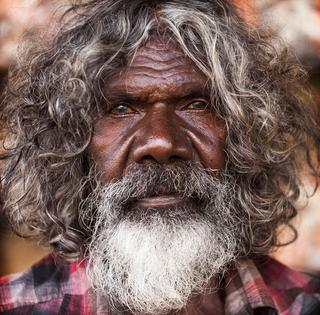
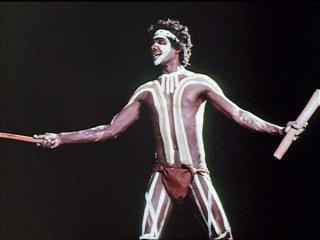
David Gulpilil
Start your own collection
A free Your Stuff account allows you to save, organise and share your favourite videos, audio and stories.


