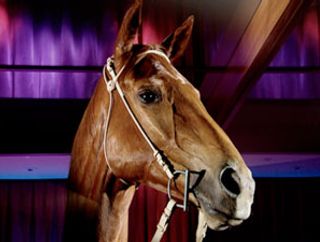
Thoroughbred: Stormalong's last race
1936
Thoroughbred: Stormalong's last race
1936
- NFSA ID0CF22YW4
- TypeFilm
- MediumMoving Image
- FormFeature Film
- Year1936
- WARNING: This clip contains animal suffering or death
After failing several times to kill the horse, Hops Warton (Lynton Moore), an Australian criminal working for an international syndicate, promises to shoot the horse during the Melbourne Cup. Tommy (Frank Leighton) rushes to thwart the plot, but Warton throws him off a high balcony and takes the shot. Stormalong stumbles across the line and falls dead, as Tommy lies badly injured. Summary by Paul Byrnes.
- WARNING: This clip contains animal suffering or death
After failing several times to kill the horse, Hops Warton (Lynton Moore), an Australian criminal working for an international syndicate, promises to shoot the horse during the Melbourne Cup. Tommy (Frank Leighton) rushes to thwart the plot, but Warton throws him off a high balcony and takes the shot. Stormalong stumbles across the line and falls dead, as Tommy lies badly injured. Summary by Paul Byrnes.
- NFSA ID0CF22YW4
- TypeFilm
- MediumMoving Image
- FormFeature Film
- Year1936
- Production companyCinesound ProductionsProducerKen G HallDirectorKen G HallWriterEdmond SewardAcknowledgementsCinesound-Movietone Productions owns all copyright which may subsist in this footage
This ending is very similar to the end of Frank Capra’s Broadway Bill (1934), a film that Ken G Hall said he had not yet seen. The Hollywood writer he hired, Edmond Seward, probably had, although Hall appears to have given him the benefit of the doubt, because he also wrote Cinesound’s next picture, Orphan of the Wilderness. The use of back-projected backgrounds can be seen clearly in the scene where Tommy attacks the gunman. The scenes also show that Ken Hall went to great lengths to film the horse race from as close as he could get, adding immediately to the excitement of the finale. Tommy, of course, survives his fall, even if Stormalong isn’t as lucky.
Thoroughbred synopsis
Tommy Dawson (Frank Leighton), would-be horse trainer, buys an emaciated stallion called Stormalong on a trip to New Zealand. When it loses its first race, the insecure Tommy vows to sell it, but Tommy’s fiancé Joan (Helen Twelvetrees), a much better judge of horses, rescues Stormalong. With Tommy’s mother, Ma Dawson (Nellie Ferguson), Joan turns Stormalong into the greatest racehorse in Australia. As the Melbourne Cup approaches, an international crime syndicate decides to kill Stormalong. Tommy has to foil the plot on race day.
Thoroughbred curator's notes
Thoroughbred is one of Ken G Hall’s stranger pictures, in terms of script. Frank Leighton’s character is a working-class boy with a chip on his shoulder, no talent for horse training, and an aggressive streak. The film makes fun of his desire to wear a top hat and be a big man, but he’s still treated as the leading man – when actually, a lot of the film is about a leading woman, the feisty and much more capable Joan, played by American actress Helen Twelvetrees. Joan’s loyalty to Tommy is difficult to understand, given that she thinks he’s ‘sweet and worthless’, and given her attraction to Bill Peel (John Longden), the much more sophisticated scion of the stud next door to Ma Dawson’s place. And yet, Leighton’s character remains memorable, precisely because he’s driven by so many psychological demons. Characterisation wasn’t normally so important in Hall’s films, but this character seems to have exercised his emotions. The picture is supposed to be an exciting tale of an ugly horse’s rise to fame, and a vehicle for Twelvetrees, Cinesound’s specially imported new glamour star, but the real emotional core of the film is how Tommy Dawson comes good in the end, from pretender to action hero.
The film is also notable for some technical innovations, and two controversies. This was Cinesound’s first film using back projection, with equipment that Hall bought during an extended research trip to Hollywood in early 1935. Back projection allowed scenes that would normally have to be filmed on location to be done in studio, saving time and money. Hall introduced the technique to Australian filmmaking and used it extensively in all subsequent Cinesound productions. On the same trip, he hired Edmond Seward, a Hollywood writer, to come to Australia. Thoroughbred was Seward’s first script for Cinesound, but the ending led to allegations of plagiarism, since it is almost identical to the end of Frank Capra’s 1934 film, Broadway Bill. In his autobiography, Hall says he had not seen the Capra film, but concedes there was ‘some justification’ to the allegations. Nevertheless, he used Seward on his next film, Orphan of the Wilderness. Both films would eventually have problems with the British film censor over allegations of cruelty to animals. The second controversy, kept secret at the time, was that Helen Twelvetrees and Frank Leighton were having an affair during the production. Hall provides an entertaining description of the repercussions – especially for Twelvetrees’ then husband – in his book, Directed by Ken G Hall.
Notes by Paul Byrnes
Education Notes
This black-and-white clip from the feature film Thoroughbred (1936) shows the champion horse Stormalong racing in the Melbourne Cup, being shot and then dying after winning. It opens with scenes of the race intercut with scenes of spectators and a glimpse of a gunman. The action then shifts to trainer Tommy Dawson (Frank Leighton) fighting with the gunman Hops Warton (Lynton Moore). Final scenes show Stormalong staggering across the line to his death, the crowd’s reactions and Warton’s arrest. The race caller describes the events seen on the track.
Educational value points
- Adventurous cinematography along with the race caller’s commentary set the pace, and rapid cuts build excitement and suspense in the clip. Director of photography George Heath wanted much of the action shot very close to the thundering racehorses and the cameraman filmed these shots lying on a homemade tin sled dragged along by a car. When the film was edited, increasingly rapid cuts between gunman, crowd and the horses were used to build suspense.
- Director Ken G Hall (1901-94) of Cinesound Productions was able to utilise newsreel footage for all the aerial and long shots of the race including Stormalong’s stumble in its early stages. The footage was seamlessly integrated with close-ups filmed for the movie itself. Hall had access to footage of an actual Melbourne Cup race and others run at Flemington racecourse held in the library of Cinesound Review, a weekly newsreel launched in November 1931.
- The climax of the clip, Stormalong’s extended fall, was both dangerous and cruel in that the filming involved a real fall of both horse and jockey caused by a long strand of wire tied to one of the horse’s legs. The fall was more dangerous than intended. The stunt organiser for the film, Lance Skulthorpe, forgot to let the wire go and what was meant to be a stumble became a dangerous fall. Jockey Alf Stanton later described it as the hardest wages he ever earned.
- The scenes in this clip of Stormalong’s shooting and death were some of the most internationally controversial scenes included in an Australian feature film in the 1930s. Firstly it was said that scriptwriter Edmond Seward had plagiarised the death scene from the Hollywood movie Broadway Bill (1934). Secondly the British censors believed the scenes were dangerous and cruel and cut them almost completely.
- In the fight scene, Hall made use of innovative back-projection equipment he had imported from the USA. Back projection involved a pre-filmed background scene being projected onto a screen behind the actors and thus removed the need to film on location. The technique relied on synchronising the cameras that filmed the foreground performances with the background projection. Its use in the fight scene creates a sense of time standing still.
- Elements of the plot, especially the attempts of a gang of international criminals to kill Stormalong, resonated with Australian cinema audiences in the 1930s who would have remembered the reported attempt to shoot champion racehorse Phar Lap in Melbourne in 1930. Phar Lap’s strapper reported that a masked gunman had fired a shot from a speeding car as the horse was being walked back to the stables in Caulfield. The gunman has never been identified.
Education notes provided by The Learning Federation and Education Services Australia
Need to license this item? A/V professionals and researchers can shortlist licensing enquiries via our NFSA Pro catalogue search and membership.
Collections to explore
Horse racing
Horses

Melbourne Cup Horse Race
Start your own collection
A free Your Stuff account allows you to save, organise and share your favourite videos, audio and stories.