The Back of Beyond: Cooper Creek in flood (1954)
1954
The Back of Beyond: Cooper Creek in flood (1954)
1954
- NFSA IDZT0W0FDR
- TypeFilm
- MediumMoving Image
- FormFeature Film, Documentary
- Duration1 hr, 2 mins
- GenresDocudrama, Indigenous themes or stories, Indigenous as subject
- Year1954
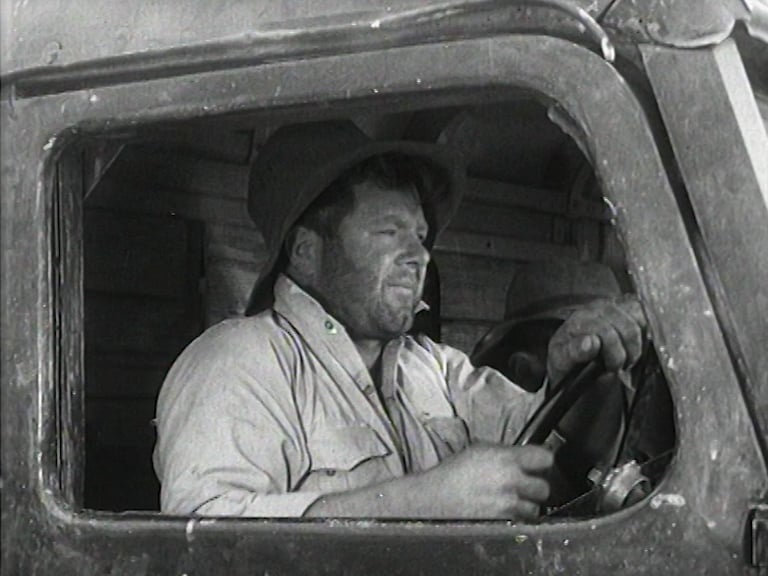
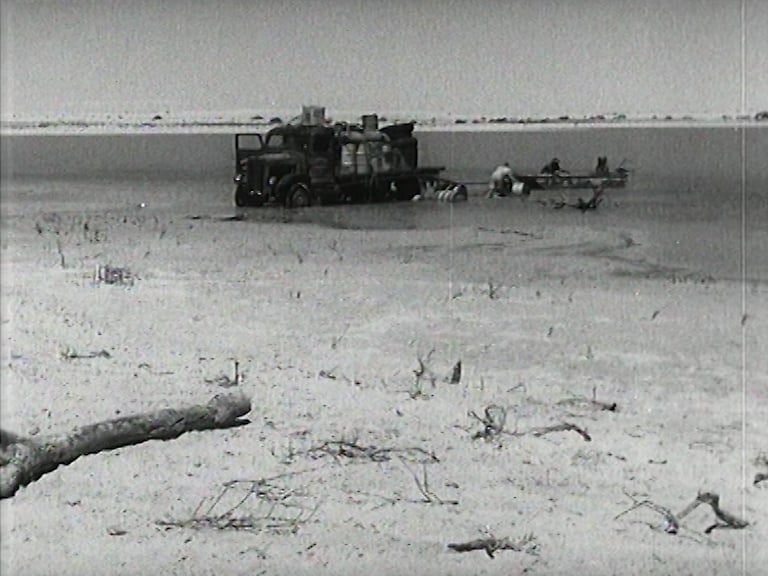
The parched remains of dead cattle are spread across the dry creek-bed of Cooper Creek. Then, a once in a lifetime flood creates an inland sea. With the creek in flood, Tom is shown ferrying his load across the waters in a small steel punt. With a passenger to help, he can get the load across in six or seven trips. As Tom and his passenger load up the punt and carry across barrels and sacks of supplies, William Henry cooks some tucker in his makeshift living room on the edge of the water.
William Henry calls them in for tucker and as Tom comes ashore, he dances light-footedly around a dressmaker’s model to the music playing in the background. The others have a good laugh. After his impromptu dance, Tom politely tips his hat to the dummy.
The parched remains of dead cattle are spread across the dry creek-bed of Cooper Creek. Then, a once in a lifetime flood creates an inland sea. With the creek in flood, Tom is shown ferrying his load across the waters in a small steel punt. With a passenger to help, he can get the load across in six or seven trips. As Tom and his passenger load up the punt and carry across barrels and sacks of supplies, William Henry cooks some tucker in his makeshift living room on the edge of the water.
William Henry calls them in for tucker and as Tom comes ashore, he dances light-footedly around a dressmaker’s model to the music playing in the background. The others have a good laugh. After his impromptu dance, Tom politely tips his hat to the dummy.
- NFSA IDZT0W0FDR
- TypeFilm
- MediumMoving Image
- FormFeature Film, Documentary
- Duration1 hr, 2 mins
- GenresDocudrama, Indigenous themes or stories, Indigenous as subject
- Year1954
- DirectorJohn HeyerWritersRoland Robinson, Janet Heyer, Douglas Stewart and John HeyerOriginal MusicSydney John Kay
This black-and-white clip from the sponsored documentary The Back of Beyond (1954) shows footage of animal carcasses strewn across the dry bed of Cooper Creek and hanging from trees, followed by images of the Creek in flood. Scenes of mailman Tom Kruse and his assistant taking their load across the Creek on a steel barge are intercut with William Henry Butler cooking over a fire in their makeshift camp. Jazz music plays as Kruse dances with a dressmaker’s model and his companions laugh at his antics.
Educational value points
- With its unusual use of music, cinematography and humour, this clip illustrates why The Back of Beyond is considered an iconic Australian documentary–drama. These elements – the theatrical music, long shots of the flooded river and birds wheeling in the sky, and the humorous camp scene – combine to present a graphic, although romanticised, view of the outback.
- While the early scenes in the clip of carcasses littering the landscape may have confirmed non-Indigenous Australians’ fears at the time about the inhospitable and largely unknown outback, Kruse and his team’s ingenuity and tenacity in crossing the flooded creek and Kruse’s dance with the dressmaker’s model, although obviously staged for the camera, suggest the possibility that working in this difficult environment could be enjoyable.
- The clip demonstrates how music can be employed to create and change the mood of a narrative. The eerie and dramatic scenes showing the carcasses of animals killed by drought and flood are rendered more atmospheric by the music soundtrack. The hard work of moving the load across the river by boat from one truck to another is rendered light-hearted with jazz piano highlighting the good humour of the three men.
- This film belongs to the documentary-drama genre, in which dramatised scenes, music, artistic cinematography and lyrical narration produced a style of documentary that could also be classified as an art film. This is well illustrated by the surreal scene of the camp on the side of the river – with its armchairs, record player and dressmaker’s model – playfully transposing a suburban living room to the middle of the desert.
- A legend of the outback, Esmond Gerald (Tom) Kruse (1914–) delivered mail for 27 years to isolated homesteads along the Birdsville Track. He was renowned for always getting the mail through, overcoming floods, dust storms and mechanical breakdowns. Kruse was awarded an Order of the British Empire (MBE) in 1955 for services to the people of the Australian outback and continued delivering mail until the early 1960s.
- The clip shows Kruse negotiating the flooded Cooper Creek on his way from Marree in South Australia to Birdsville in western Queensland. Known as the Birdsville Track, this 517-km journey over some of the driest, most inhospitable terrain on Earth, was taken by mailmen since the late 1860s delivering mail and other supplies to people who lived along the Track.
- The clip dramatically shows how introduced species such as cattle struggled to survive the cycles of drought and flood experienced in the Cooper Creek area. For the Aboriginal inhabitants of the area Cooper Creek had been a source of food and water in an arid area on a major trading route for thousands of years. Numerous rock art sites, middens and artefacts have been found in the region.
- Cooper Creek, named by Charles Sturt (1795–1869) after South Australian Judge Charles Cooper, belongs to one of the largest river systems in Australia, which drains a total area of 296,000 sq km in Australia’s inland. The Creek is not a permanent watercourse and becomes a series of waterholes that persist even in drought. When large floods occur – roughly every ten years, according to the Bureau of Meteorology – its floodwaters reach Lake Eyre.
- The barge in this clip, the Tom Brennan, was used to transport mail, stores and drovers during major flooding between 1949 and 1956. Made of steel with airtight tanks, it was powered by a 4 hp outboard motor. Restored in 1985, it now stands as a monument on the Birdsville Track. Earlier flood warnings these days mean stock and transport are able to move to higher ground in time to avoid floods.
By Poppy De Souza
This two-part sequence contrasts a realistic scenario with a more fanciful one – the latter revealing a little more of Tom’s charming character. Tom dancing with a dressmaker’s model was entirely Heyer’s invention and seems at first extremely contrived. What it does reveal, however, is a tenderness and lightness to Tom that his heavy-set frame and low-key practicality otherwise conceals.
Need to license this item? A/V professionals and researchers can shortlist licensing enquiries via our NFSA Pro catalogue search and membership.
Collections to explore
.jpg?w=320&h=240&auto=format)
Documentary
.jpg?w=320&h=240&auto=format)
.jpg?w=320&h=240&auto=format)
.jpg?w=320&h=240&auto=format)
Outback
1950s
Start your own collection
A free Your Stuff account allows you to save, organise and share your favourite videos, audio and stories.
.jpg?w=640&h=480&auto=format)

.jpg?w=640&h=480&auto=format)
.jpg?w=640&h=480&auto=format)
.jpg?w=640&h=480&auto=format)


.jpg?fp-x=0.4791666666666667&fp-y=0.37378472222222225&w=640&h=485&fit=crop&crop=focalpoint&auto=format)
.jpg?fp-x=0.6809895833333334&fp-y=0.18593749999999998&w=640&h=485&fit=crop&crop=focalpoint&auto=format)
.jpg?fp-x=0.58544921875&fp-y=0.56103515625&w=640&h=485&fit=crop&crop=focalpoint&auto=format)
.jpg?rect=4,0,760,576&w=640&h=485&fit=min&auto=format)