Smart's Labyrinth: Always the light
1994
Smart's Labyrinth: Always the light
1994
- NFSA IDXYS3RH8J
- TypeFilm
- MediumMoving Image
- FormSeries
- Duration55 mins, 35 secs
- Year1994
Artist Jeffrey Smart takes the audience on a whimsical visit to an industrial landscape where he set a painting featuring bicycle riders. Smart asks the film’s director where he would put the figure of Smart in the painting. Smart also suggests that music might set the scene. Summary by Damien Parer.
Artist Jeffrey Smart takes the audience on a whimsical visit to an industrial landscape where he set a painting featuring bicycle riders. Smart asks the film’s director where he would put the figure of Smart in the painting. Smart also suggests that music might set the scene. Summary by Damien Parer.
- NFSA IDXYS3RH8J
- TypeFilm
- MediumMoving Image
- FormSeries
- Duration55 mins, 35 secs
- Year1994
- Production companyFeatherstone ProductionsProducerDon FeatherstoneExecutive ProducerDasha RossDirectorGeoffrey BennettWriterGeoffrey BennettOriginal musicAntony Partos
Jeffrey Smart shows the filmmaker industrial sites that are reflected in his works. This is intercut with a studio interview and images of the paintings.
Jeffrey Smart, artist I can find anything beautiful. Always it’s the light, always it’s the light, I think. I don’t think it’s the object in itself, it’s the way it occurs naturally. Even ugly things or so-called – what you call ugly things – can be beautiful. If a painter’s not concerned with whatever he thinks is beautiful, there’s no point in him painting, is there? I think it’s what the Chinese say – if you are to move others, you must first of all be moved yourself – must be moved and, usually, when I paint it’s to paint something that I’ve thought absolutely so beautiful that I want to celebrate it – I want to put it down.
Jeffrey points to a bridge.
Jeffrey Smart Well, I think if I painted it, I’d not use those lights that you see there. I’d more likely use these lights, d’you see? But I think the lights that go like this take up the theme of the turning of the ramp. Now, earlier in the day the sun – or more in winter – the sun strikes those walls. You see the way the light’s on those columns looks very dramatic – very, very lovely shapes. At this point the music could be swelling up.
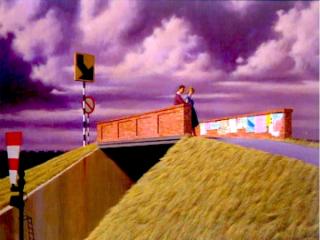
The clip cuts to an orchestra playing and Jeffrey is shown, in snap edits, standing in various positions underneath the bridge. Details of Jeremy’s painting and of the site that inspired are shown before we see the entire painting of the bridge.
Jeffrey Smart Where do you want me now? Over there? Up here? You want me to look at the back of my car? What a nice car. Do you want me to say cheese or biscuits?
Jeffrey Smart was born in Adelaide in 1921 and, like many of his contemporaries, went overseas to work. He began exhibiting regularly in 1957 and has held 25 solo exhibitions. His work is known for its stark industrial landscapes with lone figures. Producer Don Featherstone has made many documentaries about Australian artists. He is also the producer of Beautiful Lies, The Daylight Moon, An Imaginary Life and The Beach.
Smart's Labyrinth synopsis
Australian artist Jeffrey Smart has been living in Italy since the 1970s. This documentary looks at his life in the 1990s. He reflects on his life as a painter and offers observations about his artistic work. The film features footage from his home in Italy and whimsical visits to local sites seen in his work.
Notes by Damien Parer
Education notes
This clip shows artist Jeffrey Smart describing his approach to painting. It combines shots of the urban landscape that Smart paints with examples of his work. The artist explains that he is inspired by the way light falls on an object, rather than by the object itself, and that he sees and celebrates beauty in urban landscapes. In the final sequence Smart stands next to a car ramp and explains how he might paint it. In a playful reference to Smart’s use of figures in his paintings, Smart himself is placed in a variety of different places in the scene. At Smart’s on-camera suggestion, orchestral music is introduced and images of an orchestra, various shots of the ramp and the finished painting are shown.
Educational value points
- The clip shows Australian painter Jeffrey Smart (1921–), whose work is represented in the major art galleries in Australia and in international collections. After attending the South Australian School of Art and Crafts and Adelaide Teacher’s College, Smart worked as an art teacher. In 1949 he studied for 6 months with renowned French painter Fernand Léger in Paris. He began exhibiting regularly in 1957, and in 1963 moved to Italy to paint full-time. The Art Gallery of New South Wales held a major retrospective of Smart’s work in 1999–2000.
- Smart reveals his preoccupation with the depiction of urban and industrial landscapes. His subject matter is the mundane and ordinary in the modern world, such as airports, car parks, expressways, concrete streetscapes and industrial wastelands. He has been lauded by some art critics for revealing the beauty in things that are usually regarded as unattractive, but has also been criticised for producing work devoid of meaning. Smart says that he is trying to paint 'the real world I live in, as beautifully as I can, with my own eye’ (Jeffrey Smart Retrospective, Art Gallery of New South Wales, 2000). The artist and art critic James Gleeson comments that Smart paints a 'still’ and leaves it to us to construct a sequence around it.
- In the clip, Smart indicates that he is inspired by the way light falls on an object, rather than by the object itself, and that he uses light and colour to beautify ordinary objects. He refers to the dramatic way light strikes the columns on the ramp shown in the clip to create 'lovely’ shapes. Gleeson, however, has commented that the light in Smart’s paintings is arranged as one might light a stage and does not suggest the light of nature.
- Smart is heavily influenced by Piero della Francesca, an early Renaissance painter whose strong sense of composition and colour (he organised masses of colour in patterns) gave his paintings a geometrical form. Likewise, Smart uses large blocks of colour and is meticulous about the placement of objects and spatial relationships within his compositions. Smart has said he is concerned with 'putting the right shapes in the right colours in the right places. It is always the geometry’ (quoted in John MacDonald, Jeffrey Smart: Paintings of the 70s and 80s, Craftsman House, 1990).
- Smart has said that the inclusion of figures in his paintings is a compositional device, in that he uses the figures to give the viewer a sense of scale, to counterbalance the urban landscape and to give his paintings a human dimension. However, some critics have argued that his figures exist without future or past and without a possibility of personality. While the figures in Smart’s paintings are often inanimate props in the composition that create a tension between the space and the people in it, Smart has repeatedly rejected readings of his work as images of alienation.
- The clip duplicates Smart’s use of the human figure in his paintings, thus using the language of film to reflect the language of art. The placement of Smart at various points within the frame can alter the way the audience reads or responds to the image as a whole, drawing attention to the artifice involved in constructing both a work of art and a documentary. Similarly, by inserting orchestral music at Smart’s suggestion, the film reminds us that this depiction of Smart is also a construct, just as his paintings offer a representation of reality but the atmosphere of a dream.
Education notes provided by The Learning Federation and Education Services Australia
Need to license this item? A/V professionals and researchers can shortlist licensing enquiries via our NFSA Pro catalogue search and membership.
Collections to explore
Painting

Jeffrey Smart

Archibald Prize
Start your own collection
A free Your Stuff account allows you to save, organise and share your favourite videos, audio and stories.


