Shifting Sands - My Colour, Your Kind: Rugged cross
1998
Shifting Sands - My Colour, Your Kind: Rugged cross
1998
- NFSA ID150M871A
- TypeFilm
- MediumMoving Image
- FormSeries
- Duration11 mins
- GenresYouth, Indigenous themes or stories, Indigenous as subject
- Year1998
- WARNING: Aboriginal and Torres Strait Islander viewers are advised that the following program may contain images and/or audio of deceased persons
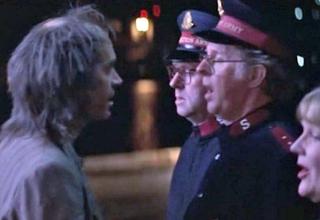
The clip opens with billowing curtains, a statuette of Christ and the close-up of a young albino girl (Melissa Middleton). In flashback the young albino girl closes her eyes as her mother (Christine Palmer) smears her with mud. A cross crashes through a pane of glass, and the young girl is running towards a security fence.
Summary by Romaine Moreton
- WARNING: Aboriginal and Torres Strait Islander viewers are advised that the following program may contain images and/or audio of deceased persons
The clip opens with billowing curtains, a statuette of Christ and the close-up of a young albino girl (Melissa Middleton). In flashback the young albino girl closes her eyes as her mother (Christine Palmer) smears her with mud. A cross crashes through a pane of glass, and the young girl is running towards a security fence.
Summary by Romaine Moreton
- NFSA ID150M871A
- TypeFilm
- MediumMoving Image
- FormSeries
- Duration11 mins
- GenresYouth, Indigenous themes or stories, Indigenous as subject
- Year1998
- Production companyCAAMA ProductionsProducerSteve McGregorSupervising producerGraeme IsaacWriter/DirectorDanielle MacleanAcknowledgementsProduced with the assistance of the Indigenous Branch of the Australian Film Commission
It was a resistance tactic by Indigenous parents to smear any fair-skinned children with mud or charcoal with the intention of fooling the authorities – usually the police – who were employed to remove children from their families and place them in welfare. The writer/director Danielle MacLean references this strategy but makes it an extreme circumstance by introducing an Indigenous girl who is born albino, a condition where an individual is born without any skin pigmentation.
My Colour, Your Kind Synopsis
A young albino Aboriginal girl (Melissa Middleton) escapes from a convent to return to her mother, her story unfolding in flashback during this journey.
My Colour, Your Kind Curator's Notes
Albino girl (as described in the credits) gives a deeply silent performance. We meet the Indigenous albino girl as she is being smeared by her brown-skinned mother (Christine Palmer). When under threat of having their children stolen by authorities, Indigenous mothers resorted to making their fair-skinned children appear darker by smearing them with mud, charcoal and any other darkening agent. The mud smearing is reminiscent of one of the final scenes of Rabbit Proof Fence (2002), where the girls, returning home, are smeared with charcoal by their mother and grandmother.
The symbolism employed by writer/director Danielle MacLean is truly poetic and painful, by contextualising this story in the era of assimilation policies and child removal policies, MacLean exposes the artificiality of basing such government programs on skin complexion, and indeed, the insubstantial base of racism itself. MacLean’s use of the mud smearing is brilliant, as its economy of meaning propels the audience into the history of scientific dictum that has shaped the lives and experience of all Indigenous peoples in the land now known as Australia. The mud smearing in this light represents much; the desire to keep family together, maintaining cultural practices and beliefs, and simply, a mother’s longing to keep her child safe. The application of scientific theories that positioned Indigenous peoples as primitive and destined to die out in the face of western civilization was reflected in the government polices implemented that sought to remove fair-skinned Indigenous children from their parents due to the belief that such children were both a danger to the state, as well as in danger themselves.
My Colour Your Kind was nominated for an AFI Award – Best Screenplay in a Short Film, 1998; a Gold Award for Flickerfest 99 8th International Film Festival and Best Cinematography, 8th Festival of Pacific Arts, 2000.
Notes by Romaine Moreton
Need to license this item? A/V professionals and researchers can shortlist licensing enquiries via our NFSA Pro catalogue search and membership.
Collections to explore


Christianity

Regional



Stolen Generations
Start your own collection
A free Your Stuff account allows you to save, organise and share your favourite videos, audio and stories.


