Samson and Delilah: Delilah, Samson and Grandma
2009
Samson and Delilah: Delilah, Samson and Grandma
2009
- NFSA ID2C98VWPV
- TypeFilm
- MediumMoving Image
- FormFeature Film
- Duration1 hr, 36 mins
- GenresIndigenous themes or stories, Indigenous as subject
- Year2009
- WARNING: Aboriginal and Torres Strait Islander viewers are advised that the following program may contain images and/or audio of deceased persons
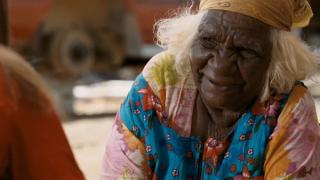
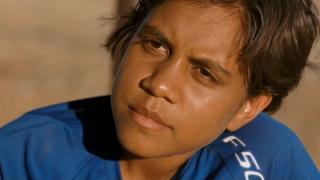
Delilah (Marissa Gibson) sees Samson (Rowan McNamara) at the shop, and his message of love written on the shop wall. She gives him a packet of chips and he follows her home to her grandmother’s place. Delilah’s grandmother (Mitjili Napanangka Gibson) explains that, under their kinship system, Samson is the right skin group for Delilah to marry, and encourages a relationship with him. Summary by Liz McNiven.
- WARNING: Aboriginal and Torres Strait Islander viewers are advised that the following program may contain images and/or audio of deceased persons
Delilah (Marissa Gibson) sees Samson (Rowan McNamara) at the shop, and his message of love written on the shop wall. She gives him a packet of chips and he follows her home to her grandmother’s place. Delilah’s grandmother (Mitjili Napanangka Gibson) explains that, under their kinship system, Samson is the right skin group for Delilah to marry, and encourages a relationship with him. Summary by Liz McNiven.
- NFSA ID2C98VWPV
- TypeFilm
- MediumMoving Image
- FormFeature Film
- Duration1 hr, 36 mins
- GenresIndigenous themes or stories, Indigenous as subject
- Year2009
- Production companyCAAMA Productions, Scarlett PicturesProducerKath ShelperDirectorWarwick ThorntonWriterWarwick ThorntonComposerWarwick ThorntonCastSteven Brown, Gregwyn Gibson, Marissa Gibson, Matthew Gibson, Rowan McNamara, Mitjili Napanangka Gibson, Noreen Robertson Nampijinpa, Scott ThorntonAcknowledgementsProduced in association with the Screen Australia Indigenous Branch, New South Wales Film and Television Office, Australian Broadcasting Corporation, Adelaide Film Festival and Northern Territory Film Office
Non-professional actors Rowan McNamara and Marissa Gibson use subtle looks and deceivingly simple gestures to suggest their strong connection. Delilah conveys mixed messages: a dismissive glance, a gift of food, and then throwing rocks so Samson keeps his distance. Thornton deliberately wanted to combine the characters’ particular circumstances of social disadvantage with the universal sense of awkwardness experienced by all teenagers, especially those in love.
After the silent courtship of Samson and Delilah, the clip features one of the longest dialogues in the film. From their brief exchange, we can see that Delilah and her grandmother have a warm and trusting relationship. Mitjili Napanangka Gibson brings a disarming laughter and sense of playfulness that has been missing from the film till now, and by association it makes us like Delilah even more. Thornton is careful to occasionally frame Samson in the background to show he has not gone away and to maintain his physical proximity with Delilah.
The scene is also interesting for suggesting the importance of tradition and kinship in Indigenous communities. The grandmother’s comment that Samson is the ‘right skin’ for Delilah, like the ‘S 4 D onley ones’ graffiti, adds to the sense of inevitability of their coming together.
Samson and Delilah Synopsis
Samson and Delilah is the story of two Indigenous teenagers growing up in a socio-economically disadvantaged community in central Australia. Samson (Rowan McNamara) and Delilah (Marissa Gibson) struggle to find the strength, courage and resilience to rise above the challenges of poverty, grief and racism around them.
To escape a small and poor community, Samson and Delilah move to the nearest large town, Alice Springs. They have no money and sleep under a bridge. Samson uses petrol to control his perception of reality, to blank out his pain, loss and misery; Delilah begins sniffing petrol too and together they traverse the streets of Alice Springs and suffer disdain, abuse and deprivation.
Supported by a homeless alcoholic called Gonzo (Scott Thornton) and family from the community, the two survive their lowest ebb and rebuild their lives. They return to the desert to Delilah’s traditional country to rehabilitate from petrol sniffing and try to build a life in tune with their cultural heritage.
Samson and Delilah Curator's Notes
The lack of infrastructure, services and resources in this small community in central Australia sets the scene for ill health, unemployment and poor housing. The use of the empty refrigerator, the wheelchair, the ever-ringing but never answered payphone, the broken-down cars and the abandoned church symbolise various dimensions of the community’s decay and depressed state.
Each of the characters in this community attempts to distract themselves in their own way from the monotony and boredom of community life. Some do it through art and music, but in Samson’s case it’s sniffing petrol. However, Samson sees Delilah as the most beautiful part of his world and Delilah in turn responds to Samson. A subtle use of sign language and silent gestures communicate the growing bond between these two characters.
After the death of Delilah’s grandmother, with whom she was very close, and following a beating from their respective families in two separate incidents, Samson and Delilah abscond in the community vehicle to Alice Springs. Here they find themselves even further marginalised within the larger dominant society. With no money, food or accommodation Samson and Delilah sleep under a bridge and depend on handouts to survive. Samson continues to sniff petrol but Delilah is more optimistic.
At one point, she sees a painting by her grandmother on sale in an art gallery window for $22,000, knowing the dealer gave her grandmother $200 per canvas painting. This scene alludes to the rip-off in the Aboriginal art trade in central Australia. Delilah steals canvas and paints to produce an artwork very similar to her grandmother’s painting displayed in the window. When she returns to the gallery to sell the painting, the gallery manager responds with a dismissive ‘not interested’. Later Delilah is abducted by thugs but makes her way back to the makeshift camp a broken young woman. Soon she joins Samson on his downward spiral, with sniffing petrol the only relief from their painful existence.
The soundscapes and visual imagery within the film convey both the sentiment and meaning. Limited dialogue becomes the norm until Gonzo demands the young couple talk to him if they want some of his food. When Samson stutters his name, ‘T-T-T Tamson’, the audience realises that up to this point, he hasn’t said a word; that Samson’s mode of expression transcends words. This highlights Thornton’s ability to harness the power of silence and body language to great effect.
The strength of family and community provides the duo with a second chance. Delilah, the healthier of the two, arranges for them to return to the desert to her traditional country to start a new life together. They find a peace within themselves, each other and their environment. In doing so they overcome the odds pitched against them.
Samson and Delilah was released in Australian cinemas on 7 May 2009. It won the Camera d’Or for Best First Feature at the 2009 Cannes International Film Festival and was nominated for 13 AFI Awards, including Best Actor (McNamara), Actress (Gibson), Supporting Actress (Mitjili Gibson), Editing (Roland Gallois) and Original Music Score (Warwick Thornton). It won eight awards: Best Picture, Director, Original Screenplay, Cinematography (Warwick Thornton), Sound (Liam Egan, David Tranter, Robert Sullivan, Tony Murtagh, Yulia Akerholt, Les Fiddess), Young Actor (an award each for McNamara and Gibson) and the Members’ Choice Award for Best Film.
Notes by Liz NcNiven
Need to license this item? A/V professionals and researchers can shortlist licensing enquiries via our NFSA Pro catalogue search and membership.
Collections to explore

Grandparents

Country music

First Nations filmmakers
Start your own collection
A free Your Stuff account allows you to save, organise and share your favourite videos, audio and stories.


