Rebetika Songs by Apodimi Compania
1987
Rebetika Songs by Apodimi Compania
1987
- NFSA ID4D230CN5
- TypeMusic and Sound Recordings
- MediumAudio
- FormMusic
- GenresFolk music
- Year1987
'Mother Send the Doctors Away' is a track from Apodimi Compania’s album Rebetika: Songs of Greece (1986). It is a Rebetika song from the 1940s, played in a style typical of the genre, with guitar, tzouras and baglama backing the voice.
Summary by Graham McDonald
'Mother Send the Doctors Away' is a track from Apodimi Compania’s album Rebetika: Songs of Greece (1986). It is a Rebetika song from the 1940s, played in a style typical of the genre, with guitar, tzouras and baglama backing the voice.
Summary by Graham McDonald
- NFSA ID4D230CN5
- TypeMusic and Sound Recordings
- MediumAudio
- FormMusic
- GenresFolk music
- Year1987
- PerformersApodimi Compania
'Mother Send the Doctors Away' is a song by blind guitarist Steliou Hrisinis (1916–70), a well-known Rembete songwriter and performer who played from the 1930s to the 1950s. The song is one of many about tuberculosis, which was common in Greece in the early years of last century. The singer is telling his mother to send the doctors away, as they can’t help, and let him die in peace.
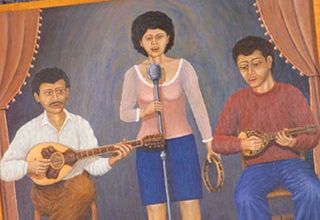
Apodimi Compania use guitar as the rhythmic basis of the song with baglama, a small half-size bouzouki, providing a rhythmic counterpoint. The melody behind the voice – and filling-in between verses – is played on a tzouras, a smaller bouzouki-style instrument. Worry beads tapped on the side of a glass are used as percussion.
Rebetika Songs synopsis
An album of Rebetika music, a style originating in Greece in the 1920s. Rebetika: Songs of Greece was recorded in 1986 by a group of young Greek-Australians who, in the late 1970s in Melbourne, began to immerse themselves in Rebetika music and culture.
Curator’s notes
Apodimi Compania (Band of Friends) was formed by a group of students of Greek heritage studying under Greek scholar and musicologist Stathis Gauntlet at Melbourne University in the early 1980s. The band – brothers George Galiatsos and Manuel Galiatsos, Nick Vergopoulos, Jim Dimitriou and Tom Dimitriou – immersed themselves in old recordings of Rebetika music. They started to perform around the inner-northern suburbs of Melbourne, which were – and still are – home to many people of Greek descent.
Rebetika (sometimes spelt Rembetika) music evolved in Athens and Piraeus in the 1920s, combining jail songs and hashish-smoking songs of the Greek underworld with music brought to Greece by refugees from the Greek-Turkish War of 1919–22. These refugees were ethnic Greeks who had lived in Anatolia for generations but were forcibly relocated to Greece during and after the war. They brought with them music of a distinctly Eastern feel as well as instruments popular in Turkish music.
The refugees lived on the fringes of Greek society in the 1920s and Rebetika music became the music of this urban underclass around the same time and in the same way as the Blues became the music of African-Americans. It was sad music, reflecting the hard life of the people who sang it, and described by author Gail Holst as ‘music of love, sorrow and hashish’. It was music played in coffee shops and cafes where hashish was smoked, and many of the early Rebetika songs are about using cannabis as an escape from the miseries of everyday existence.
The bouzouki, a modern version of an ancient Greek stringed instrument, was adopted as the main melodic instrument of Rebetika in the late 1920s and early ’30s, and has been identified with the music ever since. By the 1940s the music became the urban popular music of the day, when a lot of recordings were made.
By the 1950s, however, Rebetika had become Laika, a pop music utilising bouzoukis, often electrified, and interest in the older style faded. It wasn’t until the late 1970s that a younger generation began to rediscover the music and compilation LPs began to appear of old 78 recordings by the great performers of the 1930s and ’40s.
Apodimi Compania became part of this revival and Rebetika: Songs of Greece was their first album. They have been touring and recording ever since and currently reside in Greece, where they enjoy ongoing success.
The Brunswick Music Festival was set up and run by the then Brunswick Council and Brunswick Records to produce recordings by Brunswick residents. Rebetika: Songs of Greece was the third Brunswick Records LP and was produced with funding from the Myer Foundation.
Notes by Graham McDonald
Need to license this item? A/V professionals and researchers can shortlist licensing enquiries via our NFSA Pro catalogue search and membership.
Collections to explore

Greece


Sounds of Australia



1980s
Start your own collection
A free Your Stuff account allows you to save, organise and share your favourite videos, audio and stories.


