A Pub With No Beer by Slim Dusty
1957
A Pub With No Beer by Slim Dusty
1957
- NFSA IDVCQTRZTA
- TypeMusic and Sound Recordings
- MediumAudio
- FormMusic
- GenresCountry music, Popular music
- Year1957
This is the first verse of the original 1957 recording of ‘A Pub With No Beer’ sung by Slim Dusty. The song was composed by Gordon Parsons, with lyrics inspired by Dan Sheahan’s poem.
This is the first verse of the original 1957 recording of ‘A Pub With No Beer’ sung by Slim Dusty. The song was composed by Gordon Parsons, with lyrics inspired by Dan Sheahan’s poem.
- NFSA IDVCQTRZTA
- TypeMusic and Sound Recordings
- MediumAudio
- FormMusic
- GenresCountry music, Popular music
- Year1957
- PerformerSlim Dusty
This recording, made on 1 April 1957, is said to have been completed in one take. It was made at EMI’s studio in Castlereagh Street, Sydney, with Slim playing his new Gibson Sunburst guitar (which Joy Kirkpatrick still has, as of 2010). Reg Robinson, with whom Slim would often record, played the bass guitar.
Slim Dusty was by this time a seasoned performer, both in the studio and on the road. His voice is beautifully strong and clear, and so distinctively Australian as to be unmistakeable. For both Tex Morton and Buddy Williams, the artistic roots of their music were North American and it took time for their Australian voices to mature. Slim Dusty had listened to both men and to the American country artists they listened to – principally Jimmy Rogers and the Canadian Wilf Carter – but his home-grown sound is much more obvious in this recording.
This first verse introduces the poem’s story and sets up the humour of the song. Being away from kin, surrounded by wild dingoes at night, is bad enough but it doesn’t even compare to the nonsensical idea of a pub without beer! Clearly, the humour is part of the song’s appeal and that was universal, whether people were listening in Belgium or London or Nashville. Nor did specifically Australian touches, like references to 'dingoes’, put off overseas listeners. The Australian sound might also have been part of the appeal, both at home in Australia and overseas. Rolf Harris was yet to make it big in Britain and there were few Australian records getting a release anywhere outside Australia.
‘A Pub With No Beer’ changed all that, as well as the culture of the recording and radio businesses in Australia. ‘Hick’ and ‘hillbilly’ music could not be ignored quite so easily after this. The song certainly changed life for Slim Dusty, setting up the extraordinary career that would continue until his death in 2003, aged 76.
A Pub With No Beer synopsis
Slim Dusty’s original recording of the Gordon Parsons song about a hotel that has run out of beer, based on a poem by Dan Sheahan.
Curator's notes
Success has many fathers, as the saying goes, but few successes have had so many claims to paternity as Slim Dusty’s most famous song.
The facts, more or less, are that an Irish-born cane farmer named Dan Sheahan came to the Day Dawn Hotel in Ingham, north Queensland, one day in late 1943, but the pub had run out of beer. American servicemen, either stationed nearby or passing through to Cairns, had drunk the place dry (of beer) the previous night. According to one account, Sheahan sat in a corner with a warm glass of wine and penned a poem, ‘A Pub Without Beer’. It was published in the widely-read North Queensland Register early in 1944. It had six-line verses – unlike the song, which is based on four-line verses.
Slim Dusty was about 17 at the time and already embarked on a country music career. He was born David Gordon Kirkpatrick, but had been calling himself Slim Dusty since 1938, aged 11, when he had already decided what he was going to be. He grew up on a dairy farm at Nulla Nulla Creek, near Kempsey, and was living there at the war’s end in 1945.
Gordon Parsons, one year older, shared a similar background, having grown up on a dairy farm at Mt Kalang, between Bellingen and Dorrigo about 100 kilometres further north. He started singing around the local area at about 15, moved to the city, got a recording contract and joined the travelling shows, as many aspiring country singers did. In 1956, he joined the Slim Dusty Show, which had begun touring in 1954.
Dusty had recorded his first songs during the war at his own expense, having failed to get a recording contract. He married singer and songwriter Joy McKean in 1951, and the couple struggled in this period to get noticed. They contemplated giving up music as a career, given that they now had children, but decided in 1953 to give it one more go. They formed the Slim Dusty Show with a couple of friends and relatives and took to the road. Slim would record 36 songs for EMI over the next four years, steadily building his popularity with almost constant touring.
Gordon Parsons came and went from the show through 1956 and ’57. Joy Kirkpatrick recalls that 'A Pub With No Beer’ was partially composed one night in western New South Wales, ‘somewhere near Forbes or Young’, when Parsons and Chad Morgan shared a bottle of whisky. Parsons had heard some verses about a pub with no beer, but had no idea who wrote them. Both Slim Dusty and his wife believed that Parsons probably picked them up in a timber getter’s camp, where men would often swap yarns and songs at night. ‘Gordon adapted it and he did so quite innocently,’ says Joy Kirkpatrick. ‘He was not the type to rip anybody off.’ No-one noticed until many years later that the tune is almost identical to ‘Beautiful Dreamer’, composed by the American Stephen Foster, in about 1865.
Parsons began to sing his new song during shows. According to Slim Dusty, he asked Gordon if he was going to record the song. When he said no, Dusty asked if he could have it for the B-side of another song he was about to record. The tracks were laid down at EMI’s Castlereagh Street studio in Sydney on 1 April 1957 and issued soon after. Reg Robinson, a regular recording partner, played the bass guitar, while Slim accompanied himself on a Gibson Sunburst guitar.
He resumed touring and was unaware for some months that the song was taking off, at first in Brisbane and then in Sydney. Dusty had never cracked city radio, nor expected to. Those stations largely ignored country music, or played it at 6 am or midnight. Each station compiled its own charts and they ignored so called ‘hick’ or ‘hillbilly’ music. Even after the song had sold 50,000 copies, it did not appear on many station charts in the cities.
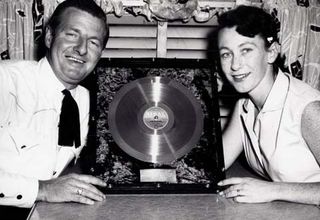
The song’s success changed all that. Once it began to sell, it didn’t stop for several years. It became the only 78 rpm gold record in Australia, and the first gold record by an Australian artist. It reached number 3 in Britain in January 1959, number one in Ireland and was popular in Canada, the US and Europe. From 1957 to 1979, according to music historian Glenn A Baker, it reigned as the most successful Australian-produced single – not just in country, but all genres.
Gordon Parsons remained on good terms with Slim Dusty. They often sang the song together on stage, but there was controversy about the song’s origins. Parsons maintained that he did not know the authorship of the original poem, which he rewrote. Dan Sheahan’s family eventually met Slim Dusty when he passed through Ingham, and showed him the original poem. Dan Sheahan and Slim Dusty became friends, and Slim Dusty was happy to acknowledge Sheahan’s part in the song’s origins. In his autobiography, Walk a Country Mile (1981), Dusty reprinted the poem and the song lyrics. Joy Kirkpatrick says that the Sheahan family never received any royalties.
Parsons maintained that his lyrics were about the pub at Taylor’s Arm, near his boyhood home. Two pubs now claim to be the ‘pub with no beer’ – the one at Taylor’s Arm and Lee’s Hotel in Ingham, which occupies the site where the Day Dawn once stood. It was demolished and rebuilt after a fire. The song has been recorded many times, both by Slim Dusty and other artists, including Johnny Cash, The Dubliners and Midnight Oil.
Recorded at EMI’s Castlereagh Street studio in Sydney on 1 April 1957 and released soon after. It spent more than half of 1958 in the Australian Top 40 chart, including one week at number one on 7 September 1958.
Summary and Notes by Paul Byrnes
Need to license this item? A/V professionals and researchers can shortlist licensing enquiries via our NFSA Pro catalogue search and membership.
Collections to explore

1950s


Sounds of Australia
Slim Dusty
Start your own collection
A free Your Stuff account allows you to save, organise and share your favourite videos, audio and stories.


