Power to Win
1942
Power to Win
1942
- NFSA ID7YQVCCWA
- TypeFilm
- MediumMoving Image
- FormShort
- GenresPropaganda, Armed Forces (includes War and Military)
- Year1942
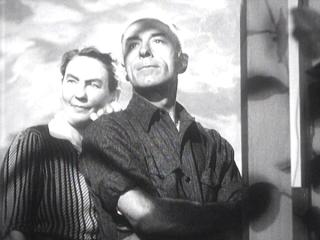
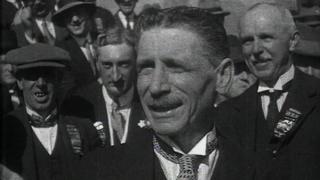
In this dramatised sequence, a mining family hears on the wireless that Singapore has fallen to the Japanese. Husband (Marshall Crosby) and wife (Beryl Bryant) look outside despairingly on an inactive coal mine. Industry stakeholders meet with a representative from the Miners Federation to discuss the need to increase coal production for the war effort. At the pit tops, a mine organiser gives a motivational speech to his workers saying that it is a 'struggle for survival’. Over breakfast, the wife goes to deliver wool and father and daughter (Dorothy Dickson) have a candid talk. The daughter proudly says that she’ll marry a miner and stay where she is because 'big things’ are happening and 'coal is the essence of all power’, a power which will allow them to win the war. Summary by Poppy De Souza.
In this dramatised sequence, a mining family hears on the wireless that Singapore has fallen to the Japanese. Husband (Marshall Crosby) and wife (Beryl Bryant) look outside despairingly on an inactive coal mine. Industry stakeholders meet with a representative from the Miners Federation to discuss the need to increase coal production for the war effort. At the pit tops, a mine organiser gives a motivational speech to his workers saying that it is a 'struggle for survival’. Over breakfast, the wife goes to deliver wool and father and daughter (Dorothy Dickson) have a candid talk. The daughter proudly says that she’ll marry a miner and stay where she is because 'big things’ are happening and 'coal is the essence of all power’, a power which will allow them to win the war. Summary by Poppy De Souza.
- NFSA ID7YQVCCWA
- TypeFilm
- MediumMoving Image
- FormShort
- GenresPropaganda, Armed Forces (includes War and Military)
- Year1942
- Production companyDepartment of InformationDirectorCharles ChauvelScriptwriterCharles Chauvel
This clip follows on immediately from the opening sequence which sets up the urgency of the situation and the harsh reality of war. From newsreel footage of combat in Europe, Chauvel brings the scale back to the domestic front. Chauvel wanted to humanise the miners as well as to motivate them to continue coal production for the war. The miners are positioned as fighters for a cause and men to be proud of (reinforced by the daughter’s dream of marrying a miner rather than a white-collar worker, despite her education). The mining organiser’s inspirational speech is another example of how Chauvel’s script emphasises the miners’ essential role in maintaining the war machine.
Power to Win synopsis
This is a short wartime documentary directed by Charles Chauvel. It emphasises the contribution of Australia’s coal mining industry to fighting the war in Europe. It includes historical wartime footage, dramatised scenes and documentary segments, with a persuasive commentary by Lou Vernon.
Power to Win curator's notes
Made in mid-1942, Power to Win was the second of four documentaries produced for the Commonwealth Department of Information by Charles and Elsa Chauvel. When he commenced work, Charles Chauvel wrote to the DOI outlining his support for their 'hard–hitting’ film propaganda campaign. Having been determined medically unfit for the army, Chauvel saw this film work as his contribution to the war effort. He ceased feature film production after Forty Thousand Horsemen (1940) to work for the DOI and his next feature, The Rats of Tobruk (1944), builds on his wartime documentary work.
According to Elsa Chauvel, Power to Win was intended as a 'morale builder’ for the miners and, like the other Chauvel documentaries for the DOI, concentrates on the domestic front. During the Second World War, coal shortages were exacerbated by industrial disputes within the mining industry. As coal was needed for gas and steel production, as well as electricity generation, productive coal pits were vital to supplying the war machine with power. Power to Win drives home to the mining industry that the coal pits are the source of the nation’s power in the battle against the enemy.
The opening sequence of graphic newsreel footage of the war in Europe establishes the context and urgency of the situation. Lou Vernon’s emotive narration (written by Chauvel) asks, 'Can we wage a war to equal this?’. A scripted scenario involving a mining family precedes a dramatised meeting between members of the Miners’ Federation and other industry stakeholders. The meeting adopts the slogan 'coal and more coal’ and the miners set to work. The final sequences of workers underground sweating and toiling for the war effort are similar to those in Chauvel’s first film for the DOI, Soldiers without Uniform (c1941). The miners are presented as trying to win the fight as much as their mates in the trenches overseas and Power to Win reminds them that their efforts are not in vain.
Notes by Poppy De Souza
Need to license this item? A/V professionals and researchers can shortlist licensing enquiries via our NFSA Pro catalogue search and membership.
Collections to explore

Mining, oil and gas industry

World War 2


Strikes, walkouts and labour disputes
Start your own collection
A free Your Stuff account allows you to save, organise and share your favourite videos, audio and stories.


