Picnic At Hanging Rock: The lost ending – Mrs Appleyard ascends the Rock
1975
Picnic At Hanging Rock: The lost ending – Mrs Appleyard ascends the Rock
1975
- NFSA ID8ACSE428
- TypeFilm
- MediumMoving Image
- FormFeature Film
- GenresDrama
- Year1975
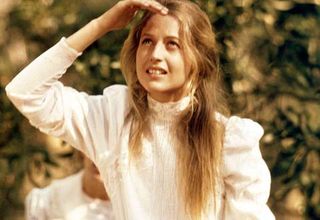
When Peter Weir was filming his 1975 masterwork Picnic at Hanging Rock, the artist Martin Sharp played an important role on the set as artistic adviser. After the shoot, he kept a collection of 35mm trims and outtakes, not included in either the original 1975 edit or the 1988 director’s cut, which he later donated to the National Film and Sound Archive. Soundless, fragmentary, the outtakes act as a dream-like augmentation to the hypnotic beauty of Weir’s film, and give insights into the processes and preoccupations of the filmmakers.
In these outtakes, we see fragments of an alternative ending. In the finished film, Weir ends with a close-up of Mrs Appleyard’s face, and we learn in a voice-over of her death at Hanging Rock. In this clip, we see her stumbling up the Rock.
Her ascent is the dark counterpart of the schoolgirls’ climb. Dishevelled by her struggle through the undergrowth, she is smothered by her dark clothes where they moved lightly in their white muslins, and she moves against grey cloud rather than idyllic golden light. But like them, she circles the boulder; like them, she falls into a mysterious sleep. Sarah, whom she had cruelly oppressed before the girl fell to her death from the roof of Appleyard Hall, is waiting in white at the top of the Rock.
Despite the power in this final confrontation on the Rock, Weir stands by his decision to cut it. ‘I can see in my mind that final close-up of the headmistress, and recall the feeling I had in the cutting room 50 years ago: “This is the ending of the film.” So much conveyed by Rachel Roberts; so much meaning in that shot. With all the advances in technique over the decades, the close-up remains the greatest single discovery, especially to see the eyes of the subject on a large screen – “the windows to the soul”.’
In our interview with Peter Weir, the director remembers the ‘strange, beautiful and haunting’ world of the film, and talks about how he shaped it.
With special thanks to Peter and Ingrid Weir.
When Peter Weir was filming his 1975 masterwork Picnic at Hanging Rock, the artist Martin Sharp played an important role on the set as artistic adviser. After the shoot, he kept a collection of 35mm trims and outtakes, not included in either the original 1975 edit or the 1988 director’s cut, which he later donated to the National Film and Sound Archive. Soundless, fragmentary, the outtakes act as a dream-like augmentation to the hypnotic beauty of Weir’s film, and give insights into the processes and preoccupations of the filmmakers.
In these outtakes, we see fragments of an alternative ending. In the finished film, Weir ends with a close-up of Mrs Appleyard’s face, and we learn in a voice-over of her death at Hanging Rock. In this clip, we see her stumbling up the Rock.
Her ascent is the dark counterpart of the schoolgirls’ climb. Dishevelled by her struggle through the undergrowth, she is smothered by her dark clothes where they moved lightly in their white muslins, and she moves against grey cloud rather than idyllic golden light. But like them, she circles the boulder; like them, she falls into a mysterious sleep. Sarah, whom she had cruelly oppressed before the girl fell to her death from the roof of Appleyard Hall, is waiting in white at the top of the Rock.
Despite the power in this final confrontation on the Rock, Weir stands by his decision to cut it. ‘I can see in my mind that final close-up of the headmistress, and recall the feeling I had in the cutting room 50 years ago: “This is the ending of the film.” So much conveyed by Rachel Roberts; so much meaning in that shot. With all the advances in technique over the decades, the close-up remains the greatest single discovery, especially to see the eyes of the subject on a large screen – “the windows to the soul”.’
In our interview with Peter Weir, the director remembers the ‘strange, beautiful and haunting’ world of the film, and talks about how he shaped it.
With special thanks to Peter and Ingrid Weir.
- NFSA ID8ACSE428
- TypeFilm
- MediumMoving Image
- FormFeature Film
- GenresDrama
- Year1975
Need to license this item? A/V professionals and researchers can shortlist licensing enquiries via our NFSA Pro catalogue search and membership.
Collections to explore
Picnic at Hanging Rock
The Power of the Dog
Turkey Shoot
Start your own collection
A free Your Stuff account allows you to save, organise and share your favourite videos, audio and stories.


