Painting Country: Kiwirrkurra
2000
Painting Country: Kiwirrkurra
2000
- NFSA IDP0532RQG
- TypeTelevision
- MediumMoving Image
- FormDocumentary
- Duration52 mins, 14 secs
- GenresIndigenous themes or stories, Indigenous as subject
- Year2000
- WARNING: Aboriginal and Torres Strait Islander viewers are advised that the following program may contain images and/or audio of deceased persons
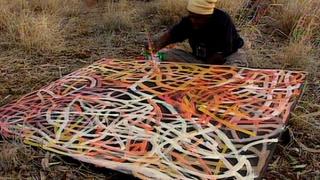
Aboriginal artists Brandy Tjungurrayi and Charlie Wallabi paint their country. Summary by Damien Parer.
- WARNING: Aboriginal and Torres Strait Islander viewers are advised that the following program may contain images and/or audio of deceased persons
Aboriginal artists Brandy Tjungurrayi and Charlie Wallabi paint their country. Summary by Damien Parer.
- NFSA IDP0532RQG
- TypeTelevision
- MediumMoving Image
- FormDocumentary
- Duration52 mins, 14 secs
- GenresIndigenous themes or stories, Indigenous as subject
- Year2000
- Production companyElectric Pictures, Robin Eastwood ProductionsProducerAndrew Ogilvie, Robin EastwoodExecutive ProducerAndrew Ogilvie (Electric Pictures)Executive ProducerEtsuzo Yamazaki (NHK)Executive ProducerRobin Eastwood (Robin Eastwood Productions)DirectorSally IngletonWriterSally IngletonComposerChris NormanCommissioning editorJohn Hughes (SBSi)AcknowledgementsProduced in association with SBS Independent and NHK. Produced with the assistance of Screenwest and the Film Financing Corporation Australia
Painting Country is an engaging work, offering accessible explanations of Aboriginal art. The painters are among the most respected artists in Australia and their gentle wisdom and dignity makes the viewing experience so much richer.
Painting Country Synopsis
Balgo is a centre for Aboriginal painters in the remote north of Western Australia. The artists originally come from hundreds of kilometres around the area. They decide to go on a painting trip to their home lands after many years away. Painting Country follows the off-road vehicles on their journey as the artists recall their country and meet relations.
Notes by Damien Parer
Additional Curator's Notes
The strength of this documentary is that it allows the audience to access the ancient philosophy framing these Indigenous artists’ works. It allows us to see that the Indigenous artists involved in this documentary are reliving and recording lived experience, knowledge and wisdom accumulated through their lifetime, and the lives of those who came before. It does this through showing us the connection with land, the responsibility of custodianship over territory and the clear understanding of boundaries in relation to land as understood and agreed upon by each artist.
The artists are able to recall landmarks with incredible accuracy and clarity, and for the audience there is a momentary glimpse into an Indigenous perspective of the land. Suddenly, land that may be seen by an outsider as rather obsolete and without familiar symbols, comes alive, and the way the artists inhabit the land as a Westerner would a house, becomes the primary focus of the film. The joy of the elders being returned to country, or the recounting of past food gathering expeditions is the essence of the art itself, and we begin to see that it is the artist’s life and cultural inheritance of wisdom and knowledge that is the basis of such beautiful works. Though the works of art may appear simple in design and composition, they are in fact gateways into another philosophical tradition and world view.
This film provides a good example of the non-linear notion of time as understood by Indigenous peoples. For example, the personal life stories of the individual artists overlap with the Dreaming stories of the Ancestors and these are re-created within the art. The idea of past and future are imbued within the present, and all narratives – past and future – are woven together through the relationship to land as represented in the artwork.
Additional notes by Romaine Moreton
Education Notes
This clip shows Indigenous Australian artists from the Warlayirti Art Centre at Balgo arriving at Kiwirrkurra, a remote community in central Western Australia, on a journey back to country. The group is shown meeting up with artists Brandy Tjungurrayi and Charlie Wallabi, who will join them on the next leg of the journey. It concludes with artist Tjumpo Tjapanangka inside one of the houses at Kiwirrkurra.
Educational value points
- For many of the Balgo artists, who live hundreds of kilometres from their country, painting is a way of maintaining a link with country. While Balgo is more than 400 km from Kiwirrkurra, strong familial ties ensure that firm links are maintained between the two communities. The Balgo artists are renowned for their vivid use of colour, strong iconic images and bold compositions, and tend to use acrylic paint on canvas – a Western medium adopted by many Indigenous Australian artists in the 1970s.
- In the clip Brandy Tjungurrayi indicates that he can ‘talk for’ the land that the Balgo artists are travelling to. Elders such as Brandy Tjungurrayi and Charlie Wallabi have a significant responsibility to continue to pass on knowledge, language and cultural practices and to protect country. Elders from particular country are permitted to ‘talk for’ or depict their country and culture in their artworks.
- Brandy Tjungurrayi was born in the bush about 1930 and paints stories connected to his country around Nyilla (Jupiter Well). He started painting at Balgo in 1985. He also lives at Kiwirrkurra with many of his relatives. His paintings are elegant linear compositions comprising fine dots that run together to create lines. In 2000 Tjungurrayi had his first solo exhibition and participated in the Kiwirrkurra Men’s Painting, which was exhibited at the Papunya Tula retrospective at the Art Gallery of New South Wales.
- Charlie Wallabi Tjungurrayi is a well-known Pintupi artist whose early years in the bush influence his work. He was born in the late 1930s or early 1940s near Nyilla in Western Australia like his elder brother, Helicopter Tjungarrayi, another major Balgo artist referred to in the clip. Charlie Wallabi has been exhibiting his artwork for more than ten years. He and his wife, the artist Josephine Nangala, come from the Western Desert community of Kiwirrkurra.
- Tjumpo Tjapanangka (1920s–2007) is shown in this clip as a senior artist and Elder with important ceremonial responsibilities who continues to value his childhood and youth spent in the bush. He was born in the late 1920s or early 1930s. He began painting in 1986 and his art varies from very large to smaller paintings with a focus on subjects connected to water and to Dreaming. He continued to eat bush foods into old age and was a marpan (healer). He died in 2007.
- The Kiwirrkurra community, situated in the Gibson Desert of central WA, is one of the most remote Indigenous communities in Australia, and has a population of about 200 people. It was established in 1982 by Pintupi people – who from the 1940s were moved off their land in the Western Desert – so they could live close to their country. In 2001 the people at Kiwirrkurra were granted native title over the land and waters of approximately 42,000 sq km of the Gibson Desert.
Education notes provided by The Learning Federation and Education Services Australia
Need to license this item? A/V professionals and researchers can shortlist licensing enquiries via our NFSA Pro catalogue search and membership.
Collections to explore
Painting

Archibald Prize
Sculpture
Start your own collection
A free Your Stuff account allows you to save, organise and share your favourite videos, audio and stories.


