Orphan of the Wilderness: Joey in pants
1936
Orphan of the Wilderness: Joey in pants
1936
- NFSA IDD34Q26CJ
- TypeFilm
- MediumMoving Image
- FormFeature Film
- GenresAdventure, Drama
- Year1936
Hunters have killed Chut’s mother and scattered his mob. Desperate for food, Chut arrives at the Henton farm, where Mrs Henton (Ethel Saker) spots him at the gate. Tom Henton (Brian Abbot) fixes the frightened joey a new pouch, made from a pair of trousers, and introduces him to a new friend, a cattle dog pup called Mike. Chut and Mike grow up together. Summary by Paul Byrnes.
Hunters have killed Chut’s mother and scattered his mob. Desperate for food, Chut arrives at the Henton farm, where Mrs Henton (Ethel Saker) spots him at the gate. Tom Henton (Brian Abbot) fixes the frightened joey a new pouch, made from a pair of trousers, and introduces him to a new friend, a cattle dog pup called Mike. Chut and Mike grow up together. Summary by Paul Byrnes.
- NFSA IDD34Q26CJ
- TypeFilm
- MediumMoving Image
- FormFeature Film
- GenresAdventure, Drama
- Year1936
- Production companyCinesound ProductionsProducerKen G HallDirectorKen G HallWriterEdmond SewardFrom a story byDorothy CottrellMusicHamilton WebberAcknowledgementsCinesound-Movietone Productions owns all copyright which may subsist in this footage
Ken G Hall’s films were often a mixture of broad comedy and broad sentiment. This one has less of the former, more of the latter, but it’s hard to resist the charm of these baby animal scenes. Hall’s films were notable for the use of working class characters with strong Australian accents – but these characters have educated, upper class tones. They are the squattocracy, rather than poor farmers – perhaps to distinguish them from the ‘Dad and Dave’ kinds of characters then common in rural comedies, some of which were also made by Ken Hall.
Orphan of the Wilderness synopsis
When hunters kill his mother, a young kangaroo becomes a family pet at the farm of Tom Henton (Brian Abbott). Tom’s mother (Ethel Saker) names him Chut and rears him by hand. Tom teaches the animal to box, then gives him to a circus animal trainer, Shorty McGee (Harry Abdy). Tom’s sweetheart Margot (Gwen Munro), who works for McGee, assures him that the animal won’t be harmed – but McGee has a vicious side. When Chut injures the trainer and escapes, Tom and his friends rush to save the frightened Chut.
Orphan of the Wilderness curator's notes
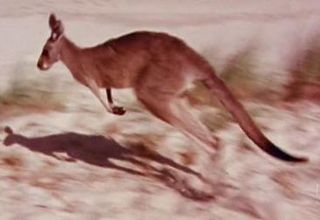
Orphan of the Wilderness was originally conceived as a B-picture, the second half of the program, but its release was beefed up when the distributor saw its Christmas appeal. It was one of the first features to use Australian wildlife as its prime attraction, and it was popular. Chut became the most famous kangaroo in Australia until Skippy came along in a television series in the 1960s. The film was a school holiday favourite for many years, but it has not worn well. The repeated sequences of the hapless Chut having to box in a ring are difficult to watch – and indeed, there was some opposition to these sequences at the time. The film was banned in England for alleged cruelty to animals, even though the RSPCA in Australia had endorsed it. It doesn’t help to know that Chut was living a life somewhat like that depicted in the film. Harry Abdy, who plays the cruel McGee, had a boxing kangaroo act that he had toured in the USA and Australia for some time, and Chut was his animal.
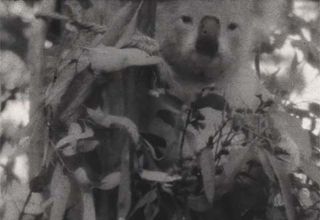
The most remarkable feature of the film is the opening sequence, where we see a mob of kangaroos living in an idyllic forest, with koalas and emus and dingoes. The forest was created from scratch in the Cinesound studio in Bondi by art director J Alan Kenyon. The kangaroos actually look like they’ve been there some time, and the studio setting allowed cameraman George Heath to capture some beautiful close-ups of the animals.
The graphic symbol of a boxing kangaroo became popular as ‘nose-art’ on aircraft flown by Australian airmen in the Second World War, and continues to be painted on RAAF aircraft. It was also the mascot for the Australian sailors who won the America’s Cup yacht race in 1983. Contests between men and kangaroos were a frequent ‘attraction’ in travelling tent shows in Australia in the 19th century.
Notes by Paul Byrnes
Need to license this item? A/V professionals and researchers can shortlist licensing enquiries via our NFSA Pro catalogue search and membership.
Collections to explore

Kangaroos
Wildlife conservation
Cats
Start your own collection
A free Your Stuff account allows you to save, organise and share your favourite videos, audio and stories.


