Melbourne Cup 1896: Melbourne Cup race
1896
Melbourne Cup 1896: Melbourne Cup race
1896
- NFSA ID6DVAWHQS
- TypeFilm
- MediumMoving Image
- FormActuality
- GenresSilent film
- Year1896
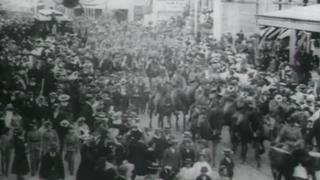
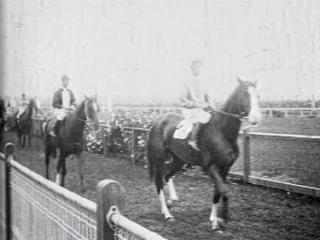
This clip shows the end of the 1896 Melbourne Cup horse race through the onlooking crowd. Newhaven wins.
Summary by Elizabeth Taggart-Speers
This clip shows the end of the 1896 Melbourne Cup horse race through the onlooking crowd. Newhaven wins.
Summary by Elizabeth Taggart-Speers
- NFSA ID6DVAWHQS
- TypeFilm
- MediumMoving Image
- FormActuality
- GenresSilent film
- Year1896
- ProducerHenry Walter BarnettFilmmakerMarius Sestier
Never short of a good idea to entertain his audiences, Walter Barnett, the producer of this film, encourages the crowd to wave their hats as the horses come down the straight to the finish line.
The camera remains static and with this the 1896 Melbourne Cup is recorded in history.
Melbourne Cup 1896 synopsis
This film documents the 1896 Melbourne Cup horse race including footage of the crowd watching the race.
Melbourne Cup 1896 Curator's notes
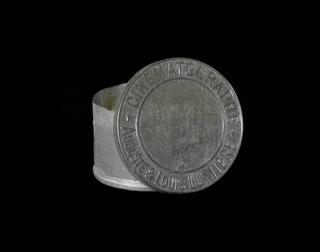
Marius Sestier shot this film using a Lumiere Cinématographe that he balanced on a tripod to ensure the camera remained steady.
This film is one of the earliest Australian films to tell a story by presenting the footage in chronological order. The Bulletin (28 November 1896) commented how 'beautifully appropriate’ it was 'that the first Australian picture presented by the new machine should be a horse race’.
Melbourne Cup 1896 was screened not only in Australia, but also in London, St Petersburg and Paris soon after the first French cinema was opened that same year. It was believed to be Australia’s earliest surviving film until the discovery of Patineur Grotesque (1896), which Sestier shot only a few days prior to the Melbourne Cup.
Throughout the film you can see Walter Barnett, the producer of the film, encouraging action and movement by directing the crowd to wave their hats. Although this film is recorded as actuality footage, this manipulation of the action not only indicates the general unfamiliarity people had with moving image but also puts a personal perspective onto Sestier’s story.
Notes by Elizabeth Taggart-Speers
Education notes
This silent, black-and-white clip shows a crowd of well-dressed men and women watching the final leg of the 1896 Melbourne Cup. As the horses approach the finish line, the producer, Walter Barnett, enters the frame, excitedly waving his hat and encouraging the crowd to do the same in an effort to create a sense of spectacle for the camera. Newhaven wins and the crowd disperses.
Educational value points
- This is a scene from one of Australia’s oldest surviving films. It was shot by Marius Sestier on a Lumière Cinématographe camera with a tripod to achieve a still frame, and was produced by Australian society photographer Walter Barnett. This clip is one of about ten films to record the event. The revolutionary Cinématographe, a camera, projector and printer combined, was invented by film pioneers, Auguste and Louis Lumière in 1895. Sestier’s Melbourne Cup films were later sent to France for distribution and it was not until 1969 that the six surviving films were returned to Australia by the Cinématèque Française.
- The clip presents a valuable historical record of one of Australia’s most famous sporting events. The Melbourne Cup began in 1861 and has been run every year since. The race was so popular that in 1866 the day was declared a public holiday for all Victorians. Held in Flemington, Melbourne, on the first Tuesday of November, the 3,200-m race is referred to in Australia as 'the race that stops the nation’. It is also recognised as one of the world’s greatest handicap races and one of the richest.
- The spectators are shown wearing typical late-19th-century English fashion. Most of the women wear long, full-skirted dresses with fitted bodices and large leg-of-mutton sleeves, which made a focal point of the shoulders, giving an illusion of a smaller waistline. The popularity of large, decorated hats and the use of parasols are also apparent. The men’s attire is more conservative and relaxed, with most men wearing jackets and waistcoats, some with bowties and boater hats, and others wearing top hats.
- The clip is taken from an example of an early 'actuality’ film. Filmmakers of the time saw the Cinématographe camera as a scientific instrument to be used to record actuality, or real life and events, without intervention or manipulation. Despite Walter Barnett’s enthusiastic manipulation of the crowd during the filming, and later, Sestier’s care in developing a sense of story by structuring the short cup scenes into chronological order and screening them as an integrated program, the footage, as a record of the 1896 Melbourne Cup, is recorded as 'actuality’.
Education notes provided by The Learning Federation and Education Services Australia
Need to license this item? A/V professionals and researchers can shortlist licensing enquiries via our NFSA Pro catalogue search and membership.
Collections to explore
-magic-lantern-432098.jpg?rect=1,0,1999,2667&w=320&h=427&auto=format)
1890s

Melbourne Cup Horse Race
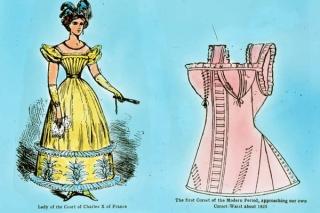
Fashion Design
Start your own collection
A free Your Stuff account allows you to save, organise and share your favourite videos, audio and stories.

-magic-lantern-432098.jpg?w=1920&h=2560&auto=format)


