Lovers and Luggers: Thursday Island cross-dressing
1937
Lovers and Luggers: Thursday Island cross-dressing
1937
- NFSA IDQSHYB9FZ
- TypeFilm
- MediumMoving Image
- FormFeature Film
- GenresRomance, Adventure, Comedy
- Year1937
Soon after arriving on Thursday Island, Daubenny (Lloyd Hughes) pays Mendoza (Ronald Whelan) 1,000 pounds for his boat and his house on the island. While the crowd follows Mendoza to the nearest hotel to knock down his cheque, Daubenny meets his new ‘diver’s handler’, Kishimuni (Charlie Chan) who sails aboard the ‘Dugong’. He also meets a mysterious woman who dresses in men’s clothes. Lorna Quidley (Shirley Ann Richards) joins him on the top step for an introduction. Summary by Paul Byrnes.
Soon after arriving on Thursday Island, Daubenny (Lloyd Hughes) pays Mendoza (Ronald Whelan) 1,000 pounds for his boat and his house on the island. While the crowd follows Mendoza to the nearest hotel to knock down his cheque, Daubenny meets his new ‘diver’s handler’, Kishimuni (Charlie Chan) who sails aboard the ‘Dugong’. He also meets a mysterious woman who dresses in men’s clothes. Lorna Quidley (Shirley Ann Richards) joins him on the top step for an introduction. Summary by Paul Byrnes.
- NFSA IDQSHYB9FZ
- TypeFilm
- MediumMoving Image
- FormFeature Film
- GenresRomance, Adventure, Comedy
- Year1937
- Production companyCinesound ProductionsProducerKen G HallDirectorKen G HallScreenplayFrank Harvey, Edmund BarclayMusicHamilton WebberAcknowledgementsCinesound-Movietone Productions owns all copyright which may subsist in this footage
The white suits are perhaps a movie exaggeration, although it was certainly a fashion in parts of the British Empire to wear white in the tropics, and to maintain a certain degree of formal attire, in order to show the natives the ‘superiority’ of British standards. Shirley Ann Richards in the men’s attire is certainly a nod towards a fashion in Hollywood in the early 1930s for androgyny. Stars such as Greta Garbo, Marlene Dietrich and Katharine Hepburn had all challenged the image of women by appearing in public – and in their films – in men’s clothes. The lesbian overtones do not appear to be a part of the meaning in this scene, however, which is intended to set up the basis for a romance between Lorna and Daubenny.
Lovers and Luggers synopsis
Tired of his life as one of the world’s greatest concert pianists, Daubenny Carshott (Lloyd Hughes) sails for Thursday Island in the Torres Strait, to become a pearl diver. London society beauty Stella Raff (Elaine Hamill) has promised to marry him if he returns with a really big pearl. He buys a lugger and a house from the villainous Mendoza (Ronald Whelan), and befriends the beautiful Lorna Quidley (Shirley Ann Richards). Her father, an old sea dog called Captain Quidley (Sidney Wheeler) teaches him to dive, in between his frequent bouts of drinking. Daubenny is unaware that another diver calling himself Bill Craig (James Raglan) is actually a respected London artist who has also fallen under Stella Raff’s spell. On his first major diving trip, Daubenny finds a huge pearl, then loses it overboard when Mendoza attacks him. Bill Craig saves Daubenny’s life in an underwater accident, and the two men discover their connection with Stella Raff. When she arrives unannounced at Thursday Island, both men denounce her. Daubenny realises he’s in love with Lorna and they decide to marry.
Lovers and Luggers curator's notes
Lovers and Luggers is one of the most entertaining and technically advanced films of the Cinesound era. Its director, Ken G Hall, always regarded it as one of his best films, with good reason. He had been to Hollywood on a four-month study tour in 1935, during which he was able to observe some of the greatest directors of the era at work. One of these was John Ford, who was already regarded as a master craftsman, and there are definite influences in the way Hall directs Lovers and Luggers. The film is driven by masculine energy and it makes rambunctious fun out of the hard-drinking white settlers of Thursday Island. Captain Quidley, in particular, is a very Fordian character – a likeable scoundrel with a heart of gold and a million tricks. There are other possible influences too: a little of the exoticism of Josef von Sternberg and the sexual playfulness of Howard Hawks. Dressing Shirley Ann Richards in men’s clothing in one scene adds a little daring, in the style of Marlene Dietrich.
It’s one of Ken Hall’s most confident films, both technically (in the use of back projection – a technique he studied on the 1935 trip) and in his direction of the actors. The plot is typically packed with Hall’s cocktail of audience pleasers – action, romance, comedy and more action – but it’s also far more sophisticated than any of the films before 1935 in terms of script. There’s an unusual verbal playfulness, as though Hall was trying to make a kind of tropical screwball comedy in the style of Frank Capra’s It Happened One Night (1934) – a film he much admired. The comedy is also more urbane and witty than Cinesound’s earlier films – a sign of the company’s move away from the broad Australiana of films like Orphan of the Wilderness (1936) and Grandad Rudd (1935). Cinesound in 1937 was making a determined effort to become more international, importing American actors and writers to help convince the Australian audiences that they were seeing a film that was ‘as good as the Americans’, and to help with the foreign sales potential of their films. Lovers and Luggers was successful on both counts – it was one of the most profitable Cinesound films. It sold to the US and UK for what was claimed to be record prices.
Hall never set foot on Thursday Island. Frank Hurley was sent to capture backgrounds and actuality of the pearling industry, while Hall was still busy directing Tall Timbers, Cinesound’s first of three films in 1937. The underwater sequences were filmed in North Sydney Olympic pool, suitably dressed with fake rocks and coral, after attempts to film in a tank at the Cinesound studios failed because of Sydney’s murky drinking water. The film features actuality and back projection seamlessly melded with pool footage. The lighting style at the studio had changed, with the switch from Frank Hurley to George Heath as chief cameraman. The shot of Elaine Hamill on the couch at the beginning is pure Hollywood glamour – soft focus, seductively low light – the kind of shot that Hurley didn’t really like doing. This new kind of cinematography was further evidence of the internationalisation that had come to Cinesound, and of Ken Hall’s vastly greater confidence as a filmmaker.
Notes by Paul Byrnes
Need to license this item? A/V professionals and researchers can shortlist licensing enquiries via our NFSA Pro catalogue search and membership.
Collections to explore

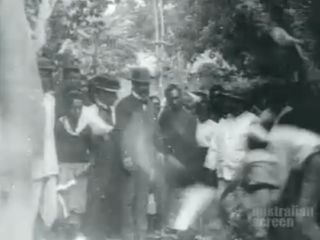

Torres Strait
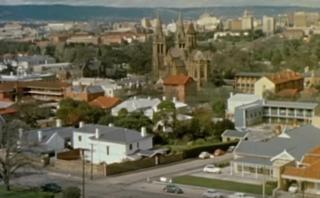

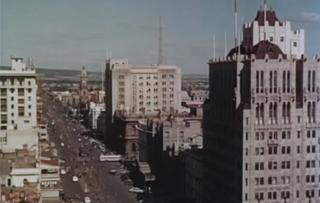
Adelaide

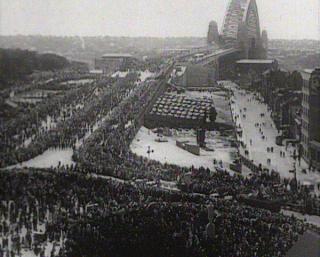
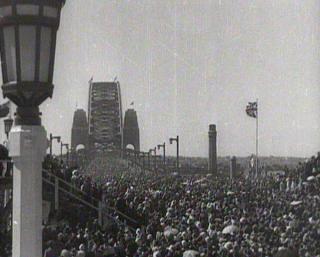
Sydney Harbour Bridge
Start your own collection
A free Your Stuff account allows you to save, organise and share your favourite videos, audio and stories.


