Jedda: Jedda dreaming again
1955
Jedda: Jedda dreaming again
1955
- NFSA IDTQR2Q4B3
- TypeFilm
- MediumMoving Image
- FormFeature Film
- Duration1 hr, 25 mins
- GenresIndigenous themes or stories
- Year1955
- WARNING: Aboriginal and Torres Strait Islander viewers are advised that the following program may contain images and/or audio of deceased persons
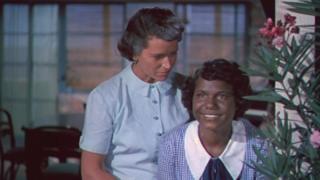
Jedda (Ngarla Kunoth), sitting by an open window, gazes out dreamily. Her adoptive mother (Betty Suttor), eventually comes to stand by her side. Jedda tells her of her desire to go walkabout, to be with the tribe. She is chastised by her adoptive mother, who warns her against the primitive ways of the Aborigines, calling them monkeys. Summary by Paul Byrnes.
- WARNING: Aboriginal and Torres Strait Islander viewers are advised that the following program may contain images and/or audio of deceased persons
Jedda (Ngarla Kunoth), sitting by an open window, gazes out dreamily. Her adoptive mother (Betty Suttor), eventually comes to stand by her side. Jedda tells her of her desire to go walkabout, to be with the tribe. She is chastised by her adoptive mother, who warns her against the primitive ways of the Aborigines, calling them monkeys. Summary by Paul Byrnes.
- NFSA IDTQR2Q4B3
- TypeFilm
- MediumMoving Image
- FormFeature Film
- Duration1 hr, 25 mins
- GenresIndigenous themes or stories
- Year1955
- Production companyCharles Chauvel ProductionsProducerCharles ChauvelDirectorCharles ChauvelScriptCharles Chauvel, Elsa ChauvelCastWason Byers, Margaret Dingle, Willie Farrar, Tas Fitzer, Ngarla Kunoth, Paul Reynall, George Simpson-Lyttle, Betty Suttor, Robert Tudawali
This clip starts approximately 24 minutes into the feature.
Jedda gazes dreamily out an open window. Her adoptive mother stands next to her.
Betty Suttor Dreaming again?
Jedda It’s time my people came back from their walkabout. You know Betty, sometimes I dream I’m out there with them. Maybe I will go one day, just for fun.
Betty Oh, Jedda, whatever would you do out in the bush with all those naked monkeys?
Jedda (laughs) Do what all the other monkeys do, I suppose.
Betty What nonsense! You’re no more like them than night is to day.
Jedda But I would like to go just once, to see.
Betty Stop talking rubbish, Jedda. The best walkabout for you is to come to Darwin with me again next year.
Jedda But Betty, they are my people. Minna says I should go walkabout and learn the customs of my tribe.
Betty Minna has no right to put ideas like that into your head. I have other plans for you, Jedda. I want you to go on living like a white girl, like my own daughter.
Jedda But Minna says they hunt the crocodiles, and spear the fishes, and climb the tree for the wild honey bird.
Betty Yes, and they eat grubs and goannas and all sorts of dreadful things.
Jedda Oh, Betty!
Betty Come on. It’s time for your music practice.Jedda is seated at a piano in a quiet living room. She begins playing a sprightly tune, then stops and begins a slow, mournful melody. Outside in the stables, we see two men talking.
Man Well, Joe, how’s my head stockman this morning?
Joe Hello, boss. It’s hot. Mrs McMahon tells me she’s coming to the buffalo camp this season.
Man That’s right — first time for years. She’s been so tied up with Jedda’s training, lessons and all that rubbish.
Joe Is Jedda coming too?
Man Oh yeah, she’s coming along.
Joe I want to have a talk to you about Jedda.
Man If you’re going to tell me that you’re in love with her and want to marry her, you don’t need to. I’ve seen it coming for years.
Joe Thanks for saving me all that, boss. How do you think Mrs McMahon will feel about it?
Man It will be the answer to her worries about Jedda’s future. Her one fear has been the girl might mate with one of the tribe. Now she’ll have you both in a neat little shack with frilly curtains. Perhaps all our problems will be solved.
Joe laughs. We see a shot of Jedda who continues to play piano. We cut back to the stables.
Man Looks like smoke over there. Tribe must be close home. When you finish here, take young Jedda and ride out to meet them. Get her away from that crazy piano playing.Jedda plays forcefully. As she looks at the Aboriginal painting on the wall, Aboriginal music becomes infused with the melody.
An Aboriginal woman dies in childbirth on a remote cattle station in the Northern Territory. The baby girl is raised by the station owner’s wife, Sarah McMann, after the death of her own child. Jedda (Margaret Dingle) grows up between cultures – forbidden from learning about her own, not fully accepted by the other. Her white mother Sarah (Betty Suttor) wants to 'civilise’ her. Sarah’s husband Doug (George Simpson-Lyttle) believes she will lose her 'pride of race’.
When Jedda is about 16 (now played by Ngarla Kunoth), she becomes fascinated by a tall stranger, Marbuck (Robert Tudawali), a tribal Aboriginal man who arrives from the bush, wanting work. When he abducts Jedda, setting fire to the camp, the head stockman Joe (Paul Reynall) sets off in pursuit. Joe, the son of an Afghan teamster and an Aboriginal woman, is in love with Jedda. He pursues them through crocodile-infested swamps and rugged mountains to Marbuck’s traditional lands, but Marbuck’s own clan has rejected him, for breaking their marriage rules. Jedda is from the wrong 'skin’ group. They sing his death song, but Marbuck defies them. As Joe catches up, Marbuck has become insane. He drags Jedda to a cliff top, determined to take her with him.
Notes by Paul Byrnes
Secondary Curator's notes
A landmark film in Australian cinema for many reasons, the idea for Jedda was suggested to Chauvel in Manhattan by a reporter for Time magazine. The idea that Chauvel should use Aboriginal people in a film was based on an observation by the reporter that Aboriginal people are unique to Australia and could not be found in Hollywood. The Chauvels searched Aboriginal communities for Aboriginal people who would act in Jedda. They eventually found Robert Tudawali (also known as Bob Wilson) for the role of Marbuck, and Rosalie Kunoth-Monks (also known as Ngarla Kunoth) to play Jedda. Tudawali would act in one more film, called Dust in the Sun, as well as programs for television. A film about his life was made in 1987, called simply Tudawali and starred Ernie Dingo. Indigenous filmmakers commemorate the career of Robert Tudawali, and have named an award after him. The Tudawali Awards are given out to Indigenous filmmakers who continue the filmmaking tradition of people like Robert Tudawali – the first Aboriginal star – and Rosalie Kunoth-Monks. Robert Tudawali moved to Wave Hill in 1965 as a stockman, and was a spokesman for the Gurindji Strike from 1966 – 67. See From Little Things Big Things Grow for more information on the Wave Hill walkout, and the Gurindji peoples’ fight for the return of their land.
Jedda was made during a time when race division was prominent in Australian society, and the narrative is informed by the idea of assimilation, and the forced removal of Aboriginal children from their families by the government in order to 'civilise’ Aboriginal peoples. At the premiere of the film, Aboriginal people were kept separate from white people, with only the two Aboriginal stars allowed to sit with the white folk. A plane carrying footage crashed, and many scenes were lost. As a consequence, the final scenes were filmed in the Blue Mountains, Sydney, with the cliffs painted red to replicate the country in the Northern Territory. Chauvel, one of the most influential filmmakers in Australian history, also made the TV series Australian Walkabout (1959), as well as feature films such as In the Wake of the Bounty (1
You can watch an interview with Rosalie Kunoth-Monks at Australian Biography.
Secondary notes by Romaine Moreton
Jedda synopsis
An Aboriginal woman dies in childbirth on a remote cattle station in the Northern Territory. The baby girl is raised by the station owner’s wife, Sarah McMann, after the death of her own child. Jedda (Margaret Dingle) grows up between cultures – forbidden from learning about her own, not fully accepted by the other. Her white mother Sarah (Betty Suttor) wants to 'civilise’ her. Sarah’s husband Doug (George Simpson-Lyttle) believes she will lose her 'pride of race’.
When Jedda is about 16 (now played by Ngarla Kunoth), she becomes fascinated by a tall stranger, Marbuck (Robert Tudawali), a tribal Aboriginal man who arrives from the bush, wanting work. When he abducts Jedda, setting fire to the camp, the head stockman Joe (Paul Reynall) sets off in pursuit. Joe, the son of an Afghan teamster and an Aboriginal woman, is in love with Jedda. He pursues them through crocodile-infested swamps and rugged mountains to Marbuck’s traditional lands, but Marbuck’s own clan has rejected him, for breaking their marriage rules. Jedda is from the wrong 'skin’ group. They sing his death song, but Marbuck defies them. As Joe catches up, Marbuck has become insane. He drags Jedda to a cliff top, determined to take her with him.
Need to license this item? A/V professionals and researchers can shortlist licensing enquiries via our NFSA Pro catalogue search and membership.
Collections to explore
Northern Territory
Feature film
Charles Chauvel
Start your own collection
A free Your Stuff account allows you to save, organise and share your favourite videos, audio and stories.


