First Surfboard
2004
First Surfboard
2004
- NFSA IDZXGVA26Y
- TypeTelevision
- MediumMoving Image
- FormShort, Documentary, Series
- GenresHistorical
- Year2004
Surfing may well be a quintessential Aussie pastime but who introduced us to the modern-day art of boardriding?
Warren Brown gets the lowdown from former world champion surfer Midget Farrelly. He tells the story of Duke Kahanamoku, a champion Hawaiian swimmer, who showed Australians how to ride a wave at Sydney’s Freshwater Beach in 1914, using a board he built himself from a lump of local timber.
Huge, heavy and completely finless, the first Australian surfboard has pride of place in the local surf club.
Investigating National Treasures with Warren Brown is also available for purchase from the NFSA Online Shop.
Surfing may well be a quintessential Aussie pastime but who introduced us to the modern-day art of boardriding?
Warren Brown gets the lowdown from former world champion surfer Midget Farrelly. He tells the story of Duke Kahanamoku, a champion Hawaiian swimmer, who showed Australians how to ride a wave at Sydney’s Freshwater Beach in 1914, using a board he built himself from a lump of local timber.
Huge, heavy and completely finless, the first Australian surfboard has pride of place in the local surf club.
Investigating National Treasures with Warren Brown is also available for purchase from the NFSA Online Shop.
- NFSA IDZXGVA26Y
- TypeTelevision
- MediumMoving Image
- FormShort, Documentary, Series
- GenresHistorical
- Year2004
WARREN BROWN:
If you were to pick a pastime that typified the image of the sun-bronzed Aussie, it's hard to go past surfing. But who introduced us to the modern-day art of board-riding? It's hard to believe it was a Duke. Well, when I say 'Duke', he wasn't a peer of the realm. Duke Kahanamoku was a Hawaiian and an Olympic swimming champion. He visited Australia many times to take part in exhibition races. It was on one of those trips that he left us this National Treasure. This board at Freshwater Surf Life Saving Club in Sydney is the one he used at Christmas 1914 to first show the Australians the sport of the Hawaiian Kings - 'he'e nalu' or what we now know as modern-day surfing¹.
Midget Farrelly is a former world champion surfer.
MIDGET FARRELLY:
The boards had come back from Honolulu because, you know, people in their travels on freighters had seen surfing. But I don't think that the total concept was understood, where you actually paddled the board out to sea, turned it around and then caught the wave of your choice.
WARREN BROWN:
This style of surfing might have been a revelation, but it sure as hell wasn't hi-tech. Everyone knows a modern surfboard is made of fibreglass with a foam core. This one has three fins, so it's easy to turn in the surf, but best of all, it's incredibly light. Can you hold this, Andy? Unlike this one. Now, this is the Duke's board. If you have a look at it, it's more than two point five metres long, it's made of timber, and if we turn it around, Trent, and have a look, it's got no fins on the back, so it must have been a dog of a thing to ride in the surf. But on top of that, it's incredibly heavy, and it weighs something in the order of 35-40 kilos, and I think I might just put it down.
So, Midget, tell us what happened on that afternoon on Christmas Eve, 1914.
MIDGET FARRELLY:
Keeping in mind I wasn't here. As I understand it, Kahanamoku's board came down the beach in the back of a horse-drawn car. The locals said to him, 'Look, we'll take you out in the surfboat and you can catch a wave from out the back'. They thought he was going to ride the wave lying down. He said, 'No, no, no, I'll paddle the board out'. He did that, and proceeded to catch waves here on the northern bank.
WARREN BROWN:
The board itself, like its manufacture, has a great story behind it. So how did that all come about?
MIDGET FARRELLY:
I think that the people who brought Kahanamoku out here knew that he could ride a surfboard, and they wanted to see one ridden. So he said, 'Hey, I can make one', and he did make his own boards with some sugar pine from the local timber yard. He made the board and then he rode it.
WARREN BROWN:
Sun, sand and surfing. It wouldn't be an Australian summer without those three ingredients, and although the surfing part of it was made possible by Duke Kahanamoku of Hawaii, it all began on a lump of local sugar pine which became a surfboard, and one of our genuine National Treasures.
¹ Correction: Duke Kahanamoku's exhibition of surfing took place on 15 January 1915.
Need to license this item? A/V professionals and researchers can shortlist licensing enquiries via our NFSA Pro catalogue search and membership.
Collections to explore
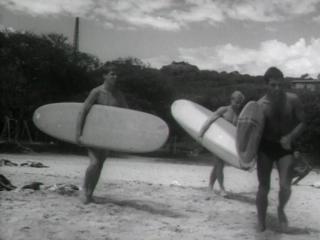
Surfing
Beaches

National Treasures
Start your own collection
A free Your Stuff account allows you to save, organise and share your favourite videos, audio and stories.


