Dreamtime, Machinetime: A marriage of cultures
1987
Dreamtime, Machinetime: A marriage of cultures
1987
- NFSA IDGD3SJEXN
- TypeFilm
- MediumMoving Image
- FormDocumentary
- GenresIndigenous themes or stories, Indigenous as subject
- Year1987
- WARNING: Aboriginal and Torres Strait Islander viewers are advised that the following program may contain images and/or audio of deceased persons
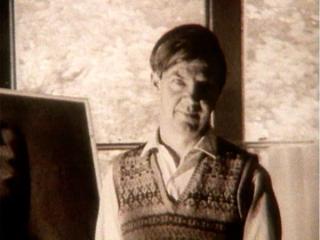
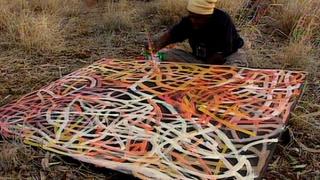
A brush pushes dots against an all black canvas. Trevor Nickolls tells us about the influences that shape his work. Nickolls refers to the Western machinery and Indigenous cosmology known as the Dreaming. Summary by Romaine Moreton.
- WARNING: Aboriginal and Torres Strait Islander viewers are advised that the following program may contain images and/or audio of deceased persons
A brush pushes dots against an all black canvas. Trevor Nickolls tells us about the influences that shape his work. Nickolls refers to the Western machinery and Indigenous cosmology known as the Dreaming. Summary by Romaine Moreton.
- NFSA IDGD3SJEXN
- TypeFilm
- MediumMoving Image
- FormDocumentary
- GenresIndigenous themes or stories, Indigenous as subject
- Year1987
- Production companyFeatherstone ProductionsProducerDon FeatherstoneDirectorDon FeatherstoneWriterDon FeatherstoneComposerPeter Crosbie
Nickolls’ artwork speaks predominantly about the juxtaposition of Indigenous cosmology (Dreaming) and Western machinery and technology, and the coexistence of both in the land now known as Australia.
Dreamtime, Machinetime synopsis
An episodic documentary featuring distinguished Indigenous artists specialising in literary and visual art forms.
Dreamtime, Machinetime curator's notes
Dreamtime, Machinetime is a title borrowed from Trevor Nickolls’ artwork of the same name, and visits locations such as Yirrikala, Warndoolier (Perth), Minjerriba (Stradbroke Island), Narr’n (Melbourne), Balingup and Warrane (Sydney). A nicely paced documentary that showcases the work of writers Archie Welter and Oodgeroo Noonuccal and artists Banduk Marika and Trevor Nickolls. The documentary highlights the artists’ social conscience that gives substance and form to their work. The rhythm of this documentary allows the audience to participate in the work presented; entering the poetry of Kath Walker, or the prose of Archie Weller, their literature is given a visual component by the filmmakers.
In the culture of Banduk Marika, stories are inherited generation through generation, and are restricted. The word restricted means that each person can only re-tell a story that they have permission to. This inherited right to stories exists in all Indigenous cultures in Australia, and Banduk Marika tells us that she as an individual can only tell certain stories and paint certain symbols, like the barramundi for example. What this means is that not every artist is permitted to use the barramundi to tell their stories.
Nickolls’ visual art speaks about the marriage between Western culture and Indigenous culture, and how they represent two different ways of seeing the world. All of the artists in Dreamtime, Machinetime comment on the changes that are occurring for Indigenous peoples and Indigenous culture as a result of coming into contact with Western society, and it is this commentary that informs their artwork.
Notes by Romaine Moreton
Education notes
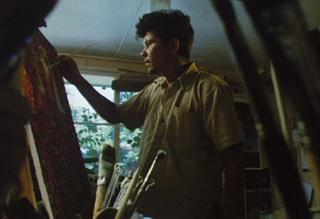
This clip shows Aboriginal artist Trevor Nickolls at work painting a canvas and talking about his art practice and philosophy. The clip opens with Nickolls applying dots to a canvas while describing the meaning of the dots in his work. ‘Self portrait’ (1973) is shown as Nickolls explains its significance. Nickolls speaks directly to camera about the inspiration for ‘Melbourne Dreaming’ (1981) followed by a long shot as the camera pans down the painting and the traffic noise on the soundtrack becomes increasingly louder.
Educational value points
- The clip illustrates how Trevor Nickolls’s art is distinguished by his incorporation of Aboriginal and Western cultural traditions. The painting ‘Melbourne Dreaming’ (1981) has symbols that for Nickolls reveal a dichotomy between Western and Indigenous cultures, including symbolic representations of what he perceives as threats to Indigenous cultures from urban values. Nickolls explains his ironic use of the Dreamtime serpent to create the dollar sign, and the tree of life becoming a dollar sign to illustrate the damage to the Earth caused by new technologies and money.
- Nickolls’s painting ‘Self portrait’ (1973) and his discussion of it in the clip indicate his exploration of personal and wider racial identity. The painting depicts the narrative of Nickolls’s marriage, fatherhood and ‘real life’ in suburbia, and includes associated images. For Nickolls ‘Self portrait’ also reflects what he sees as a difference between African Americans and Aboriginal people. He expresses his view that African Americans have been assimilated into US society after being cut off from their origins, while Aboriginal people are still ‘connected with the land’.
- In the clip Nickolls says that the traditional dot motif is flexible and he uses it to depict various ideas. He says that in his work, the dots may represent the ‘skin of the Earth’, ‘molecules exploding’ or a computer print-out. The documentary was made in 1987 and so he is probably referring to dot-matrix printing, which was common at the time.
- Dreamtime, Machinetime, the title of the documentary from which this clip has been taken, encapsulates the central theme of Nickolls’s work: Indigenous experiences of combining traditional ways of living with the technological demands and values of the Western world. The title borrows from the title of Nicholls’s solo exhibition ‘From Dreamtime to machinetime’ (1978) and his 1981 painting ‘Machinetime Dreamtime’.
- Nickolls’s work has been exhibited nationally and internationally. Born in Adelaide in 1949, he studied art there and in Melbourne. His first solo exhibition, ‘From Dreamtime to machinetime’, was held in 1978 and, with Rover Thomas, he represented Australia at the Venice Biennale in 1990.
Education notes provided by The Learning Federation and Education Services Australia
Need to license this item? A/V professionals and researchers can shortlist licensing enquiries via our NFSA Pro catalogue search and membership.
Collections to explore
Painting
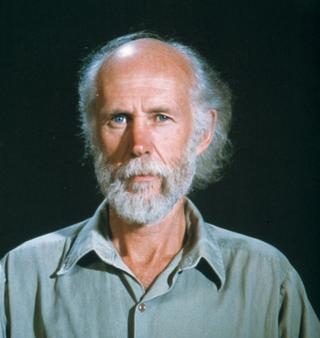

First Nations
Art deco
Start your own collection
A free Your Stuff account allows you to save, organise and share your favourite videos, audio and stories.


