The Dirtwater Dynasty: 'Let's try to put it all behind us'
1988
The Dirtwater Dynasty: 'Let's try to put it all behind us'
1988
- NFSA ID28JSNGEF
- TypeTelevision
- MediumMoving Image
- FormMini series
- Duration7 hrs, 50 mins
- GenresIndigenous themes or stories, Drama
- Year1988
Richard Eastwick (Hugo Weaving) has a second son, Richie (Robert Menzies), who has returned from the Second World War a broken man. He was a prisoner of war of the Japanese and seems unable to settle to life back in Australia. He feels guilt that he survived when so many others didn’t and can’t seem to shake off the terrible nightmares that keep bringing back to him what happened in those terrible jungle camps. Summary by Janet Bell.
Richard Eastwick (Hugo Weaving) has a second son, Richie (Robert Menzies), who has returned from the Second World War a broken man. He was a prisoner of war of the Japanese and seems unable to settle to life back in Australia. He feels guilt that he survived when so many others didn’t and can’t seem to shake off the terrible nightmares that keep bringing back to him what happened in those terrible jungle camps. Summary by Janet Bell.
- NFSA ID28JSNGEF
- TypeTelevision
- MediumMoving Image
- FormMini series
- Duration7 hrs, 50 mins
- GenresIndigenous themes or stories, Drama
- Year1988
- Production companyKennedy MillerProducersTerry Hayes, Doug Mitchell, George MillerDirectorMichael JenkinsOriginal musicBrian Beamish, Garry Hardman
The production captures the problems that beset many a returning POW after the Second World War. The whole nation felt that what happened should be put behind them so they were forced to bottle up their years of horror. When they found that impossible, their families were ill equipped to deal with the consequences, such as alcoholism and suicide.
The Dirtwater Dynasty synopsis
Richard Eastwick (Hugo Weaving) was born in a London slum and through his vision of a future on the land and with sheer hard work and courage, he rose to become one of the wealthiest landowners in his adopted country of Australia. He encounters enormous setbacks along the way as droughts, depression and two world wars leave their mark, but what keeps him going is his dream to pass on what he has built to future generations of Eastwicks, to establish a family dynasty.
The Dirtwater Dynasty curator's notes
This is another of the great epic productions from the Kennedy Miller stable during their remarkable decade of television drama, the 1980s. Their output included the virtually unknown but true story of The Cowra Breakout, the larger than life political drama, The Dismissal and the great empire cricketing story of Bodyline.
Dirtwater Dynasty echoes the rags to riches Kidman and Durack pastoralist family sagas of a young man who begins life with nothing but a burning ambition to conquer the land, falls in love with the majesty of the outback and spends his life building a pastoral empire.
This family saga tells the story of Richard Eastwick (Hugo Weaving) whose shattered dreams are largely the result of his stubborn and deeply unforgiving nature. The melodrama develops as one after the other of his descendants dies or is unable to produce the family line he craves.
Notes by Janet Bell
Education notes
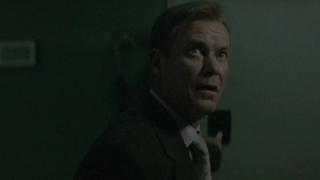
This clip shows a scene in a large house at night as Christine Eastwick (Leverne McDonnell) and her father-in-law, Richard Eastwick (Hugo Weaving), are woken by screams from a bedroom and go to investigate. Christine goes in to find her husband Richie (Robert Menzies), recently returned from the Second World War, having a nightmare. He wakes, turns and reveals his back, covered with scars. The next scene, in a billiard room, shows Richie refusing his father’s suggestion that they tour some of the family properties. His father urges him to 'put it [the War] behind us’. That provokes an outburst from the son, who shouts and rants as he recalls some of the mates, including his brother, who would not be coming back. The film is in colour and accompanied by a music soundtrack.
Educational value points
- The dramatic sequence seen in the clip graphically reveals a family in turmoil; one family member has been broken by the experience of war and the other members are unable to give him the assistance that he needs. In the sequence Richie’s distress is compounded by his belief that his father wishes Richie’s elder brother, killed in the First World War, had returned home instead. The difficulty of resuming civilian and family life after the experience of war trauma is dramatically illustrated.
- The psychological distress of the former prisoner of war (POW) is graphically depicted in the clip. Psychological trauma experienced in battle was recognised in the First World War, and the range of symptoms were called 'shell shock’. In the Second World War the name 'battle fatigue’ was applied to the psychological casualties among the wounded. In the First World War numbers of POWs suffered psychological problems on their return to civilian life; however, doctors and military authorities were slow to recognise that the suffering endured by POWs of the Japanese may have produced lasting psychological damage.
- The clip shows an Australian who has recently returned to his family, having been a POW of the Japanese. More than 22,000 Australians were captured by the Japanese after their victories in South-East Asia during the Second World War in 1942. Most Australian POWs were captured in Singapore. At the end of the War, Australian prisoners were scattered widely throughout South-East Asia and 8,031 had died in captivity. The privations and cruelty experienced by the survivors affected their physical and mental health during their repatriation and later.
- Richard’s outburst and his family’s response, including his father’s admonition that they 'put it all behind us’, illustrate how difficult it was for POWs, who were instructed by military authorities not to upset their families by talking to them about their experiences. Family members were also advised not to ask about the experiences. The prisoners had to endure years of starvation, enforced labour and severe mistreatment. They watched their 'mates’ die and then were expected to resume normal lives on their return.
- The Dirtwater Dynasty (1988) was one of 65 miniseries made for Australian television in the 1980s. A so-called renaissance of the Australian film industry had begun in the 1970s in response to tax incentives and a points system that required 50 per cent of evening television to be Australian content. Despite doubts expressed by commercial stations, Australian content, which typically drew on themes associated with Australian nation-building, proved to be very popular with Australian audiences.
- The Kennedy Miller Entertainment production company has been enormously successful; their first feature film was the international hit Mad Max (1979) and a more recent success was the Academy Award winning Happy Feet (2006). The company was founded in 1975 by George Miller (1945–) and Byron Kennedy (1949–83), who met at a summer film school workshop in 1971. In 1983 Kennedy was killed in a helicopter crash, but Miller, who started out as a doctor, has maintained the early success of Kennedy Miller with a large number of Australian and international successes.
- Hugo Weaving (1960–), who plays the father, Richard Eastwick, is shown in one of his earliest roles. He graduated from the National Institute of Dramatic Art in Sydney in 1981 and achieved his first success in a major role in Bodyline (1984). He has pursued an acting career in film, television and theatre, both in Australia and overseas. He has won two Australian Film Institute Awards and his international profile was established through roles in The Matrix (1999), The Matrix Reloaded (2003) and the Lord of the Rings trilogy (2001, 2002, 2003).
Education notes provided by The Learning Federation and Education Services Australia
Need to license this item? A/V professionals and researchers can shortlist licensing enquiries via our NFSA Pro catalogue search and membership.
Collections to explore
Family tradition

Parenting


Domestic life
Start your own collection
A free Your Stuff account allows you to save, organise and share your favourite videos, audio and stories.


