Crocodile Dundee: A room with two dunnies
1985
Crocodile Dundee: A room with two dunnies
1985
- NFSA IDEHDB4502
- TypeFilm
- MediumMoving Image
- FormFeature Film
- Duration1 hr, 40 mins, 19 secs
- GenresIndigenous themes or stories, Indigenous as subject, Comedy
- Year1985
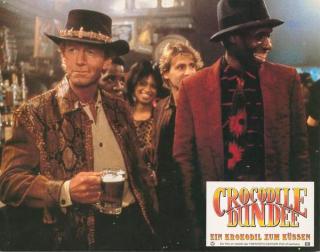
At the Plaza Hotel in New York, Mick (Paul Hogan) is amused and confused by the luxuries of a modern hotel room. Nor does he understand tipping – but he soon works it out. Summary by Paul Byrnes
At the Plaza Hotel in New York, Mick (Paul Hogan) is amused and confused by the luxuries of a modern hotel room. Nor does he understand tipping – but he soon works it out. Summary by Paul Byrnes
- NFSA IDEHDB4502
- TypeFilm
- MediumMoving Image
- FormFeature Film
- Duration1 hr, 40 mins, 19 secs
- GenresIndigenous themes or stories, Indigenous as subject, Comedy
- Year1985
- Production companyRimfire FilmsProducerJohn CornellAssociate producerWayne YoungDirectorPeter FaimanScreenplayPaul Hogan, Ken Shadie, John CornellComposerPeter Best
Crocodile Dundee synopsis
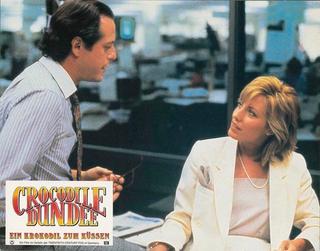
A glamorous American reporter, Sue Charlton (Linda Kozlowski), goes to the Northern Territory to interview a man who survived a crocodile attack. Michael J 'Crocodile’ Dundee (Paul Hogan) charms her with his bushman’s humour and toughness. He is both more complex and more mysterious than she expects. She invites him to New York, a city that expands his horizons and tests his survival skills.
Crocodile Dundee Curator's notes
Crocodile Dundee is not just the most commercially successful Australian film ever made, it is one of the most successful non-Hollywood films of all time. The reasons for its success are complex. Paul Hogan was already a well-established star of television comedy in Australia, but he was also becoming well-known in the US, because of an extraordinarily successful tourism campaign in 1984.
For most Americans, before the movie came out, Hogan was that funny Aussie bloke who told them he’d 'put another shrimp on the barbie’ if they visited Australia. In a sense the movie is a continuation of the campaign. The first half of the movie showcases both the beauty of the Northern Territory and the cultural quaintness of the Territorians. John Meillon’s character, Wally, acts as Sue Charlton’s guide to this odd, but friendly, masculine world. Wally knows about the rest of the world and tries to spin her the kind of yarn he thinks she wants, for her news magazine. Mick Dundee, though less worldly, is also more truthful, capable of telling tall stories himself, which often turn out to be true.
The film both constructs and deconstructs an idea of Australian masculinity. That is one of the main preoccupations of Australian cinema, going back to the silent era – but few films have done it so cleverly, or with so many layers. Mick Dundee is all things to all people – self-made man, tough guy, bush philosopher, romantic lead, old-fashioned knight, defender of women, tamer of wild animals, and wandering free spirit. As a pioneer frontiersman, he appeals specifically to the foundation mythologies of both Americans and Australians – but he goes further, as a fully initiated member of an Aboriginal clan. Indeed, he’s 'blacker’ than some other members of his clan, notably his mate Neville (David Gulpilil), who’s described as a real city boy who finds his cultural obligations 'a drag’.
The film’s attitudes to colour and Aboriginality are central to its meaning and preoccupations. Far from being 'unpolitical’, Mick has firm views about the question of land rights, as 'two fleas fighting over the same dog’. In New York, his reactions to and interactions with people of colour are a clue to the film’s awareness of American unease with issues of race. The film’s most famous joke – 'That’s not a knife’ – is a gesture to mainstream anxiety about both New York and young black men. The fact that Mick is saved from a beating by Gus the chauffeur, another black male, is no accident. The film is constantly creating 'solidarities’ across cultural, or colour, lines.
The cementing of a sense of community between Australians and Americans is what Hogan’s tourism advertisements also set out to do. Crocodile Dundee continued that process, in spectacularly successful and non-threatening fashion. The debate about whether that was an act of cultural assertion, as many Australians believed, or the ultimate demonstration of Australian subservience, is still going on.
Notes by Paul Byrnes
Need to license this item? A/V professionals and researchers can shortlist licensing enquiries via our NFSA Pro catalogue search and membership.
Collections to explore

Crocodile Dundee
Feature film

Academy Awards
Start your own collection
A free Your Stuff account allows you to save, organise and share your favourite videos, audio and stories.


