Breaker Morant: 'The gentleman's war is over'
1979
Breaker Morant: 'The gentleman's war is over'
1979
- NFSA IDZH2GAXJW
- TypeFilm
- MediumMoving Image
- FormFeature Film
- GenresDrama
- Year1979
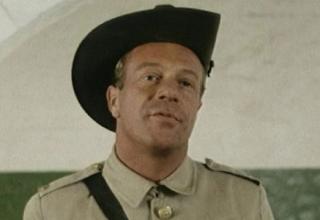
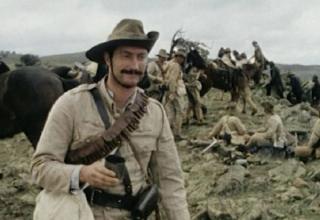
In a lonely, windswept hill camp, far out in the veldt, Captain Hunt (Terence Donovan) instructs Captain Taylor (John Waters) to execute Boer prisoners brought in by Morant (Edward Woodward). When Morant queries the order to shoot prisoners, Hunt tells Morant that these are Lord Kitchener’s new orders, confirmed to him personally by Colonel Hamilton. Morant looks uneasy at the fate of his prisoners.
Summary by Paul Byrnes
In a lonely, windswept hill camp, far out in the veldt, Captain Hunt (Terence Donovan) instructs Captain Taylor (John Waters) to execute Boer prisoners brought in by Morant (Edward Woodward). When Morant queries the order to shoot prisoners, Hunt tells Morant that these are Lord Kitchener’s new orders, confirmed to him personally by Colonel Hamilton. Morant looks uneasy at the fate of his prisoners.
Summary by Paul Byrnes
- NFSA IDZH2GAXJW
- TypeFilm
- MediumMoving Image
- FormFeature Film
- GenresDrama
- Year1979
- DirectorBruce BeresfordProducerMatt CarrollProduction CompanySouth Australian Film Corporation
A very atmospheric and harsh introduction to the real politik of war. Morant is jubilant when he arrives back from a night’s raid, having lost only one of his own, and killed 13 of theirs, but his sense of fair play is offended by the new orders to shoot prisoners. Beresford is careful to maintain a sense of discipline about this scene, because that underlines what the movie is about – following orders. John Waters gives only the slightest hint of hesitation when told to shoot the prisoners; Morant is careful in the way he questions the order. The scene is meant to establish a precedent for the later killings, to suggest that Morant and his two co-defendants thought they were following orders. The Colonel Hamilton mentioned here is Sir Ian Hamilton, who would later command the allied forces at the start of the Gallipoli campaign – his last command. He was relieved after an Australian journalist, Keith Murdoch, delivered a scathing secret attack to the British cabinet about the Gallipoli campaign.
Breaker Morant Synopsis
In the Boer War in South Africa in 1901, three Australian 'irregular’ soldiers are tried by a British military court for the murder of 12 prisoners and a German missionary. The accused are Lieutenants Harry Morant (Edward Woodward), Peter Handcock (Bryan Brown) and George Witton (Lewis Fitz-Gerald). Morant, an English-born adventurer who has spent years in Australia, maintains he was following unwritten orders. Their inexperienced Australian lawyer (Jack Thompson) struggles to have his case heard.
Curator's Notes
The trial of Morant, Handcock, and Witton was enormously controversial at the time and remains so, more than 100 years later. The film rekindled the debate in 1980, but was itself attacked over accuracy. The script, based on a play by Kenneth Ross, argues that their trial was fixed from the outset. Lord Kitchener, head of the British forces, is shown agreeing that the soldiers must be sacrificed, in order to keep Germany from joining the war on the Boer side. At the same time, the film shows that the soldiers did kill the prisoners and the missionary. The question is whether these constituted war crimes and whether they got a fair trial.
With the recent war in Vietnam fresh in the public mind, these questions still had strong resonance in 1980. Debate still rages about whether Kitchener ever issued verbal orders to kill prisoners. The film represented Australia in the competitive section of the Cannes Film Festival in 1980. Jack Thompson won the festival’s best supporting actor award.
Notes by Paul Byrnes
Need to license this item? A/V professionals and researchers can shortlist licensing enquiries via our NFSA Pro catalogue search and membership.
Collections to explore
Boer War


Feature film

1970s
Start your own collection
A free Your Stuff account allows you to save, organise and share your favourite videos, audio and stories.


