Australasian Gazette: Maoris Give Their War Cry
1922
Australasian Gazette: Maoris Give Their War Cry
1922
- NFSA IDTSNMQAMG
- TypeFilm
- MediumMoving Image
- FormNewsreel, Series
- Year1922
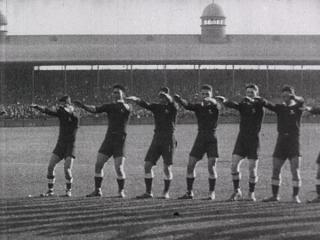
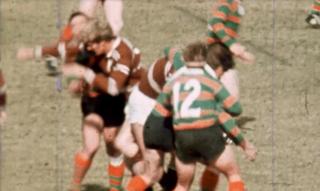
This Australasian Gazette newsreel from approximately 1922 shows the New Zealand Maori rugby league team on the field of a stadium performing the haka ceremonial war dance before a match. The clip then ends with a shot of the New South Wales team and the game in progress. Summary by Elizabeth Taggart-Speers.
This Australasian Gazette newsreel from approximately 1922 shows the New Zealand Maori rugby league team on the field of a stadium performing the haka ceremonial war dance before a match. The clip then ends with a shot of the New South Wales team and the game in progress. Summary by Elizabeth Taggart-Speers.
- NFSA IDTSNMQAMG
- TypeFilm
- MediumMoving Image
- FormNewsreel, Series
- Year1922
The haka has often been used by New Zealand football teams to intimidate their opponents before a game. Here we see the New Zealand Maori rugby league team perform it before competing against New South Wales.
Notes by Elizabeth Taggart-Speers
Education Notes
This silent black-and-white clip shows newsreel footage of a rugby league match played between the New Zealand Maori team and the New South Wales side the Waratahs, possibly at the Sydney Cricket Ground (SCG) in the early 1920s. The New Zealand Maori players perform a haka (chant and dance) prior to the match, watched by a huge crowd of spectators. The clip then pans across the line-up of the NSW team before cutting to footage of the game in progress.
Educational value points
- The clip shows a match involving the New Zealand Maori, a team originally formed in 1910 to promote the involvement of Maori players in rugby league. The team toured NSW in 1922 or 1923 in an effort to popularise the game. In the 1922 tour, the New Zealand Maori played three matches against NSW, defeating the home side in every one. To qualify for the New Zealand Maoris, players must be of Maori descent, although this rule has been relaxed to include Pacific Islanders.
- The haka (‘ha’ meaning breath and ‘ka’ meaning fire) is a traditional Maori dance accompanied by a chant and in rugby league games, as seen here, it is used by NZ teams to motivate both players and supporters and to intimidate the opposition. The haka is a complex dance that uses the hands, feet, legs, body, voice, tongue and eyes, with each action conveying a meaning. There are different types of hakas, ranging from a welcome to a war dance.
- New Zealand rugby league teams performed prematch hakas as early as 1884 when a team visiting NSW gave what a Sydney newspaper described as a ‘Maori war cry’. According to the paper, ‘The NSW men declared it was hardly fair of the visitors to frighten them out of their wits before the game began’. By the 1922 and 1923 tours, however, the haka was an expected part of the proceedings.
- Rugby originated in Britain and was played in the NZ and Australian colonies from about the mid-19th century. Maoris have had a long involvement in rugby and NZ was unusual among the colonies at the time in giving Indigenous players such a prominent role in the game. A team of mainly Maori players, the New Zealand Natives, first toured Britain and its colonies in 1888.
- The New Zealand Maori team members shown in the clip wear black shorts and black jerseys with a crest in the form of a silver fern, a uniform that NZ’s national team, the All Blacks, later adopted. The mismatched shorts worn by the NSW Waratahs, which they may have provided themselves, probably reflects the amateur status of the game, but also suggests that rugby in NSW in the 1920s did not yet attract much sponsorship or generate much revenue.
- The huge number of spectators watching the game is indicative of the interest generated by the trans-Tasman rivalry between, in this case, NZ and NSW. Trans-Tasman rugby rivalry dates back to 1903 when 30,000 spectators watched the first international Test match between Australia and NZ at the SCG, which was won by NZ.
Education notes provided by The Learning Federation and Education Services Australia
Need to license this item? A/V professionals and researchers can shortlist licensing enquiries via our NFSA Pro catalogue search and membership.
Collections to explore
1920s
Athletes
Rugby League
Start your own collection
A free Your Stuff account allows you to save, organise and share your favourite videos, audio and stories.


