Across the Trans-continental Railway: From Kalgoorlie to Port Augusta - Laying the Railway Line
1917
Across the Trans-continental Railway: From Kalgoorlie to Port Augusta - Laying the Railway Line
1917
- NFSA IDPX2NDRGS
- TypeFilm
- MediumMoving Image
- FormDocumentary
- Year1917
Railway workers unload materials from a railway truck for the construction of a segment of the trans-continental railway line. Two men in a horsedrawn buggy ride past the camera. Another view shows men laying timber sleepers and metal rails. Men shovel dirt away in another section of railway built over raised concrete platforms. A tracking shot reveals massive piles of wooden rails that will be laid to form the tracks. Summary by Poppy de Souza.
Railway workers unload materials from a railway truck for the construction of a segment of the trans-continental railway line. Two men in a horsedrawn buggy ride past the camera. Another view shows men laying timber sleepers and metal rails. Men shovel dirt away in another section of railway built over raised concrete platforms. A tracking shot reveals massive piles of wooden rails that will be laid to form the tracks. Summary by Poppy de Souza.
- NFSA IDPX2NDRGS
- TypeFilm
- MediumMoving Image
- FormDocumentary
- Year1917
This clip starts approximately 6 minutes into the documentary.
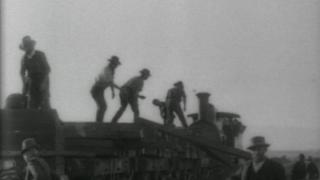
This clip is silent. Men on top of a railway truck unload materials for the construction of a segment of the trans-continental railway line. There are teams of men working on various sections of the line. Two men in a horse-drawn buggy ride past the camera and into the worksite. A steam engine is stationary at the site, blowing plumes of smoke. Five men lift heavy timber sleepers together and lay them on the metal rails. The camera pans across the construction as men shovel dirt away in another section of railway built over raised concrete platforms. A tracking shot reveals massive piles of wooden rails that will be laid to form the tracks.
The two men in the horsedrawn buggy may be the Honourable WA Watt, the Federal Minister for Works and Railways at the time, and the Engineer-in-Chief for the Commonwealth Railways, NG Bell.
Across the Trans-Continental Railway synopsis
This documentary details part of the building of the trans-continental railway from Port Augusta to Kalgoorlie.
Across the Trans-Continental Railway curator's notes
Across the Trans-continental Railway is held in an incomplete form at the National Film and Sound Archive. The first half of the film print comprises titles and intertitles only, and the visual footage that follows refers to some, but not all, of these intertitles. It is therefore difficult to identify segments of this documentary and where they were filmed. With much early Australian cinema, only fragments or incomplete versions have survived. What survives, however, remains valuable and the seventeen minutes of surviving footage in this documentary provides a visual record of one of the country’s largest infrastructure projects.
The trans-continental railway (which began construction in 1912) linked the eastern and western parts of the country with the cost of construction at around ₤6.5 million. Intertitles explain that the project employed 3,000 men in the construction; that it connected 1,600 miles (over 2,500 kilometres) of eastern States with 3,400 miles (over 5,400 kilometres) of western States; and that it carried out construction from both ends simultaneously.
The 35mm nitrate negative held at the NFSA is one of many found during the 'Last Film Search’, which became operational in 1982.
Notes by Poppy de Souza
Education notes
This silent black-and-white clip shows scenes from the construction of the Trans-Australian Railway between Port Augusta in South Australia and Kalgoorlie in Western Australia. The opening scene of men unloading timber sleepers is followed by scenes of two men in a buggy driving alongside the railway track, of a steam engine and of teams of men carrying heavy rails into position. A slow pan shows work on an elevated section of line and the clip concludes with a tracking shot of stockpiled sleepers.
Educational value points
- The Trans-Australian Railway was the most important national infrastructure project completed in Australia in the first half of the 20th century. In December 1911 the Australian Government voted to undertake the project at an estimated cost of £4.05 million (equivalent to $200 million in 2007). Work began at Port Augusta in September 1912 and at Kalgoorlie five months later. The 1,692-km line was completed on schedule on 17 October 1917.
- Unlike other major infrastructure projects, such as the WA gold fields water pipeline (1898–1903) or the Snowy Mountains Hydro-electric Scheme (1949–74), both of which relied on materials or expertise from overseas, the railway was largely Australian-made. Commonwealth Railways handled engineering, logistics and carriage construction; the locomotives and most of the steel rails came from New South Wales; and the sleepers were logged in south-west WA.
- The railway-building project was funded through loans provided by overseas investors with the legacy of interest on the loans being carried by succeeding generations. The money was invested on the basis that the governments of the colonies built and guaranteed the railway.
- The clip reveals that the railway was built mostly by the heavy physical labour of hundreds of workers. Large numbers of draught horses, 250 camels and a small number of machines, including steam shovels and the first track-laying machine to be used in Australia, were also utilised in the building of the railway. An average of 1.6 km of line was laid every working day.
- The transcontinental line was the result of a promise made at the time of the federation of Australian states in 1901. Physically isolated from the eastern states, WA was reluctant to agree to such a federation. However, Premier Forrest rightly believed that the promise of the transcontinental railway would help to convince the WA electorate. WA agreed to join the federation, although it took nearly 17 years to see the promise of a transcontinental railway come to fruition.
- The large number of wooden sleepers seen in the clip gives some indication of the deforestation brought about by the railway project, particularly in the karri forests of south-west WA. The Pemberton sawmill alone supplied 500,000 sleepers. Ironically, karri timber is not suitable for use on or in the ground and it had to be boiled in a mixture of sodium fluoride and either arsenic trioxide or sodium dinitrophenate to extend the life of the sleepers.
- The steel rails shown being hauled into position were probably Australian-made, the nation’s first iron ore blast furnace and open hearth having come into production at Newcastle in April 1915. The demands of the railway and of the First World War (1914–18) led to the Australian Government booking the first year’s production – all 150,000 tonnes of steel rails. The rails seen here weighed 40 kg to the metre and varied in length from 10.05 m to 13.70 m.
- This clip comes from an 18-minute documentary produced by Australasian Films, a company established in 1913 to produce Australian-made films. In the documentary as a whole, the cinematographer used a variety of techniques including point-of-view and tracking shots to give the audience the sense of being in the midst of the railway’s construction. The scenes in the clip were probably shot somewhere between mid-1914 and mid-1917.
Education notes provided by The Learning Federation and Education Services Australia
Need to license this item? A/V professionals and researchers can shortlist licensing enquiries via our NFSA Pro catalogue search and membership.
Collections to explore

Regional

Building and construction
Trains
Start your own collection
A free Your Stuff account allows you to save, organise and share your favourite videos, audio and stories.


